Mortefontaine Castle: A French Country Residence and Diplomatic Venue
Site at a Glance
- Popularity
- High
- Country
- France
- Primary era
- Early Modern
- Eras represented
- Early Modern
- Civilizations
- French
- Site type
- Domestic
- Remains
- Castle
On this page15 sections
History
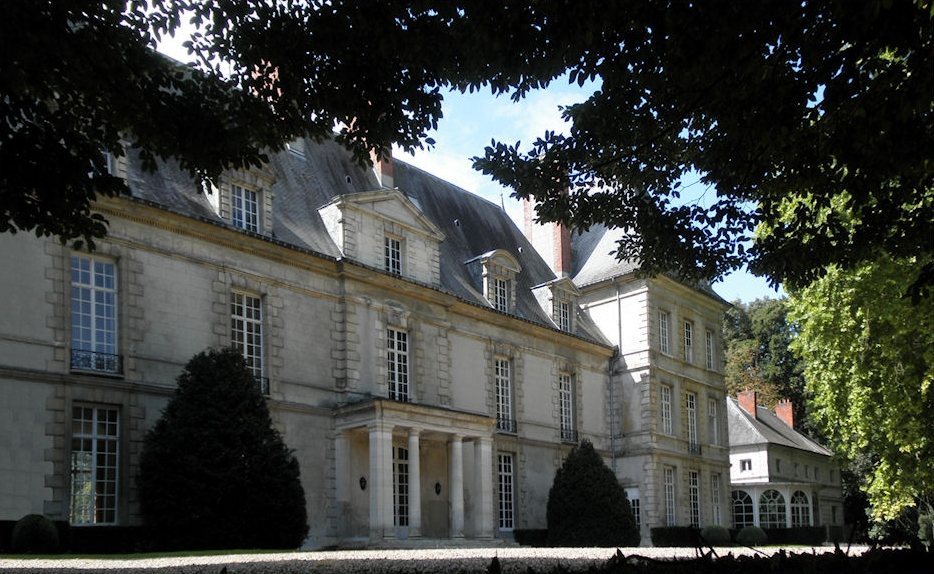
Mortefontaine Castle is a country residence in France, built between 1600 and 1630, probably on Philippe Hotman’s initiative. Under Joseph Bonaparte it became a prominent setting for social gatherings and diplomatic events, including the signing of the Franco-American Treaty of Mortefontaine in 1800.
The medieval lordship and its owners
Mortefontaine belonged to the lordship of Montmélian. The French crown held that territory until Philip Augustus, also known as Philip II, king from 1180 to 1223, exchanged it for the lordship of Vernon and granted it to Richard de Vernon and his son Richard. Much of the land was held by the Bouteiller family of Senlis.
When Richard II de Vernon died without a son, his daughter Marie inherited his interests. Her husband, Guillaume Calletot, transferred his possessions in the Pays de France, a historic region north of Paris, to the Benedictine Abbey of Saint-Denis in 1283. Mortefontaine then had two lords: the abbey, represented by a provost who managed its interests and acted as castle keeper, and Jean le Bouteiller, lord of Chantilly.
In 1345, Guillaume IV le Bouteiller, burdened by debt, ceded the Montmélian domain to his brother-in-law Robert de Clermont, keeping a square tower for his own residence. The lordship comprised numerous fiefs, or landholdings subject to obligations. The Laillier family, allied with the Plailly family, accumulated several of them. Jean de Lallier, also known as Christophe de Plailly, was styled lord of Mortefontaine in 1500. After his death in 1518, his property passed to another Jean de Lallier, who named four squires as heirs. They soon sold their holdings to Germain II Le Rebours, a magistrate and councillor of the Parlement of Paris, the monarchy’s high court.
Construction and the marquisate
Before 1547, Germain II’s sons divided the lordship between Bertrandfosse and Mortefontaine. Germain III received Mortefontaine. After his early death, his widow and cousin Madeleine Brachet passed it to her relative Jérôme Brachet. The estate was sold to François Hotman in 1570. In 1599, the Abbey of Saint-Denis also sold him its lordship of Montmélian-Plailly, bringing most of Mortefontaine’s lands under one lord. The fief of Vallière and other holdings remained separate, while the abbey retained superior lordship. Administration and local justice continued at the Hôtel du Four in Plailly.
François Hotman, an ambassador in Switzerland, died in 1600 and left the lordship to his third son, Philippe. Philippe held no other lordship and had no manor at Mortefontaine, making him the probable initiator of the new residence. The square tower at Montmélian was a separate property belonging to the Duke of Montmorency and was already in ruins by 1621.
Jacques le Coigneux acquired the castle, lordship, and Vallière in 1652. In 1654, the lordship and its jurisdiction were raised to a marquisate, a territory held by a marquis, although its administrative center remained at Plailly. Louis II le Peletier purchased the marquisate in 1680. After his death in 1736, his third son Jacques-Louis inherited it and enlarged the estate by acquiring Bertrandfosse.
The Le Peletier estate
Louis III le Peletier took charge of the estate after his father Jacques-Louis died in 1770. A friend of the landscape designer René-Louis de Girardin, he developed the grounds in an Anglo-Chinese manner, combining English landscape design with Chinese-inspired features. He also arranged for a monumental fountain to improve local residents’ access to drinking water.
At the Revolution, Louis went into exile and sold his property in December 1790 before it could be seized. Joseph Duruey, a councillor of state, and his wife Jeanne Morin acquired the former marquisate. Duruey was condemned and guillotined on 18 March 1794, and the state confiscated the estate as national property, meaning property taken over by the Revolutionary government. Napoleon Bonaparte’s elder brother Joseph bought Mortefontaine by deed dated 20 October 1798.
Joseph Bonaparte’s residence
Joseph made Mortefontaine his country residence from 1798 to 1814. On 30 November 1800, the Franco-American Treaty of Mortefontaine was signed there, ending the Quasi-War, an undeclared conflict between France and the United States in the late 1790s and 1800. A celebration for 1,200 guests followed. Preliminary negotiations for the Peace of Amiens took place at the castle on 25 March 1802; the 1802 agreement temporarily ended hostilities between France and Britain.
Two Bonaparte family marriages were celebrated at Mortefontaine: Joachim Murat and Caroline Bonaparte on 20 January 1800, and Prince Camille Borghèse and Pauline Bonaparte on 5 November 1803. Lucien Bonaparte, owner of nearby Plessis-Chamant Castle, and Napoleon Bonaparte and his wife Joséphine de Beauharnais often visited. Joseph’s wife, Julie Clary, spent most of her time at Mortefontaine because fragile health kept her largely out of public life. Major building works began in 1808 under architect Jacques Cellerier.
Ownership after the Empire
After the fall of the Empire, the estate was placed in the name of Madame de Villeneuve, a relative of Julie Clary, to avert confiscation. The castle was leased to Baron von Schickler, a German keen on hunting, while Joseph eventually decided to sell it from exile. The last Prince of Condé bought Mortefontaine in 1827 but did not live there. After his death in 1830, his mistress, the Baroness de Feuchères, inherited the estate and took possession in 1832. When she died in 1840, she left it to her goddaughter Sophie Thanaron, later Madame Corbin.
In 1894, Sophie Corbin sold the northern Grand Parc to Agénor de Gramont, the 11th Duke of Gramont, and his wife Marguerite de Rothschild. They built Vallière Castle on the land. Sophie’s daughters inherited Mortefontaine after her death in 1901 and divided its use between them. The building was in poor condition, and they arranged its wings to their own preferences while carrying out only urgent repairs. Around 1928, Count Louis-René de Gramont bought the castle and undertook a careful restoration. The castle and parks were brought together within the Gramont family between 1928 and 1949.
Religious use and later ownership
German forces occupied Mortefontaine from June 1940 until the liberation of Paris in August 1944, causing minor damage. In 1949, the count transferred the estate to the Dominican Third Order, a branch of the Catholic religious order. The Dominicans established a novitiate, a community for people preparing to enter religious life, built a priory, and opened a school. In 1958, most of the sisters moved to a new central house in Rome and the novitiate closed. The school continued, with new classroom buildings added, while the castle later stood vacant.
In 1985, plant nursery operator Ponthieu bought the castle and leased it to the Alliance hotel chain. The hotel opened in 1987 and has since closed; the castle is now a private residence. The Dominican order retains the priory and Institut Saint-Dominique, a school serving pupils from primary through secondary level.
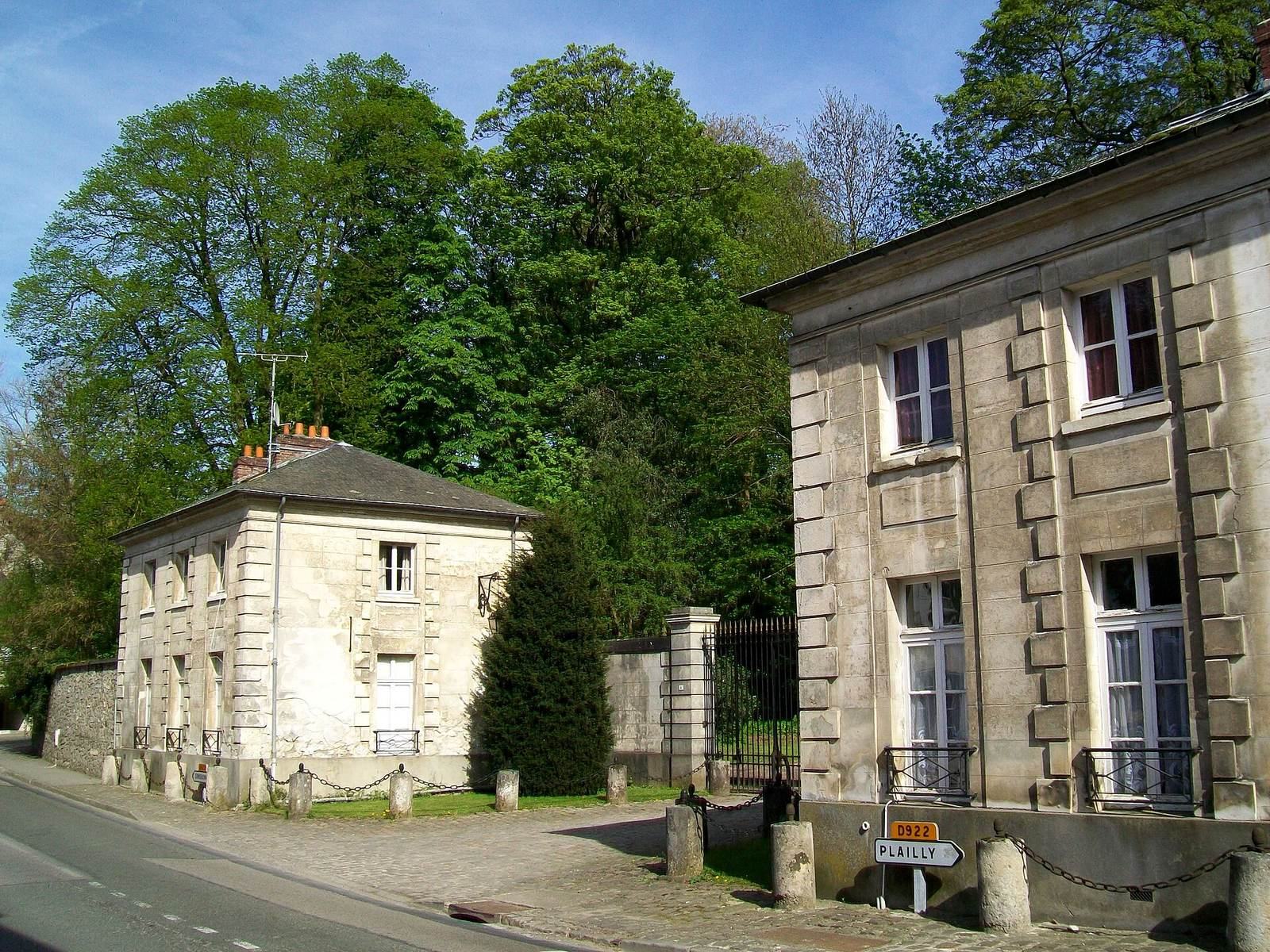
In 1947, the 40-hectare area of the former Petit Parc was registered under France’s 1930 law protecting sites of natural, artistic, historic, scientific, legendary, or picturesque character. In 2004, Mortefontaine Castle, its two entrance pavilions, and the park, including its icehouse, were registered as historic monuments.
Remains
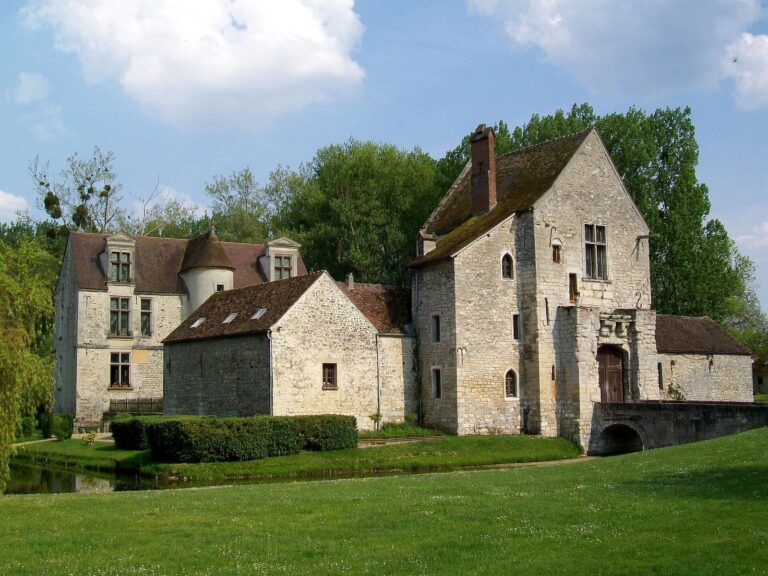
The estate’s late-18th-century arrangement centered on a main residence and its courts, with parks, gardens, and service buildings around them. A description from 1790 records slate roofs on the principal buildings and tiled roofs on many of the associated structures. The surviving grounds also include the two entrance pavilions and the park icehouse.
The residence and courts
Main residence and forecourt
The principal building was flanked by two substantial pavilions, with a large wing on the left when entering. A broad courtyard lay beside the residence, with open ground in front, ditches, and terraces. The two entrance pavilions are part of the castle grounds.
Service court and outbuildings
A lower court contained a separate building with rooms and attics, along with stables, coach houses, barns, a byre, woodshed, pigsties, dairy, orangery, and playhouse. A freestanding pigeon house and other tiled-roof buildings stood nearby, with a green courtyard behind the group.
Parks and garden features
Petit Parc
From 1770, the Petit Parc beside the castle was arranged as an Anglo-Chinese garden. An artificial stream widened into a chain of small ponds, while a Chinese pavilion, obelisk, column, meadow, and feature known as the Valley of Tombs formed parts of the design. The grounds also contained an icehouse topped by a pavilion, animal statues, a theatre, an orangery, and an aviary. The icehouse, used to store ice, remains among the components of the grounds. A gladiator statue stands on the lawn in front of the castle entrance.
Grand Parc and Temple enclosure
The Grand Parc had a simpler design. Joseph Bonaparte added about ten garden structures there, including bridges, towers, ruins, and an underground passage connecting two parts of the domain. The 1790 estate arrangement covered about 52 arpents, a historical unit of land area, including roughly 49 arpents of park and garden. A separate enclosure at a place called the Temple covered about 19.5 arpents. Inside it stood a building resembling a temple portico, an attached tiled-roof house with rooms and attics, a byre, and a stable. Ditches enclosed the area.
Fountain and commemorative features
The estate’s monumental fountain was built to improve residents’ access to drinking water. A rock was engraved in tribute to the poet Delille, whose descriptive poem Les Jardins appeared in 1782.