Château de Méridon: A Neo-Renaissance Country Residence in France


Site at a Glance
- Rating
- 4.5
- Popularity
- Low
- Country
- France
- Primary era
- Modern
- External website
- Open
- Eras represented
- Modern
- Civilizations
- French
- Site type
- Domestic
- Remains
- Castle
On this page9 sections
History
Château de Méridon is a nineteenth-century Neo-Renaissance country residence in Chevreuse, France, completed in 1883 on the site of an earlier noble estate. Located in the Chevreuse Valley near the Yvette River, it formed part of a landscape of valuable estates whose proximity to Paris and Versailles enhanced their importance.
Medieval Estate and Early Rebuilding
Méridon was the center of a large estate from the Early Middle Ages. In the thirteenth century, the knight Archambault, a vassal of Pierre de Chevreuse, was its earliest known owner. At that time, the site consisted of a fortified noble residence. The buildings were later burned or destroyed during the Hundred Years’ War, a prolonged series of conflicts between the English and French crowns from the fourteenth to the fifteenth century. Fields and pastures also reverted to woodland.
Jean Langlois acquired the fief, a landed holding granted within a feudal relationship, in 1464, when the estate was in severe disrepair. Under Jean de Péricard, a first château complex was built on the former feudal castle in 1601, and a park was laid out around it. That same year, the estate’s former manor was first described as a château.
Seventeenth-Century Ownership and Revolutionary Ruin
Guillaume Dugué de Bagnols purchased Méridon in 1650, and his descendants retained the estate until the end of the eighteenth century. Neglect and the lack of repairs caused the complex to deteriorate. The French Revolution then left Méridon almost entirely in ruins.
Nineteenth-Century Reconstruction
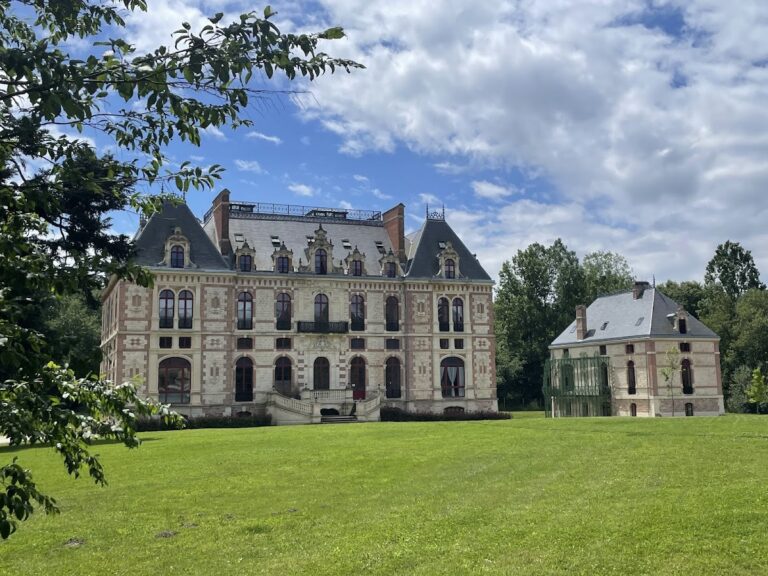
In the 1870s, the Marquis di Braga, director of Crédit Foncier, acquired the estate and its remaining structures. Crédit Foncier was a French financial institution historically associated with property and mortgage lending. He commissioned the architect Eugène Bruneau to build the present château in the Neo-Renaissance style, a nineteenth-century revival of Renaissance architectural forms and decoration. Construction was completed in 1883, and the earlier park was restored.
Twentieth-Century Uses
Marquis de Breteuil acquired the estate in 1908 and converted Méridon into a château for hunting with hounds, a form of mounted hunting in which trained dogs pursue game. The property was subsequently rented mainly to wealthy Americans. One tenant, Madame Sullivan, financed a major reconstruction that made the residence one of the most luxurious in the region.
After the Second World War, from 1946, a Dutch educational association leased the estate and established an educational center there. It initially trained Dutch farmers planning to immigrate to France, including instruction in the French language and customs, and later expanded into broader cultural education.
The Franco-Dutch Cultural Center purchased Méridon in 1958 and organized educational and cultural courses and activities there until 2013. The property was then sold to a Breton family and returned to private ownership. In 2022, it was sold to a Parisian family. The château remains privately owned and is described as restored.
Remains
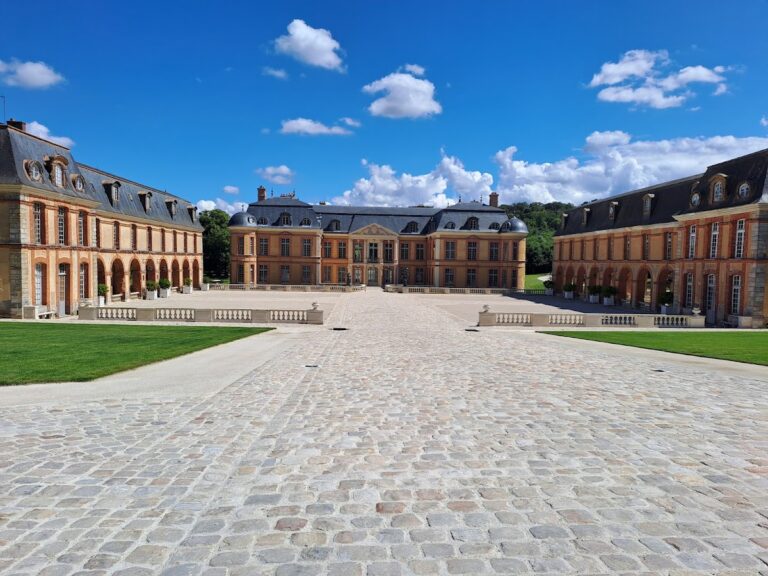
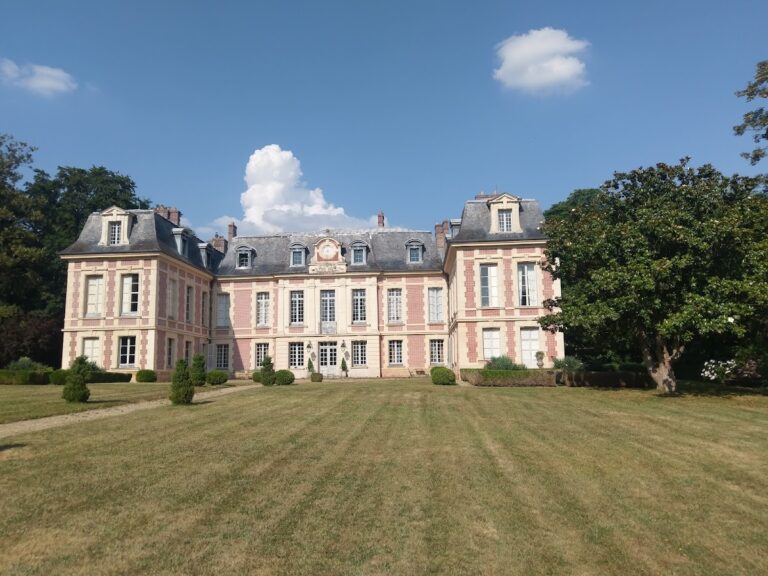
The present complex is arranged around a rectangular, three-storey château built of stone and brick. Its east-facing façade is asymmetrical, while a straight avenue approaches the main entrance. High roofs cover the buildings, and the façades retain elegant nineteenth-century decorative detailing.
Château and Grounds
Main Residence
The main block has two attached towers positioned at opposite ends. One tower is square and the other rectangular, giving the residence an intentionally varied outline within its otherwise regular rectangular plan. The building represents the nineteenth-century rebuilding of Méridon on the site of the earlier residence.
Park and Enclosed Garden
A large park surrounds the château and contains many mature trees. Its layout began around the first château complex in 1601 and was restored during construction of the present residence in the nineteenth century. A small enclosed garden survives on the west side of the residence.
Nearby sites