Château de Breteuil: A Historic Estate and Garden in France


Site at a Glance
- Rating
- 4.6
- Popularity
- Medium
- Country
- France
- Primary era
- Early Modern
- External website
- Open
- Eras represented
- Early Modern, Modern
- Civilizations
- French
- Site type
- Domestic
- Remains
- Castle
On this page17 sections
History
Château de Breteuil is a historic estate in Choisel, France, in the Chevreuse Valley about 35 kilometres south of Paris. Its architecture is organized around a seventeenth-century quadrangular courtyard, while the estate’s recorded history reaches back to a seigneurial domain first mentioned in 1142. The property later became associated with the Breteuil family and with important political, diplomatic, and cultural episodes in French history.
From Bévilliers to a seventeenth-century residence
The site was originally known as Bévilliers or Buvilliers, a name associated with two Gallo-Roman villas. The earliest reference to a manor dates from 1560. During the sixteenth century, the estate belonged to the Le Jay family. Major building works are generally attributed to Nicolas Le Jay, who probably commissioned them in the 1580s, although another interpretation assigns them to Thibault Desportes, who acquired the domain by adjudication in 1596. These works established the residence’s present basic plan. A foundation date of 1610 is also recorded.
During the seventeenth century, ownership passed from uncle to nephew through the Desportes, Chanteclerc, Renouard, and Breteuil families. In 1712, Charles Le Tonnelier de Breteuil inherited the estate from the last member of the Renouard family. It then passed from father to son and remained with the Breteuil family.
Eighteenth-century expansion and the Breteuil family
Claude Stanislas Le Tonnelier de Breteuil, who lived from 1730 to 1784, carried out extensive changes inside and outside the château. His works included the Garenne Grove, the Chimerical Grove, garden rooms, a four-terraced kitchen garden and orchard, a Chinese pavilion, and a ha-ha, a sunken boundary that separates a garden from surrounding land without blocking the view.
The family included several notable figures. Gabrielle-Émilie de Breteuil, later known as Émilie du Châtelet, was an eighteenth-century woman of science. Louis Auguste Le Tonnelier de Breteuil served as an ambassador and later as a minister of Louis XVI. On 15 August 1785, during the Affair of the Diamond Necklace, he was charged with arresting Cardinal de Rohan at Versailles. He was also a prominent supporter of Marie Antoinette and Louis XVI.
Revolutionary change and nineteenth-century rebuilding
During the French Revolution, the domain was placed under sequestration. Charles de Breteuil recovered it in 1802, after which an English-style garden was created on the grounds. Between 1820 and 1830, the courtyard walls were demolished and the moats were drained, changing the relationship between the buildings and their former enclosure.
Late in the nineteenth century, Henry Le Tonnelier de Breteuil, the eighth Marquis de Breteuil, began another major building campaign. Two wings were added behind the surviving rear building, the front pavilions were raised, and the service buildings were reconstructed. The medieval dovecote was preserved from the former service buildings. Henry de Breteuil also hosted Léon Gambetta and the future Edward VII on 12 March 1881. Their meeting contributed to diplomatic efforts that led to the Entente Cordiale of 1904, the agreements that settled several disputes between France and the United Kingdom and brought the two countries into a closer diplomatic relationship.
Royal connections and twentieth-century restoration
In 1912, the young Prince of Wales, the future Edward VIII, stayed at the château for four months to improve his French. During the First World War, in 1917, François de Breteuil introduced him to the Parisian courtesan Marguerite Alibert.
From 1967, Henri-François, Marquis de Breteuil, and his wife, Séverine Decazes de Glücksberg, restored the château and opened it to the public. Historical scenes and scenes inspired by the tales of Charles Perrault were installed using wax figures produced by the Musée Grévin and automata made by Janie and Armand Langlois. The presentation combines the history and domestic life of the château’s occupants with scenes based on Perrault’s tales.
The château interior and park were registered as historic monuments by an order dated 29 October 1961. In France, registration is one level of protection within the monument historique system, whose classification generally provides stronger protection. A large part of the estate, including the château façades and roofs, the park, its statuary, and its architectural features, was classified by an order dated 16 February 2024. The park and its French- and English-style gardens also hold the Remarkable Garden label.
Remains
Château and architectural layout
Quadrangular courtyard
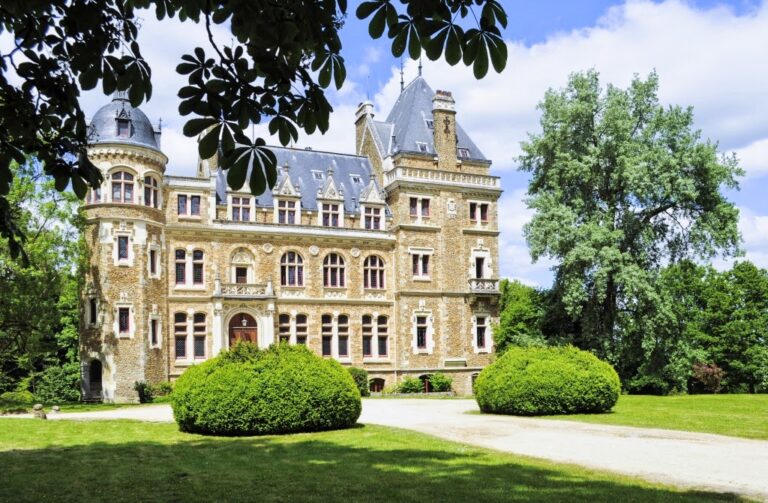
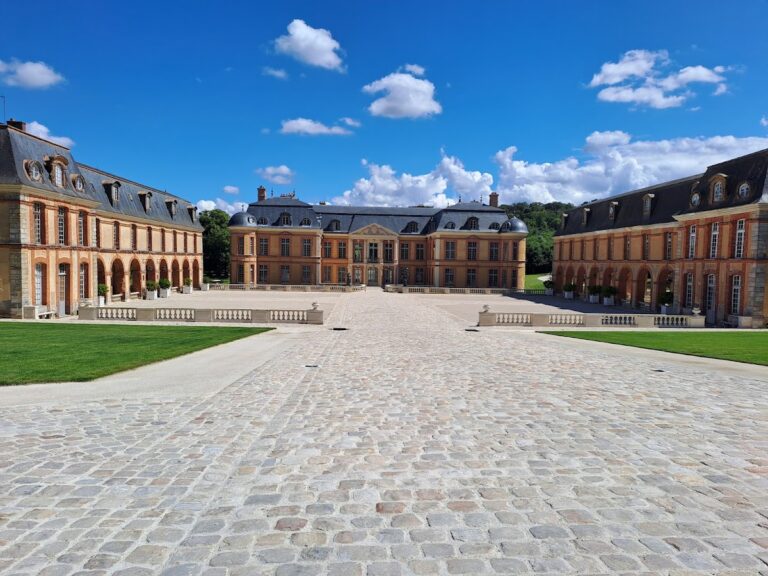
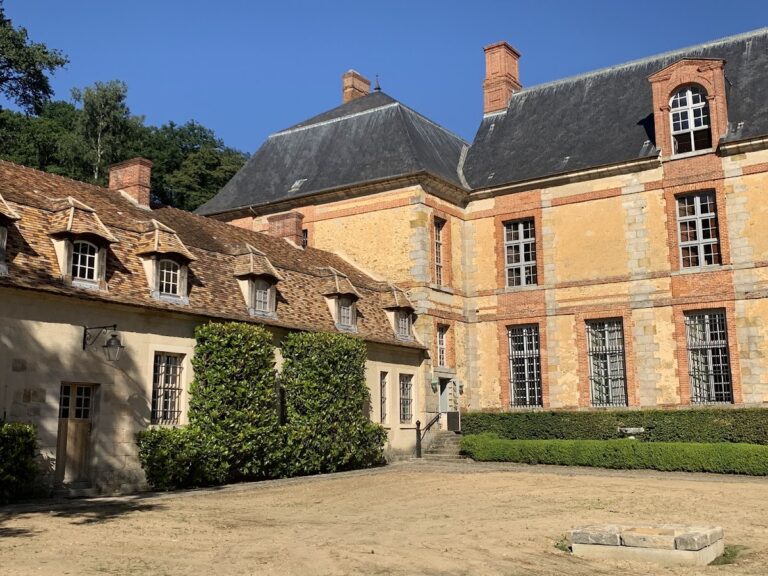
The château’s seventeenth-century buildings are arranged around a quadrangular courtyard. The court was originally enclosed by walls or buildings and bordered by moats. Its front consisted of two corner pavilions and a central passage building. On the rear side stood a large building extending across the width of the court, of which the central section survives. The buildings combine brick structural elements with infill covered by render. Their design has been compared with that of Château de Dampierre-en-Yvelines, associated with the architect Jules Hardouin-Mansart.
Nineteenth-century additions
The late-nineteenth-century form includes two wings returning from the rear building and raised front pavilions. The service buildings were reconstructed during the same period, while the medieval dovecote was retained. These changes form part of the architectural fabric that surrounds the former courtyard.
Formal gardens and terraces
French-style garden
The 75-hectare estate includes French-style gardens on both sides of the château, which stands on a north-south axis. A French-style garden uses symmetry, geometric beds, axial views, clipped shrubs, and controlled water features. The garden assumed its present form during works carried out between 1897 and 1903 under Henry de Breteuil and the landscape gardeners Henri and Achille Duchêne. The campaign created broad perspectives, including a reflecting pool on the northern side overlooking the Chevreuse Valley, improved the lawns and paths, and added boxwood embroidery gardens to the south, a boxwood mosaic, and spherical and truncated-pyramid topiary to the north.
Garden of the Princes
The English-style garden known as the Garden of the Princes occupies the oldest terrace of the former kitchen garden and orchard, which had become overgrown. Its restoration began in 1991 under Séverine de Breteuil, following studies by René Péchère and chief architect Jean-Claude Rochette. Traditional kitchen-garden paths were reinstated and stabilized. Large squares were planted with grass and edged with flower beds, while the central irrigation basin was restored and filled with water. Cordon, palmette, and espalier fruit trees were replanted along the edges, and an avenue of Japanese cherry trees was added. The garden’s name refers to the friendship between the Breteuil family and the English royal family.
Romantic park and labyrinth
The romantic park contains woodland, marked paths, romantic ponds, and a perspective over the Chevreuse Valley. Wild cyclamen flower there from late August to mid-October, and a trail presents notable trees including a cedar of Lebanon said to date from the time of Marie Antoinette, three-hundred-year-old oaks, chestnut trees associated with the time of Henry IV, bald cypresses, tulip trees from Virginia, and Licario pines. The ponds lie below the estate, and their first landscaping dates from the reign of Napoleon III. A marked tree route was established with the association A.R.B.R.E.S. and Professor Georges Feterman.
A labyrinth created in 2000 lies below the orangery terrace. It recalls an earlier labyrinth connected with the Chimerical Grove, created between 1772 and March 1773 on Claude Stanislas de Breteuil’s initiative when he was a field marshal. The earlier grove stood behind the medieval dovecote, and its plan survives in the château archives.
Interiors, collections, and staged scenes
Domestic and ceremonial interiors
The interiors contain royal paintings and eighteenth-century furniture, together with bedrooms, a smoking room, a bathroom, early-twentieth-century kitchens, and stables holding a collection of carriages. These spaces present the material surroundings and household life associated with the château’s occupants.
Perrault scenes and wax figures
Fifty wax figures made by the Musée Grévin are arranged in the salons and service buildings. About twenty illustrate seven tales by Charles Perrault, including Little Red Riding Hood. Other installations include Armand Langlois’s scene of musical Puss in Boots and a wax figure of Catherine Deneuve as Donkeyskin in the film adaptation.
Teschen Table
The Teschen Table, an eighteenth-century German goldsmith’s work by Johann Christian Neuber, was formerly kept at the château. Classified as a National Treasure, it was sold in 2014 and acquired by the Louvre, which exhibits it in Paris or Lens.
Nearby sites