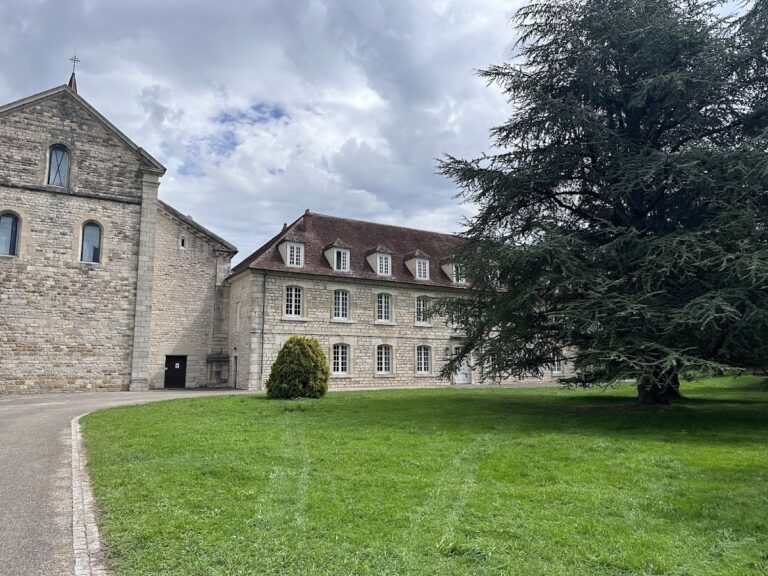
Château de Marnay: A Fortified Castle of Franche-Comté


Site at a Glance
- Rating
- 5
- Popularity
- Very Low
- Country
- France
- Primary era
- Medieval
- Eras represented
- Medieval, Early Modern
- Civilizations
- Holy Roman Empire
- Site type
- Military
- Remains
- Castle
On this page9 sections
History
Château de Marnay is a fortified castle in France, built and enlarged through medieval and early-modern phases on a strategic site overlooking the Ognon valley. First mentioned in the mid-eleventh century, it protected the route between Langres and Besançon and remained closely connected with the political history of Franche-Comté, the historic County of Burgundy, until the region was definitively incorporated into France in 1678–1679.
Imperial and Burgundian foundations
In 1044, Emperor Henry III, who was also king of Burgundy, granted Marnay and the lands between the Ognon and Saône to the archbishop of Besançon. At that time, the castle lay within the Holy Roman Empire, the central European political framework that governed the region for centuries. Marnay stood in the Comté territory known as Amaous, near the lordships of Ruffey, Étrabonne, and Pesmes.
By 1109, Marnay was regarded as a considerable place. Count Stephen I of Burgundy acquired the castle and its domains, making them a fief, or lordship held from a superior ruler in return for recognized obligations, of the Burgundy-Auxonne-Chalon branch of the counts of Burgundy. Stephen II of Auxonne and his son Stephen III, later also count of Chalon, strengthened and improved the castle. Stephen II died at Marnay on 6 March 1241.
The Joinville-Gex lordship
Béatrice d’Auxonne inherited Marnay as her dowry and residence, taking the title Lady of Marnay. After her marriage to Simon I of Joinville in 1215, she left the castle in the care of her younger son Simon II of Joinville when she returned there following Simon I’s death on the way back from a crusade in 1233. Her elder son Geoffroy approved this arrangement. Simon II later became Baron of Gex through his marriage to Léonette of Gex in 1252 and acknowledged Marnay as a fief of John I of Chalon.
The Joinville-Gex family retained the lordship until Hugues of Joinville-Gex died without issue around 1347–1351. In 1361, John II of Chalon-Arlay entrusted Marnay to Henri of Montfaucon-Montbéliard, his grandson and the nephew of Jeanne of Montfaucon-Montbéliard. Through Henri’s daughter Agnès and her marriage to Thiebaut VIII of Neufchâtel-Urtière, control later passed to the Neufchâtel-Montaigu family, including John II of Neufchâtel-Montaigu and his son Ferdinand.
Conflict and reconstruction
Marnay’s strategic position brought it into the wars of Franche-Comté. Troops of Duke Odo IV of Burgundy captured the castle in 1336 during the conflict between Burgundian forces and the Comtois barons led by John of Chalon-Auxerre. On 14 June 1354, John II of Chalon-Arlay granted the inhabitants their freedom. In spring 1477, troops of King Louis XI of France devastated the castle during the French invasion of Franche-Comté.
Laurent of Gorrevod acquired the lordship in 1512 and began rebuilding the castle in 1520. His campaign restored the seigneurial chapel, a chapel associated with a lord’s residence or estate, and modernized the complex. Artists involved in the contemporary construction of the Royal Monastery of Brou may also have worked at Marnay. Laurent formally acknowledged his relationship to Emperor Charles V through homage, the ceremony by which a lord recognized the authority of a superior.
Laurent died without legitimate issue and left his property to his cousin John of Gorrevod in his 1527 will. The lordship then remained within the Gorrevod family until Charles-Emmanuel I of Gorrevod was created the first Marquis of Marnay around 1600–1602. This title recognized his decisive participation in the Battle of Nieuwpoort on 2 July 1600. He became a prince of the Holy Roman Empire in 1623 and the first Duke of Pont-de-Vaux, while his younger brother Charles-Emmanuel II became archbishop of Besançon in 1654.
The castle passed to the Tremblecourt branch of Lorraine in 1595 before Don Fernando Velasco, Constable of Castile, recovered it. Charles-Emmanuel I carried out major alterations between 1602 and 1617, when Marnay was regarded as one of the finest castles in Franche-Comté. After Philippe-Eugène of Gorrevod died without issue in 1681, Charles-Louis of Bauffremont claimed the succession. The Bauffremont-Scey family secured the lordship from 1686 and thereafter held the titles of Marquis of Marnay and Prince of the Holy Roman Empire, among others.
French conquest and later changes
Marnay resisted the first French attempt to conquer Franche-Comté in 1636. In 1674, the army of Philippe de Montaut-Bénac de Navailles occupied the castle. Louis XIV stayed there in May while directing the siege of Besançon. Afterward, the French king ordered the defenses dismantled to prevent a renewed movement for Comtois independence. The Treaty of Nijmegen confirmed Franche-Comté’s definitive incorporation into France in 1678–1679.
During the eighteenth century, the Bauffremont-Scey family leased the castle, but the complex deteriorated. Alexandre, first Duke of Bauffremont, sold it in 1799. Following the French Revolution, ownership was divided among several parties. The castle was originally defensive, while its current use is residential, with ownership shared between the municipality and private owners. The base of the round tower, the spiral staircase, the north wing, parts of the east wing, the gatehouse, the concierge’s lodge, and the archive pavilion with its tower were entered on the French register of historic monuments on 6 December 2002.
Remains
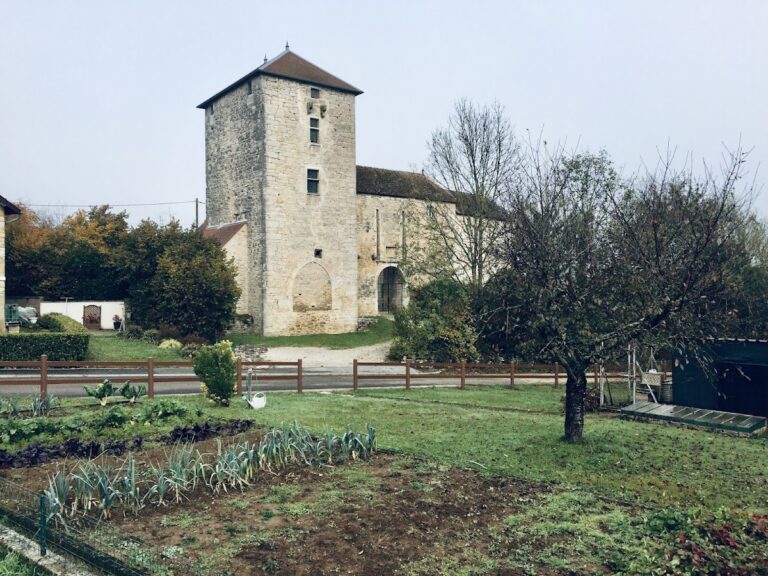
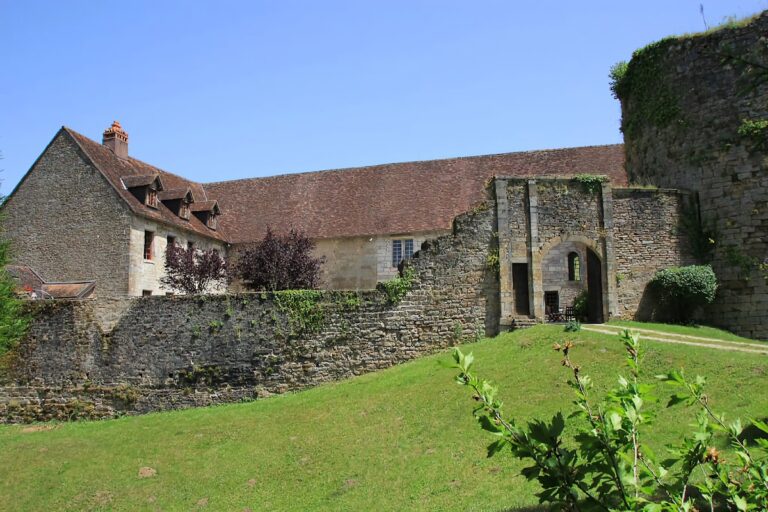
Château de Marnay survives as a fortified complex formed by successive building phases from the thirteenth through the seventeenth century. Its defenses were arranged around a feudal enclosure and a later second fortified boundary, with deep ditches and as many as sixteen turrets. The complex occupied elevated ground above the Ognon valley and controlled the route between Langres and Besançon. Later residential and defensive alterations produced the layered form that remains today.
Defensive system
The castle’s medieval defenses were expanded through additional turrets, deep ditches, and a second enclosure that surrounded or doubled the earlier fortified boundary. By the seventeenth century, sixteen turrets still formed part of the complex, whose defensive strength contributed to its reputation as one of the finest castles in Franche-Comté. Louis XIV’s orders after the 1674 occupation dismantled these defenses, changing the military character of the surviving buildings.
Surviving wings and towers
The protected remains include the base of a round tower, the north wing, and the facades and roofs of the east wing and its northern section, excluding the chapel. The gatehouse, concierge’s lodge, and archive pavilion with its tower are also preserved components of the complex. A spiral staircase forms part of the protected fabric, while the combination of wings, towers, and entrance buildings reflects the castle’s expansion over several centuries.
Chapel and later residence
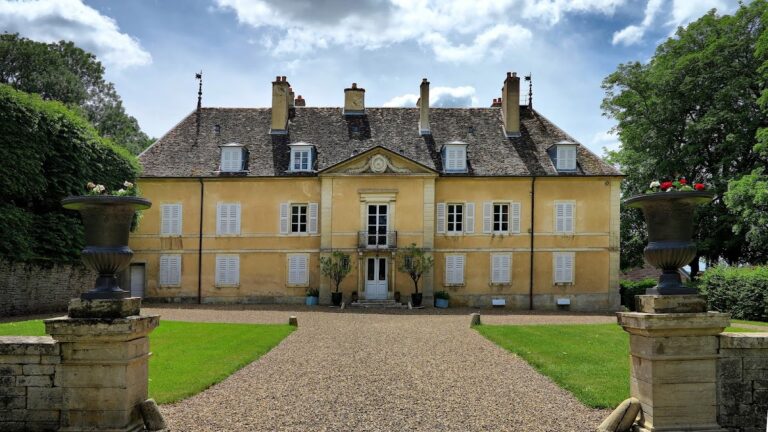
The seigneurial chapel was restored during Laurent of Gorrevod’s rebuilding campaign, which began in 1520, and the wider complex was modernized during the same period. Major alterations carried out between 1602 and 1617 further changed the buildings. These successive interventions left a castle in which medieval fortification, sixteenth-century reconstruction, and seventeenth-century modernization remain combined within the surviving residential complex.
Nearby sites