Château de la Rivière-Bourdet: A Seventeenth-Century Residence in Normandy

Site at a Glance
- Rating
- 5
- Popularity
- Very Low
- Country
- France
- Primary era
- Early Modern
- External website
- Open
- Eras represented
- Medieval, Early Modern
- Civilizations
- French
- Site type
- Domestic
- Remains
- Castle
On this page6 sections
History
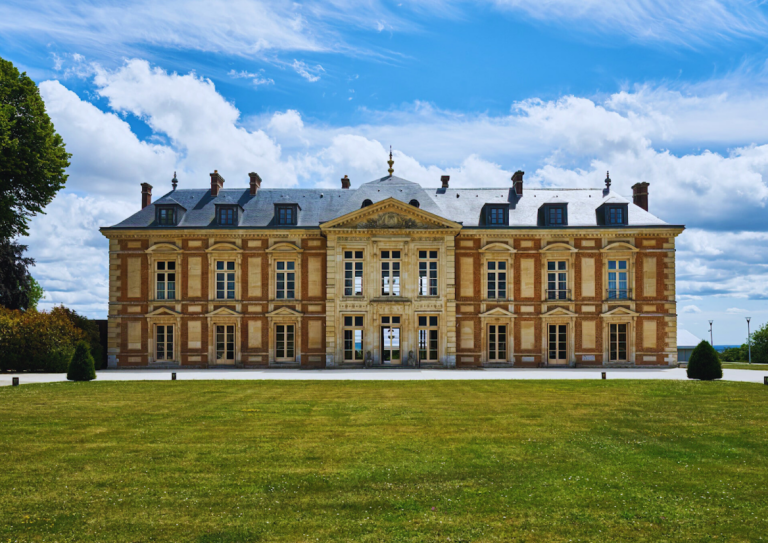
Château de la Rivière-Bourdet is a seventeenth-century residence in Quevillon, France, standing on the bank of the Seine in Normandy. Its earliest château was built in the thirteenth century by Étienne Bourdet, whose name became attached to the domain.
From the medieval estate to the Maignard de Bernières family
In the fifteenth century, the lordship of La Rivière was acquired by Jean Durand, a merchant from Rouen. Through marriage, it later entered the Maignard de Bernières family, which retained the property until 1734.
The château was sacked in 1570 and was probably rebuilt during the 1620s on the initiative of Charles II Maignard de Bernières. This rebuilding established the early modern residence that preceded its later nineteenth-century restoration.
Eighteenth- and nineteenth-century associations
In 1724, Voltaire, the French writer and philosopher, stayed at the château at the invitation of the last Marquise de Bernières. During his stay, he wrote parts of Mariamne and La Henriade. In 1734, the property passed by marriage to Jacques du Moncel de Lourailles, a senior magistrate of the Parlement of Normandy, the regional sovereign court under the pre-Revolutionary monarchy.
During the Bourbon Restoration, the period after Napoleon’s fall when the Bourbon monarchy was restored in France, the property belonged to the Duchess of Fitz-James. Honoré de Balzac stayed at the château in 1834 and 1835. The residence inspired his depiction of the Château de Rosembray in Modeste Mignon.
By inheritance, the château passed through the de Montholon-Sémonville family from 1862 to 1940 and then came to the Brillet de Candé family. Around 1865, the Princess of Montholon-Sémonville carried out an extensive restoration of the residence.
War, reuse, and preservation
The château was occupied during the Second World War. In 1944, it served as a school camp for 200 children from Le Havre, Dieppe, and Rouen. A bombing in July that year damaged the south wing, after which the château entered a period of abandonment.
Following its sale in 1962, the property became a retirement home in 1966 and remained in that use until 1995. In 2011, it belonged to Chantal Trapes and her sister, who had inherited it from their parents. The chartrier of La Rivière-Bourdet, an archival collection of title deeds and other estate records, is held in the Seine-Maritime departmental archives under series 30 J. The façades and roofs of the château and the dovecote were listed as historic monuments by an order dated 30 November 1934.
Remains
Château de la Rivière-Bourdet is arranged as a large residence beside the Seine. The surviving building reflects its seventeenth-century character, although it was very extensively restored around 1865. It is described as one of the largest residences in the area around Rouen. The south wing retains the physical effects of the bombing of July 1944, which damaged that part of the château.
Estate buildings
The estate includes a dovecote whose façades and roofs share the château’s historic-monument protection. Neoclassical stables also form part of the property, although they are now ruinous. Together, these surviving and damaged structures preserve the architectural extent of the residence and its associated estate buildings.