château de la Marigny, Alexain: A seigneurial residence and manorial centre


Site at a Glance
- Rating
- 4.7
- Popularity
- Very Low
- Country
- France
- Primary era
- Early Modern
- Eras represented
- Early Modern
- Civilizations
- French
- Site type
- Domestic
- Remains
- Castle
History
The château de la Marigny in Alexain, France, is a seigneurial residence whose principal rebuilding took place in 1563 and which functioned as a local centre of manorial and ecclesiastical authority. Its lands and rights tied it into the feudal networks of the duchy of Mayenne and the neighbouring fief of La Feuillée, giving the estate judicial and patronage roles that made it an important local seat of power from the late medieval period into the early modern era.
The place-name appears in documentary records under several spellings: Marigné in 1423, Marigni in 1500, Marigné again in 1630, and Marigny on later maps. During the fifteenth century Étienne de la Croix sold a rent to Charles, Count of Maine. In 1681 Louis-François Le Peultre acquired Marigny; his widow Marguerite-Françoise Benoist is noted in connection with the property in 1703. On 29 August 1722 Louis Le Peultre sold the lands of Marigny and Surgon in the Châtelet court to Henri Crozat de Ramond of Paris for 400,005 livres.
The Crozat family’s involvement continued unevenly: Henri Gabriel de Crozat, his son, underwent a real seizure in 1749. Ownership passed to Claude-Pierre Lefebvre de la Faluère on 18 December 1751. Claude-Pierre had served as an officer in the Régiment du Roi and maintained residence either at Château de Jallanges or at his city hôtel in Tours. He ordered a manorial terrier for Marigny that was compiled by the feudist Henri Chenou; the second volume of that terrier no longer survives.
As a seigneury Marigny exercised wide prerogatives. It held high justice over the seigneuries of Surgon and Hambers, enjoyed honorary rights in the church of Placé, held direct patronage and judicial control of Alexain’s large cemetery and church, and had the right to present chaplains both in Alexain and at Marigni itself. Land associated with the demesne and its holdings was substantial, measured in the period’s local units as one thousand and one journaux and twenty-one perches in demesne, 2,397 journaux in direct tenure, and 300 journaux in feudal tenure. A chapel dedicated to Sainte-Marguerite served liturgical needs with provision for two masses each week. Named chapelains attached to Sainte-Marguerite include Julien de Fontenailles, tonsured at Laval on 9 March 1571 and later bearing arms among League supporters; François de Fontenailles in 1592; Madelon de Fontenailles in 1659; François Leblanc, appointed 1656 and deceased 1689; Jean Durand, who served as curé dean of Mayenne from 1689 until his death in 1706; and Louis-Guillaume Leblanc de l’Ile, a knight of the Order of Malta in 1751.
Remains
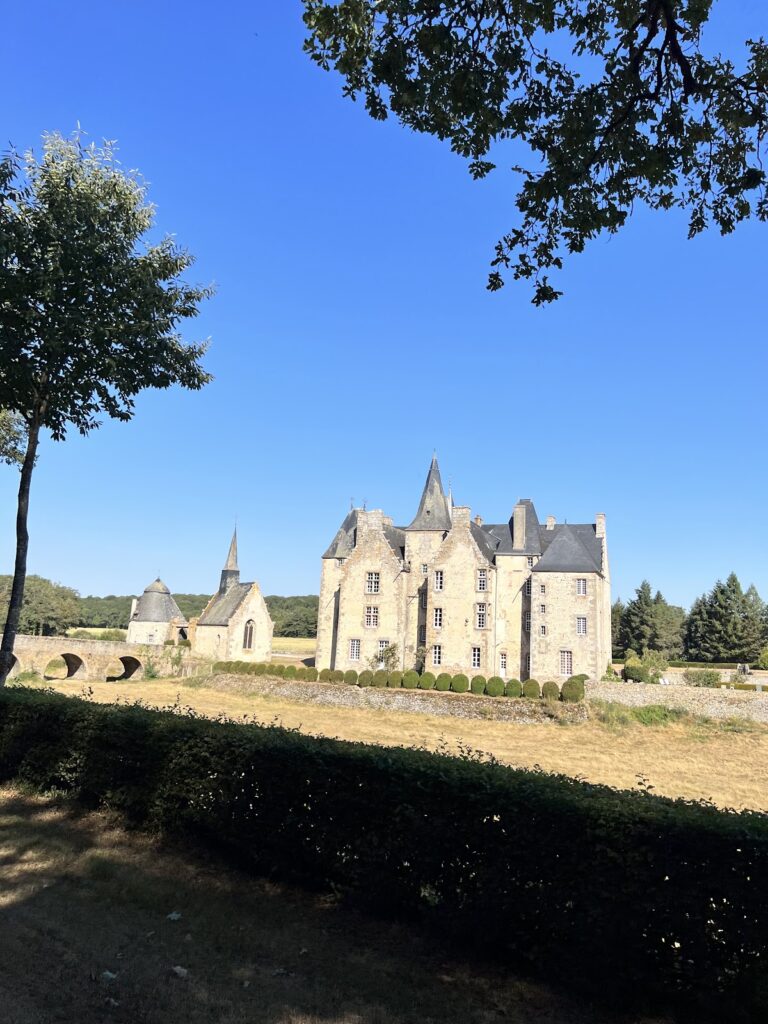
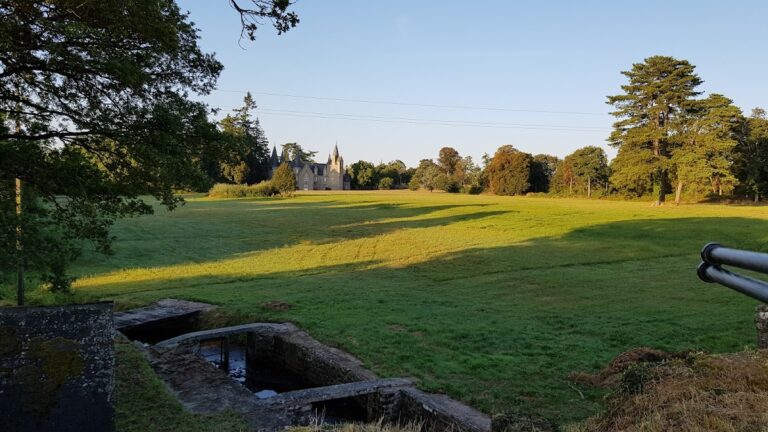
The complex is organised around a main dwelling block flanked on each side by separate pavilions, creating a compact, ordered plan typical of a seigneurial house evolved and rebuilt over centuries. The southern pavilion is finished with a corbelled corner turret, a projecting small tower built on stepped masonry supports. The pavilion at the opposite side formerly served as the site’s chapel and is identified with the dedication to Sainte-Marguerite.
Inside the principal building a central staircase survives, notable for its monolithic steps carved from single blocks of stone. A date carved on a doorway, 1563, marks a near-complete rebuilding episode and links the present fabric directly to that mid-sixteenth-century campaign. A large, freestanding tower stands apart from the main group; local tradition connects it to a crusader who, the story says, suffered brutal punishment at the hands of Saracens. By the end of the nineteenth century the façade that faces the river had been held up only by temporary props, a condition recorded in that period. The chapel of Sainte-Marguerite remains part of the ensemble, recognised both as the former pavilion chapel and under its dedication name.