Edelgave: A Historic Manor Estate in Denmark


Site at a Glance
- Rating
- 4.5
- Popularity
- Very Low
- Country
- Denmark
- Primary era
- Early Modern
- External website
- Open
- Eras represented
- Early Modern, Modern
- Civilizations
- Danish
- Site type
- Domestic
- Remains
- Manor House
On this page11 sections
History
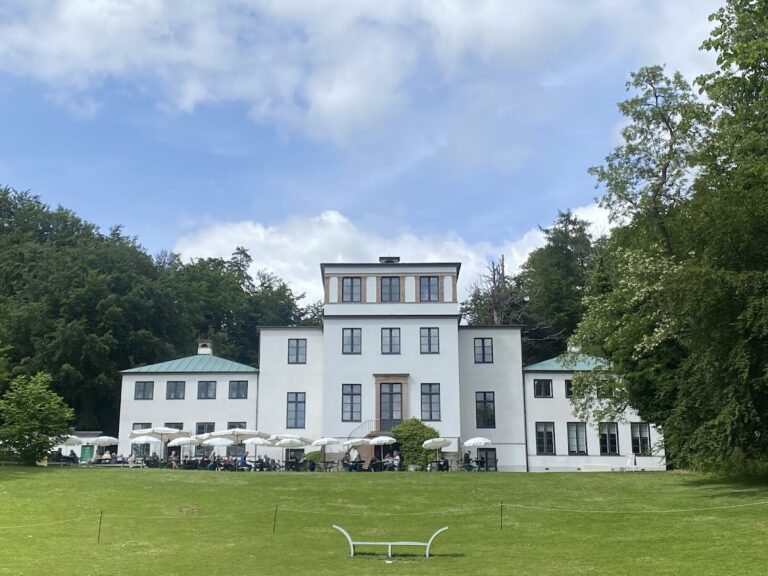
Edelgave is a manor estate in Denmark near Smørumnedre, whose present Neoclassical main house was completed in 1791. The property was first recorded in 1307, when Cecilie Jonsdatter bequeathed it to Esrum Abbey, a major Cistercian monastery in medieval Denmark. It was later known as Rompe.
From Abbey Property to Royal Estate
The crown owned Edelgave from about 1600. During the Dano-Swedish Wars of 1657–1660, a conflict between Denmark-Norway and Sweden, the farm was destroyed. In 1663, King Frederik III granted the property for life to Admiral of the Realm Henrik Bjelke and his wife, Edel Ulfeldt. An Admiral of the Realm was a senior naval rank in the Danish monarchy.
Five years later, a royal deed transferred the property to Edel Ulfeldt and her descendants. The deed referred to “Edelgave” as the intended name of the future manor house. Henrik Bjelke enlarged the estate by adding several tenant farms, and Edelgave was elevated to a manor in 1682. He also built a new three-winged main building using half-timbering, a method based on a visible timber frame filled with masonry or plaster.
Eighteenth-Century Rebuilding
Ownership subsequently passed through Henrik and Edel Bjelke’s son Christian Bielke, his wife Vibeke Bielke, and Heinrich and Christian Weldingh. After Christian Weldingh died around 1758–1759, the estate was sold at public auction to Anne Marie Bornemann for 22,800 rigsdaler.
The earlier main house was destroyed by fire in the early 1780s. Jakob Bornemann commissioned a replacement from Andreas Kirkerup, a Danish architect associated with Neoclassical manor-house design. The new building was completed in 1791.
Edelgave changed hands several times during this period. Hans Georg Faith bought it in 1787 for 60,000 rigsdaler and sold it in 1791 to county manager Jakob Rosted for 69,000 rigsdaler. Christian Lange acquired the estate in 1798 for 88,100 rigsdaler and sold it to J. Bartholin-Eichel in 1806 for 100,000 rigsdaler. Friederich Tutein purchased Edelgave in 1808 for 134,000 rigsdaler and transferred it to his son, Friederich Wilhelm Tutein, in 1830.
Nineteenth and Twentieth-Century Ownership
The Tutein family retained Edelgave for almost a century. The recorded succession included Beate Elise Tutein from 1867 to 1890 and Ellis Tutein from 1890 to 1919. Niels Jørgensen owned the estate from 1919 to 1921, followed by Thomas Madsen-Mygdal from 1921 to 1943 and Marie Madsen-Mygdal from 1943 to 1956. Madsen-Mygdal later became prime minister.
J. Th. Oltmann owned Edelgave from 1956 to 1958. Gudmund Jørgensen then held it from 1958 to 1988, followed by Lisa Jørgensen from 1988 to 1992. Gudmund Jørgensen founded Vallø Saft and planted most of the estate’s land with fruit trees. Edelgave Gods ApS has owned the property from 1992 onward.
The estate covers 300 hectares. Its principal building is listed, while the farm buildings are not. Edelgave Allé and the burial mound Gyngehøj are protected.
Remains
Edelgave is arranged around a larger courtyard. The present main building occupies its west side, while farm buildings enclose the other three sides. A driveway edged with white-painted boulders crosses the courtyard. Immediately southeast of the main building lies Smørholm, identified as the 700-year-old site of the principal castle building.
Manor House and Courtyard Buildings
The Neoclassical Main House
Designed by Andreas Kirkerup, the present main house is a plastered Neoclassical building. Its principal residential block has two storeys and is covered by a black-glazed tile roof. One-storey service wings flank the house and have hipped red-tile roofs, which slope upward from all sides rather than ending in vertical gables. Together, the house and wings form a formal entrance court.
Farm Buildings
Most of the farm buildings date from 1866, although they incorporate remains of Henrik Bjelke’s original half-timbered farm buildings. They stand around the three sides of the larger courtyard, with the main house forming its western side.
Older Site and Estate Landscape
Smørholm
Smørholm lies immediately southeast of the present main building. It is identified as the site of the principal castle building associated with the estate’s roughly 700-year-old history.
Woods, Farmland, and Orchards
The estate includes Edelgave Skov and Slotsskoven, two woods covering 27 hectares together. The remaining land consists of farmland and orchards. Edelgave Allé is an avenue of ash trees, and the burial mound Gyngehøj lies beside it.
Nearby sites