Château de la Bâtie: A Medieval Fortress in France


Site at a Glance
- Rating
- 4.3
- Popularity
- Very Low
- Country
- France
- Primary era
- Medieval
- External website
- Open
- Eras represented
- Medieval, Early Modern, Modern
- Civilizations
- French
- Site type
- Military
- Remains
- Castle
On this page9 sections
History
Château de la Bâtie is a former medieval fortress in Montceaux, France, probably founded in the 12th century by the Beaujeu family. First evidence of its existence dates from the 13th century, when the castle served as the center of the lordship of La Bâtie. It later became the seat of a barony and then a county, hereditary territorial lordships whose titles reflected different levels of aristocratic status and jurisdiction.
From the Beaujeu family to the Champiers
After its foundation, the fortress entered the domain of the Bourbon family, a major French noble and ruling dynasty. In 1350, the estate belonged to Guillaume de Francheleins. His daughter Louise brought it as her dowry to Henri de Juys, lord of Belvey. Their granddaughter Claudine de Juys married Jean du Saix, lord of Rigna, in January 1447, making him lord of La Bâtie.
Jacques de Limosin, lord of Montaubert, later acquired the estate from the heirs of Janus du Saix, who had died without children. On 29 March 1540, the property passed by inheritance to Marguerite, Limosin’s eldest daughter. Her marriage to Claude de Champier, bailiff and later governor of Dombes, brought La Bâtie into the Champier family. In favor of their son Jacques de Champier, Henri de Bourbon-Montpensier, a nobleman of the Bourbon-Montpensier branch, raised the estate to a barony.
Later owners and changing uses
The estate passed to the Villeneuve family in the 17th century. It later became a county under the Ormesson de Chamarande family, who remodeled the castle. In the 18th century, ownership passed to the Tour-Vidaud family, which still possessed La Bâtie in 1789.
After the French Revolution, the castle changed hands among several families before becoming the private residence of the Chalon family. During the Second World War, it provided a hiding place for numerous members of the French Resistance, including Jean Moulin, one of the movement’s leading figures.
The chapel and modern protection
In the 15th century, the lords of La Bâtie transferred a chapel dedicated to Saint Maurice into the castle. It had previously stood alone among vineyards. The chapel was altered in the 19th century, while the castle also underwent physical changes during that period.
The entire castle, including the chapel, dependencies, and associated land parcels, was listed as a historic monument by an order dated 17 July 2006. This protection recognizes the surviving complex as a group of related historic structures and grounds.
Remains
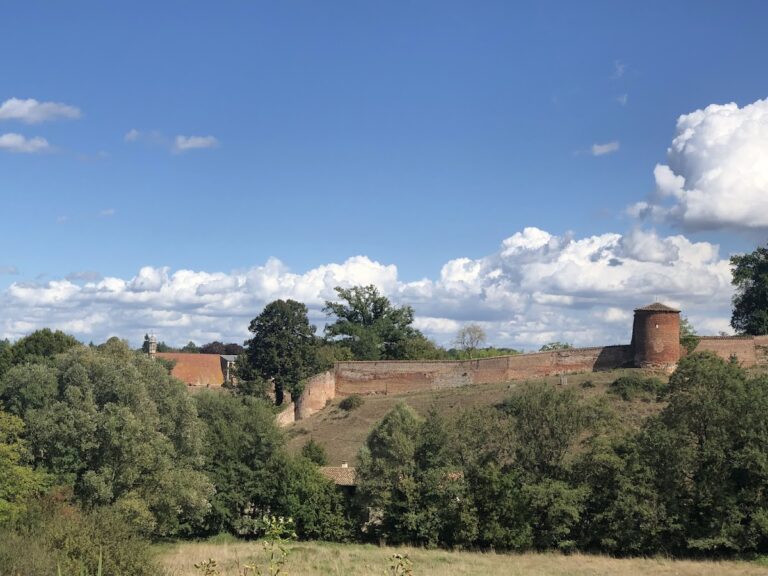
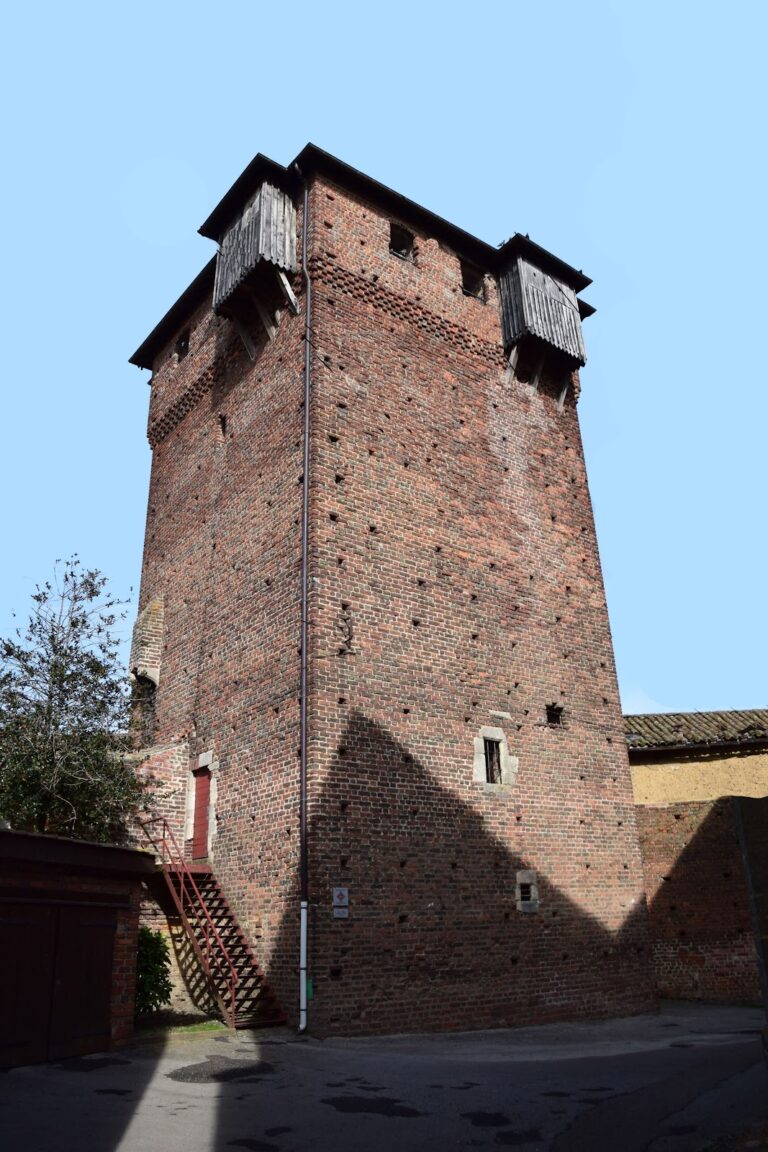
Château de la Bâtie is a fortified complex built from large red bricks known as Savoyard carrons, a material characteristic of the Dombes, a historic region of eastern France now largely within the Ain department. Its surviving fabric brings together medieval defensive construction, 16th-century interior work, 18th-century alterations, and later changes to the chapel and fortifications.
Fortifications and residential buildings
Enclosures and towers
In the 13th century, the fortress consisted of four enclosures and 19 towers. The keep, the principal fortified tower of a medieval castle, and the original residential building stood on the western side. Part of the inner defensive enclosure was destroyed in the 19th century, leaving the castle’s present form shaped by both medieval construction and later alteration.
Keep and interior features
Some beams in the keep retain painted decoration from the 16th century. One beam on the second floor carries a danse macabre, or dance of death, a representation linking human figures with mortality. A vaulted gallery from the same century conceals earlier Gothic elements, including features belonging to the medieval architectural style associated with pointed arches and ribbed vaults. Openings were added to the castle in the 18th century.
Saint Maurice Chapel
The chapel of Saint Maurice forms part of the castle complex and contains a crypt, a vaulted chamber beneath a church or chapel. Transferred into the castle during the 15th century, it was later altered in the 19th century. Its surviving structure preserves the chapel’s role within the fortified residence while also reflecting subsequent changes to the building.