Castle of Vianino: A Medieval Hilltop Fortification in Italy


Site at a Glance
- Rating
- 4.3
- Popularity
- Very Low
- Country
- Italy
- Primary era
- Medieval
- Eras represented
- Medieval
- Civilizations
- Holy Roman Empire
- Site type
- Military
- Remains
- Castle
On this page6 sections
History
Castle of Vianino is a medieval hilltop fortification in Italy, above the settlement of Vianino. The original stronghold was probably built in the tenth century, and its existence is first recorded in 1001, when the relics of Saint Justina passed through the locality during their transfer from Rome to Piacenza.
Early landholding and Piacenza
In the early eleventh century, the territory belonged to Ildegarda, the wife of the Lombard Odone. The Lombards were a Germanic people who established a kingdom across much of Italy during the early medieval period. In 1028, Ildegarda sold her lands, including Viazzano and the Castle of Roccalanzona, to the rector of the church of Saint Peter of Paderna. The rector donated these possessions in 1043 to the Monastery of San Savino in Piacenza, which was directly subject to the bishop of Piacenza.
The Ardemanni family previously held Vianino as a fief, meaning land or jurisdiction granted by a superior ruler to a subordinate lord in return for service. In 1188, the municipality of Piacenza acquired the castle. In 1209, it assigned the castle and settlement to the Scarpa family, which already held other castles in the surrounding area.
Visconti and Pallavicino control
In 1382, Gian Galeazzo Visconti, Duke of Milan, invested the marquis Galvano Pallavicino with the fief. The Visconti were one of the ruling dynasties of Milan. In 1428, Filippo Maria Visconti sent troops under the mercenary captain Niccolò Piccinino against Manfredo Pallavicino and attacked his Castle of Pellegrino. Manfredo was arrested, tortured into confessing that he had conspired against the duke, sentenced to death, and deprived of his possessions. Vianino and Pellegrino were then assigned to Piccinino.
In 1447, the inhabitants rebelled and killed Angelo, Piccinino’s third son. The fief was subsequently reclaimed by the ducal administration of Milan, the governmental office responsible for managing a duke’s lands and revenues. In 1481, Gian Galeazzo Maria Sforza, Duke of Milan, granted Vianino to the marquis Pallavicino Pallavicini on the occasion of the marriage of his eldest son, Galeazzo I, to Elisabetta, daughter of Tristano Sforza.
Parma, abolition of feudal rights, and survival
After the death of the marquis Gerolamo Pallavicino in 1579, the castle was reclaimed by the ducal administration of Parma. Alessandro Farnese, Duke of Parma, granted it to the Bolognese marquises Facchinetti in 1592. The Farnese were a major Italian ruling family associated with the Duchy of Parma. Vianino passed to the marquises Dalla Rosa Prati in 1647 and to the Fogliani Sforza family in 1752.
Napoleonic decrees abolished feudal rights in the Duchy of Parma and Piacenza in 1805. By that time, the old fortress had already been repeatedly altered and subdivided. Only a corner tower remained, and private individuals subsequently purchased the surviving structure.
Remains
Surviving corner tower
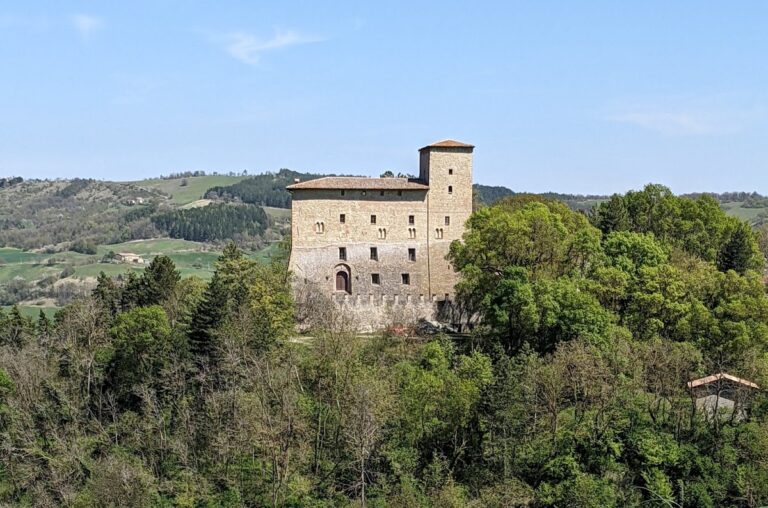
The former castle occupies a steep position above the edge of Vianino’s inhabited center, overlooking the small settlement. Its surviving remains are represented by a single circular-plan corner tower, the last visible part of the larger hilltop fortification. The former castle is a ruin, while the tower itself is also described as restored.
Entirely faced in rubble stone, the small tower has a roof covered with slate slabs. It contains very few openings, all directed toward the settlement, an arrangement that reflects its strongly defensive character. The entrance has a shallow segmental arch and is reached by an access ladder. This entrance form belongs to the military architecture of the Piacenza area and is compared with the nearby Castle of Varsi.
Nearby sites