De Nederhorst: A Historic Castle in the Netherlands
Site at a Glance
- Rating
- 4.8
- Popularity
- Very Low
- Country
- Netherlands
- Primary era
- Early Modern
- External website
- Open
- Eras represented
- Medieval, Early Modern
- Civilizations
- Holy Roman Empire
- Site type
- Domestic
- Remains
- Castle
On this page10 sections
History
De Nederhorst, also known as Nederhorst Castle, is a Dutch castle in Nederhorst den Berg, Netherlands. Its origins reach back to the late thirteenth century, when the Van Wulven family probably began building it around 1280. The castle stood in a strategically important position on the boundary between Holland and the Sticht, the historic territory around Utrecht within the political and ecclesiastical sphere of the bishopric of Utrecht.
Origins and medieval lordship
The earliest known reference to the castle dates to 1301. In that year, Alfer, Baron of Wulven, placed it under the authority of his liege lord in return for protection. His family soon adopted the name Van der Horst and exercised judicial authority and collected taxes in the surrounding area. The castle was then known as Horst.
The name later changed to Nederhorst. It may have distinguished the castle from Hogerhorst, a castle formerly located near Rhenen, or it may have referred to the castle’s lower position in relation to De Berg, the hill where the church and settlement developed. Until a boundary change in 1819, Nederhorst belonged to Utrecht’s Nedersticht. From 1536, the castle was among the recognized knightly manor houses, a status given to formally acknowledged manorial residences within the local system of noble estates.
From the Van der Horst family to reconstruction
Alfer I was followed by Alfer II through Alfer VII, and finally by Dirk. Dirk sold the castle in 1579. French troops set it on fire in 1672 during the conflict that brought French military occupation and attacks into the Dutch Republic. The castle was sold the following year and subsequently rebuilt. Its present appearance took shape in the early eighteenth century.
Restoration and cultural associations
Jan Jonker bought De Nederhorst at the beginning of the 1960s and completely restored it. He housed his unique clock collection in the building, while more than half of the castle was leased to Toonder Studios in 1966. The company was associated with Dutch cartoonist and writer Marten Toonder and operated from the castle for many years.
A fire on 10 January 1971 burned out the castle completely and destroyed Jonker’s clock collection. With assistance from Toonder Studios, the collection was later restored to its former condition. Jonker transferred the burned-out castle to the Harmine Wolters Foundation, named after his wife. After restoration, the castle reopened to the public in 1973. Toonder Studios continued working in temporary buildings before occupying the upper floors and constructing a large studio hall behind the outbuildings. The company remained active at Nederhorst until 2002.
Because of its connection with the castle of Heer Bommel, Toonder’s principal fictional aristocratic character, Nederhorst is popularly known as Bommelstein. The character Loeki de Leeuw, known from an earlier advertising segment on Dutch public television, also originated at the castle.
Recent ownership
In 2019, Stadsherstel Amsterdam announced the purchase of the castle and plans to convert it into housing. This Dutch heritage organization acquires, restores, and reuses historic buildings. Ownership passed from the Harmine Wolters Foundation to Stadsherstel Amsterdam, with the transaction completed in spring 2022. The plan provides apartments of approximately 40 to 115 square metres while retaining public access to the castle and gardens. De Nederhorst is a protected monument registered as monument number 520084.
Remains
De Nederhorst occupies the lower part of an elongated drifting-sand dune formed during the last Ice Age. The church stands separately on De Berg, the higher part of the same dune. The surviving site comprises the square castle, its surrounding historic garden and park layout, and associated access and service structures.
Castle and grounds
Square castle
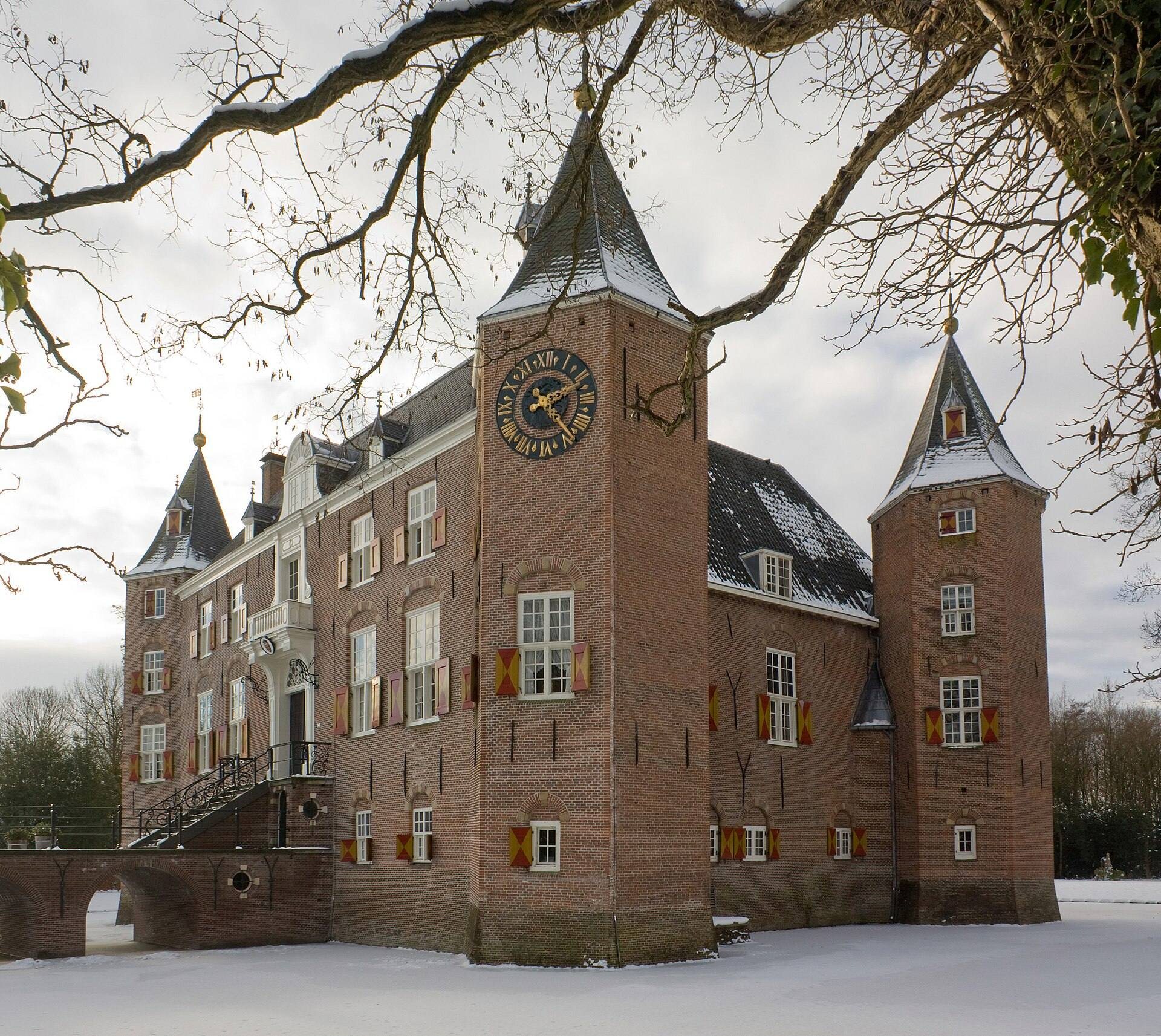
The main building is a square structure rebuilt after the seventeenth-century fire. A hexagonal tower rises at each corner, giving the castle its characteristic early eighteenth-century form. An iron gate was installed around 1730. The castle forms the central architectural element of a wider historic ensemble that includes its gardens and park layout.
Bridges and entrance features
The grounds include an access bridge, an entrance gate, another bridge, and a gate at the landing stage. Together with the iron gate around the castle, these features define the approaches across the water and connect the principal building with its surrounding grounds.
Service buildings and garden elements
The site also contains a coach house, a shed, and a set of garden vases. These elements belong to the historic arrangement of the castle grounds and accompany the main building within the surviving garden and park setting.