Château de Grosbois: A Renaissance and Classical Estate in France


Site at a Glance
- Rating
- 4.5
- Popularity
- Medium
- Country
- France
- Primary era
- Early Modern
- External website
- Open
- Eras represented
- Early Modern, Modern
- Civilizations
- French
- Site type
- Domestic
- Remains
- Castle
On this page14 sections
History
Château de Grosbois is a Renaissance and classical château in France, located in Marolles-en-Brie. Its central residential building was erected in 1597 for Nicolas de Harlay de Sancy, creating the core of an estate whose history later became linked to the French monarchy, the Revolution, Napoleon’s Empire, and horse racing.
From royal domain to private estate
The lands of Grosbois were exchanged in 1190 between Philip II of France and the Abbey of Saint-Victor in Paris for territory in the Bois de Vincennes. They were recorded as part of the royal domain in 1226, when John II the Good came there to hunt. In 1563, the abbey transferred the lands to Raoul Moreau, Treasurer of the Épargne, a financial officer in the royal administration. Moreau later provided them as a dowry for his daughter Marie when she married Nicolas de Harlay de Sancy in 1575.
Harlay de Sancy commissioned the central residence in 1597 through Florent Fournier, a contractor from Paris. The architect is unknown, although the design appears to have been influenced by Jacques Androuet du Cerceau, a prominent French Renaissance architect and architectural designer. The unfinished château was sold in 1616 to Charles de Valois, Count of Auvergne and, from 1619, Duke of Angoulême. An illegitimate son of Charles IX of France and Marie Touchet, Charles completed the work around 1640. His additions included the enclosing wall, built in 1623, and the two wings bordering the main courtyard.
Seventeenth- and eighteenth-century owners
For his remarriage to Françoise de Nargonne in 1644, Charles of Angoulême commissioned the engraver Abraham Bosse to create mural decoration for the Chamber of Honour. The painted decoration depicted the wedding ceremony beneath a French-style ceiling, with cartouches carrying the nuptial cipher. It was rediscovered by chance beneath several layers of wallpaper in 1910. Its attribution to Horace Le Blanc remains uncertain.
After Charles of Angoulême died in 1650, the enlarged estate passed to his granddaughter, the Duchess of Joyeuse. It later returned to the Harlay family, including Achille de Harlay, First President of the Parlement of Paris. The property then passed to his granddaughter, the Marshal of Luxembourg, who sold it in 1718 to Samuel-Jacques Bernard.
Bernard commissioned the wood panelling of the Régence Salon. A salon Régence uses the decorative style associated with the Regency government that ruled France during Louis XV’s minority. Grosbois subsequently belonged to Germain Louis Chauvelin, François Marie Peyrenc de Moras, Anne-Marie de Merle de Beauchamps, and Pierre-Paul II Gilbert de Voisins. Their son, Pierre Paul Alexandre Gilbert de Voisins, transferred the property to the Count of Provence in 1776. The Count remained at Grosbois until he left France for exile.
Revolutionary and imperial transformations
During the French Revolution, the château was confiscated as national property. Paul Barras acquired it on 9 November 1797, but after the coup of 1799 he went into exile in Belgium. He sold the estate in 1801 to General Jean-Victor Moreau for 200,000 francs. Moreau was arrested for conspiracy in 1804 and exiled to the United States. Napoleon then acquired Grosbois through his minister Joseph Fouché and transferred it in the same year or in 1805 to Marshal Louis-Alexandre Berthier, Prince of Wagram.
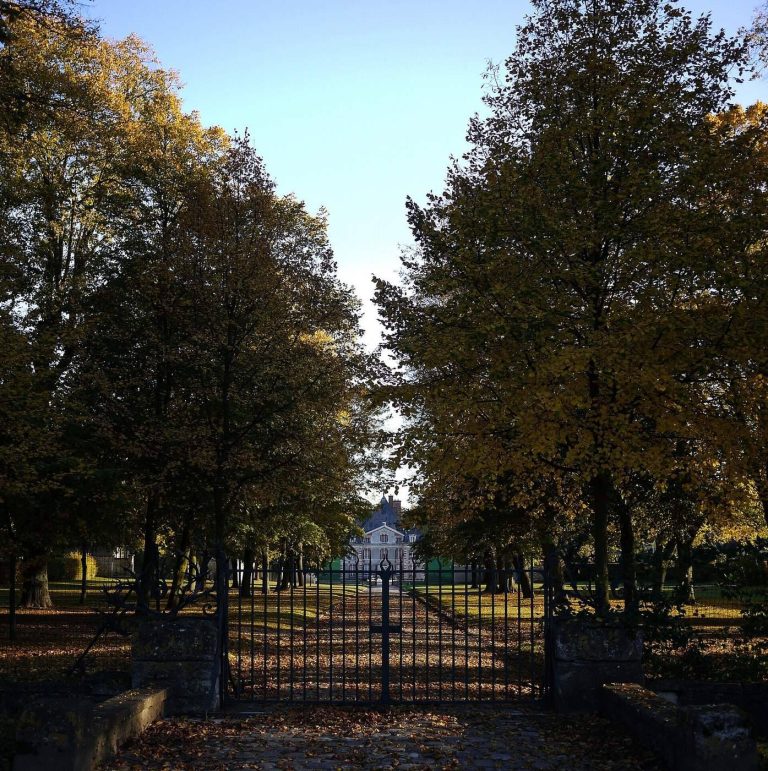
Berthier extensively remodelled the interior. He enlarged the library, created the Gallery of Battles, the Emperor’s or Yellow Salon, and the Usher’s Salon, and commissioned furniture from the cabinetmaker Bellangé. He also built two pavilions and the entrance gate on the road. As Grand Veneur, the senior official responsible for the sovereign’s hunt, Berthier expanded the estate into a major imperial hunting ground, reportedly containing up to 5,600 head of game, and held grand fêtes there.
Grosbois also preserved two paintings by Jean-Baptiste Oudry, Dogs Attacking a Stag and Dogs Attacking a Boar. Louis XV had given the works to the Prince of Condé for Chantilly in 1725, and they disappeared after being seized in 1794. On the night of 23 to 24 April 1814, the château sheltered the King of Rome, the title given to Napoleon Bonaparte’s son, Napoleon II, before his mother, Empress Marie-Louise, took him to Austria. Berthier later joined his wife and father-in-law at his residence in Bamberg, where he died after falling from a window on 1 June 1815.
Later ownership and modern uses
Berthier’s son, Napoleon Alexandre Berthier, second Prince of Wagram, reorganised the library, which contained more than 3,000 books. The estate later passed through the Berthier and La Tour d’Auvergne-Lauraguais families. In 1914, Louis Marie Philippe Alexandre Berthier transferred it to his sister Élisabeth Berthier de Wagram before leaving for the front. The inheritance later passed to their nephew, Godefroy de La Tour d’Auvergne-Lauraguais.
During the First World War, the château served as a Red Cross hospital with 30 beds, while hundreds of army troops were quartered there. During the Second World War, it became the headquarters of the Luftwaffe. On 26 July 1962, the Société d’encouragement à l’élevage du cheval français acquired the château and its 450-hectare estate to establish a racehorse training centre. Since June 2010, the château has also housed a trotting museum.
Château de Grosbois has several protections under French heritage law. The château was listed as a historic monument in 1933. In 1948, the château façades and roofs, the outbuildings, entrance gate, pavilions, and park were classified, a higher level of protection. The façades and roofs of the outbuildings were listed separately in 1964.
Remains
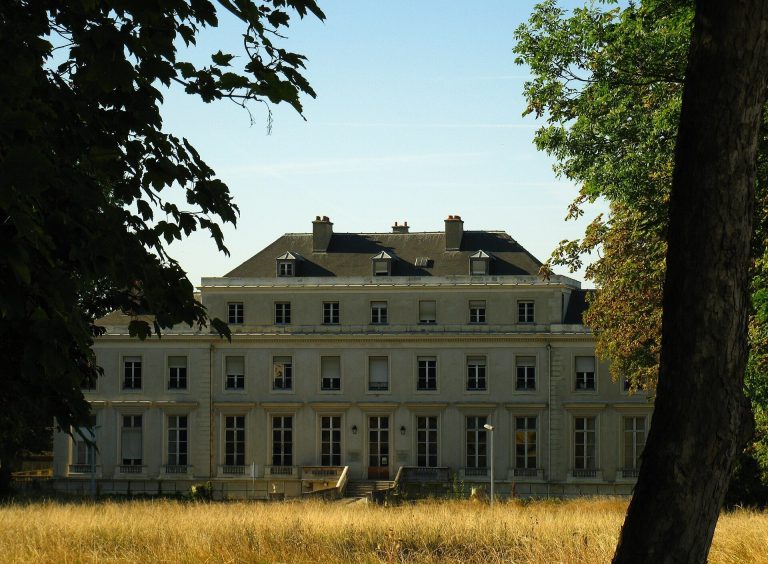
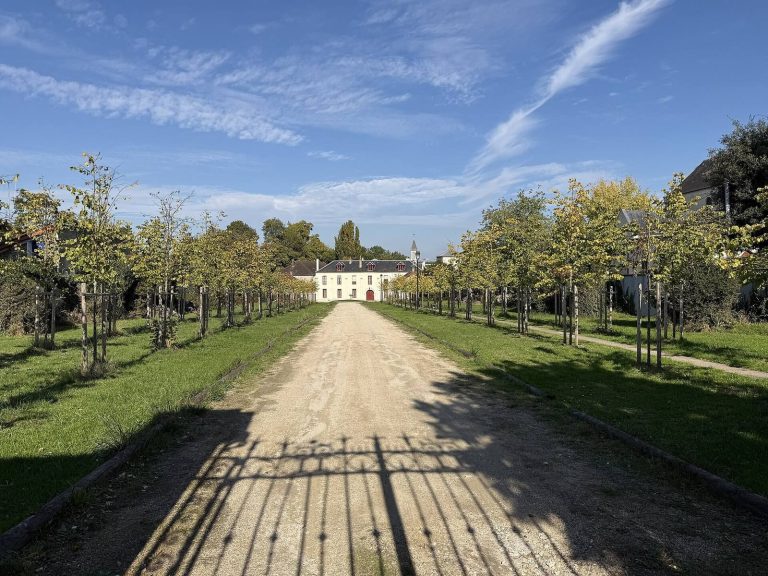
Château de Grosbois occupies a rectangular platform surrounded by a moat, formerly water-filled and now dry. Three footbridges reach the platform. The château follows a U-shaped plan, with a central body projecting in a curved exedra, meaning a semicircular or rounded recess or projection. Pavilions of the same height flank the central building, while two lower wings extend at right angles. Together with the enclosing wall, entrance gate, outbuildings, park, and hunting grounds, these elements form the principal surviving architectural framework of the estate.
Residential buildings and courtyard
Central residence and wings
The central building, erected in 1597, forms the historic core of the château. Its outward-curving central body is flanked by matching pavilions and by two lower wings bordering the main courtyard. The enclosing wall was added in 1623, and the wings were completed during Charles of Angoulême’s enlargement of the château around 1640.
Entrance buildings
Two pavilions and the entrance gate were built during Marshal Berthier’s ownership. They belong to the later imperial reworking of the estate and remain among the architectural components associated with the approach to the château.
Interior rooms and collections
Chamber of Honour
The Chamber of Honour retains the mural decoration commissioned for Charles of Angoulême’s remarriage in 1644. The compositions represent the wedding ceremony and appear beneath a French-style ceiling, a decorated ceiling formed from exposed or painted structural elements and ornamental panels. Cartouches carry the nuptial cipher. The paintings were found beneath wallpaper in 1910, and their attribution to Horace Le Blanc remains debated.
Gallery of Battles
The Gallery of Battles was decorated with eight large paintings representing battles in which Berthier participated. Busts of his fellow Marshals of the Empire were displayed with the paintings. This arrangement was recorded as surviving in 1963.
Salons and library
The interior includes the Régence Salon, whose wood panelling was commissioned by Samuel-Jacques Bernard, as well as the Emperor’s or Yellow Salon and the Usher’s Salon, created or arranged during Berthier’s remodelling. The library contains more than 3,000 books and was reorganised by Berthier’s son, Napoleon Alexandre Berthier.
Paintings and later representations
The two paintings by Jean-Baptiste Oudry, Dogs Attacking a Stag and Dogs Attacking a Boar, were part of Berthier’s collection at Grosbois after their earlier association with Chantilly and their disappearance following seizure in 1794. A painting of the château by Paul Girol is preserved at the Musée du Domaine départemental de Sceaux.