Fort de Sucy: A Séré de Rivières Fort Defending Paris


Site at a Glance
- Rating
- 4.4
- Popularity
- Low
- Country
- France
- Primary era
- Modern
- Eras represented
- Modern
- Civilizations
- French
- Site type
- Military
- Remains
- Fort
On this page8 sections
History
Fort de Sucy is a French military fort at Sucy-en-Brie, France, built between 1879 and 1881 to help defend Paris after the Franco-Prussian War, the 1870–1871 conflict in which Prussia and its German allies defeated France. It formed part of the Séré de Rivières system, a network of French forts, redoubts, and batteries created to protect strategic approaches and major cities. The outer Paris network developed between 1874 and 1881 comprised 18 forts, five redoubts, and 34 batteries.
Creation and strategic position
The fort occupied ground used by Prussian forces in 1870 to bombard the Saint-Maur peninsula. Its position controlled movement along the Paris–Strasbourg and Paris–Mulhouse national roads and overlooked the Bois Notre-Dame and Armainvillers Forest. These responsibilities placed Fort de Sucy within the wider effort to secure the approaches to the capital after the defeat of 1870–1871.
Advances in artillery, especially the use of more powerful explosive shells, soon threatened traditional masonry defenses. Concrete protective cover was therefore added to the fort shortly after its completion. A further modernization scheme prepared in 1911 proposed additional concrete defenses, three shelters, and two observation turrets equipped with machine guns. Funding was unavailable, so the planned modernization was not carried out.
Armament and twentieth-century use
In 1914, Fort de Sucy mounted fourteen guns on its rampart and ten on its caponiers, fortified structures projecting into the ditch so defenders could fire along it. Two 75 mm anti-aircraft guns were added by 1915. Four 105 mm anti-aircraft guns followed in 1935. The fort saw little action during the Second World War.
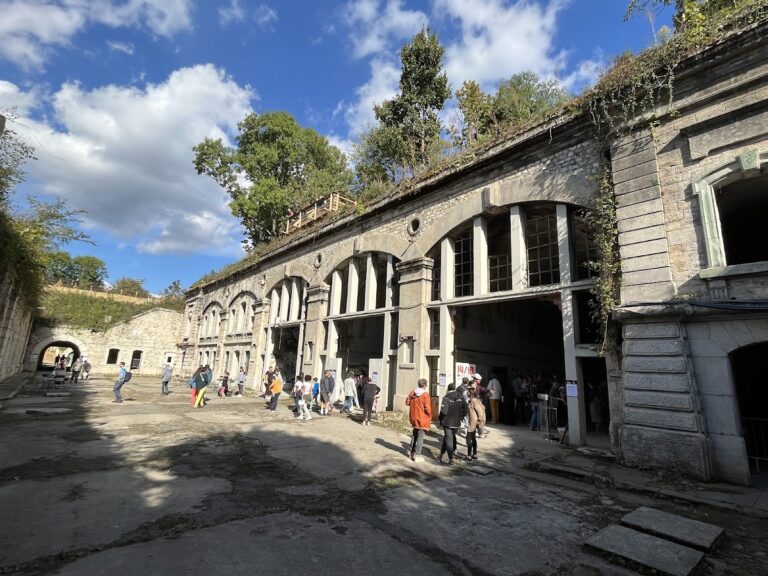
Before withdrawing on 22 August 1944, the German army destroyed the barracks, which had been used to store munitions. After the fort was abandoned, the commune of Sucy-en-Brie purchased it in 1970. The association À la découverte du Fort de Sucy has carried out restoration work since 1996, and the site is used by associations. Fort de Sucy forms part of the Fortifications of Paris and is owned by Sucy-en-Brie.
Remains
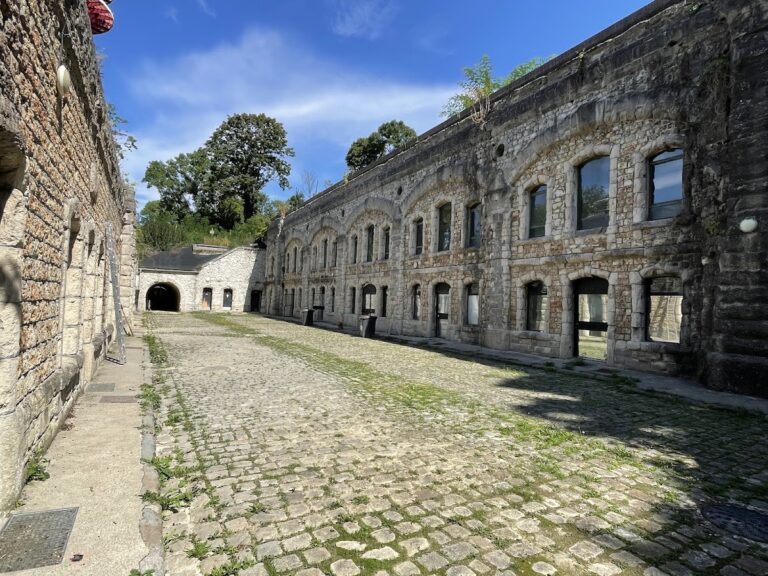
Fort de Sucy has a roughly rectangular plan with an indented front. A ditch approximately nine metres wide surrounds the main defensive frontage, where the entrance is placed centrally. Caponiers flank the entrance within the ditch, allowing fire along this space and helping protect the fort’s walls from close attack. Concrete protective work added after construction altered the original masonry defenses, while restoration continues to shape the fort’s present condition.
Barracks and internal facilities
Barracks and powder magazine
The barracks were designed to house 372 men and ten officers and included a tank. At their center was a magazine with capacity for 67 tons of gunpowder. The barracks later served for munitions storage before their destruction by the German army in 1944.
Defensive armament
Rampart guns and caponiers
The fort was designed for 24 artillery pieces on the rampart and ten flanking pieces mounted on the caponiers. Its armament changed over time as anti-aircraft weapons were installed. Four 105 mm anti-aircraft guns were placed at the fort in 1935, following the addition of two 75 mm anti-aircraft guns by 1915.