Château de Freundstein: A Medieval Fortified Residence in France

Site at a Glance
- Rating
- 4.2
- Popularity
- Very Low
- Country
- France
- Primary era
- Medieval
- Eras represented
- Medieval
- Civilizations
- Holy Roman Empire
- Site type
- Military
- Remains
- Castle
On this page6 sections
History
Château de Freundstein is a ruined medieval castle in France, located at Goldbach-Altenbach in the Haut-Rhin, and probably founded during the second half of the thirteenth century, around 1275. Built as a fortified residence for the holder of the right of ban, the medieval authority to command and exercise jurisdiction over a territory and its inhabitants, it was designed to withstand assault and siege. The castle was recorded in 1297, when ownership was shared by Murbach Abbey, a major ecclesiastical institution in Alsace, and the bishop of Strasbourg.
Feudal lordship and decline
In 1297, the castle was granted as a fief to the Waldner von Freundstein family. A fief was a fortified property or parcel of land held from a superior lord in return for defined obligations. The family retained ownership even after the castle had fallen into ruin, while Murbach Abbey and the bishop represented the superior feudal authorities over the property.
Château de Freundstein began deteriorating during the early fourteenth century, and its condition worsened severely after the Basel earthquake of 1356. The castle was attacked by Mulhouse in 1441. Tensions involving the Waldner von Freundstein family continued in the following decades. The family purchased Weckenthal Castle from the nobles of Wattwiller in 1457, and in 1473 the people of Soultz, who were at war with the Waldners, besieged Weckenthal after plundering Berrwiller. In 1490, the same forces sacked Freundstein Castle.
Destruction, restoration, and military reuse
During the German Peasants’ War, a widespread Central European uprising of 1524 and 1525 against feudal burdens and legal changes, peasants from the Sundgau rebelled and besieged the castle in 1525. The fighting caused a fire that ravaged the buildings. Lightning inflicted further destruction in 1562. The castle was restored during the sixteenth century, but it had been abandoned by the beginning of the seventeenth century. Its function had changed repeatedly over the course of its history.
Because the ruins faced the Vieil-Armand, also known as Hartmannswillerkopf, a mountain and First World War battlefield in the Vosges, the French army converted them into a military observatory from late 1915. The ruins have been protected as a French historical monument since 1922.
Remains
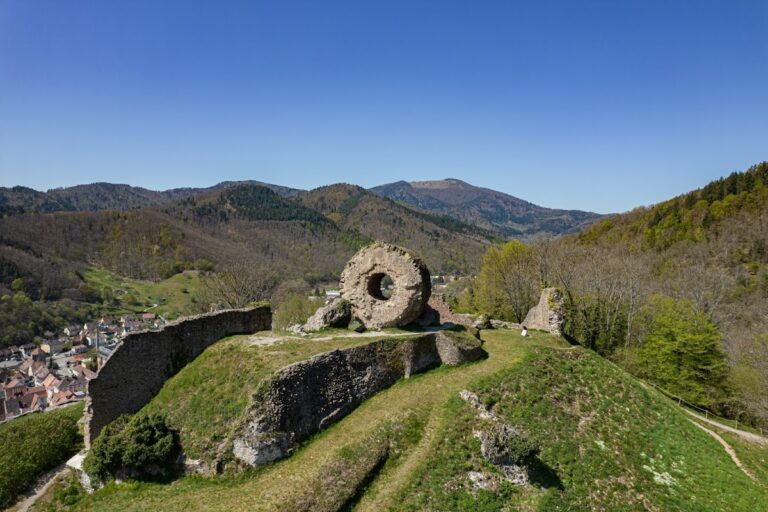
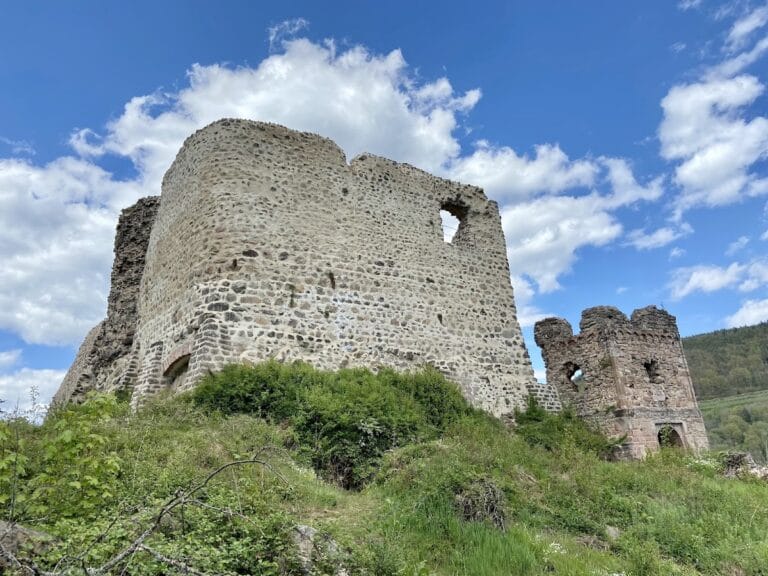
Château de Freundstein stands at approximately 927 metres above sea level on a granite outcrop in Goldbach-Altenbach. The castle’s residential building followed a quadrangular plan, placing the main built area on the rocky summit. Its walls used rubble masonry made from grauwacke, a dark, coarse-grained sedimentary rock formed from sand-sized mineral fragments and pieces of other rocks. Granite was reserved for the more resistant surrounds of doors and windows.
Upper castle and defensive walls
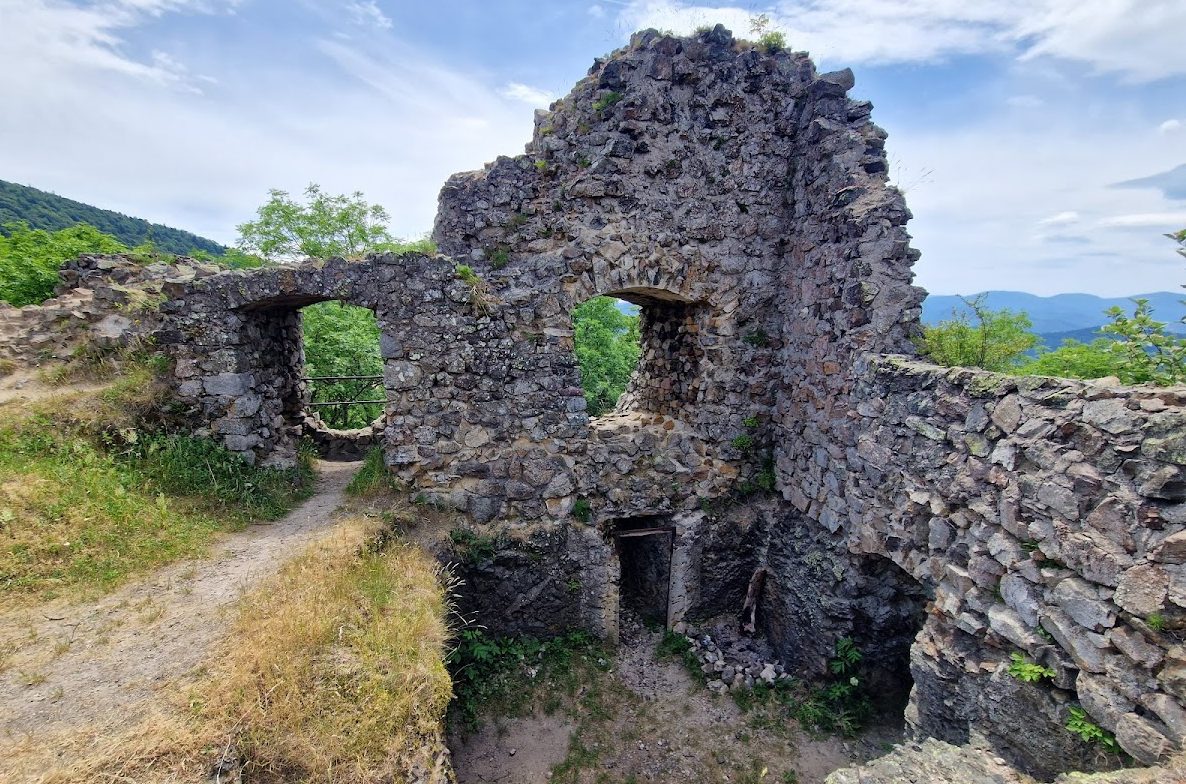
Surviving sections of the upper castle walls preserve loopholes, narrow openings through which weapons could be used while defenders remained protected, together with later openings made in the masonry. The remains also include part of a keep that served both as a defensive tower and as living quarters. Although the castle was built for defense, its architecture remained relatively austere and technically simple, including during its most prosperous period.
Staircase and ruined arrangement
A severely damaged staircase survives among the ruins, but access to it is dangerous. The granite rock supporting the castle is difficult to distinguish in place because it is covered, and the destruction of the buildings makes the original arrangement of the complex difficult to determine. The surviving walls, keep, residential remains, and staircase nevertheless preserve the outlines of a fortified residence whose defensive and domestic functions were combined.
Nearby sites