Reichenstein Castle: A Ruined Medieval Fortress near Riquewihr, France


Site at a Glance
- Rating
- 3.6
- Popularity
- Very Low
- Country
- France
- Primary era
- Medieval
- External website
- Open
- Eras represented
- Medieval
- Civilizations
- Holy Roman Empire
- Site type
- Military
- Remains
- Castle
On this page9 sections
History
Origins and the Lords of Reichenstein
Reichenstein Castle is a ruined medieval hillside fortress in France, near Riquewihr in Alsace. It was built after 1220 and before its first recorded mention in 1255. The castle stood in the Sembach valley, where its elevated position formed part of its defensive purpose.
In 1255, the castle belonged to the Lords of Reichenstein. They were described as robber barons and accused of interfering with local trade, linking the fortress with the conflicts that affected movement and commerce in the surrounding area.
Seizure and later feudal tenure
In 1269, Rudolf I of Habsburg and forces from Colmar seized Reichenstein Castle. Rudolf was German king from 1273 to 1291 and the first Habsburg ruler of Austria. After the capture, some of the occupants were reportedly hanged and others beheaded.
The castle suffered major damage in the Basel earthquake of 1356. In 1457, Count Ludwig of Württemberg granted it as a fief to the Lords of Reichenstein, restoring their feudal connection with the site. This relationship continued until at least 1559, while the Reichenstein family died out shortly before 1575.
The ruin and its modern name
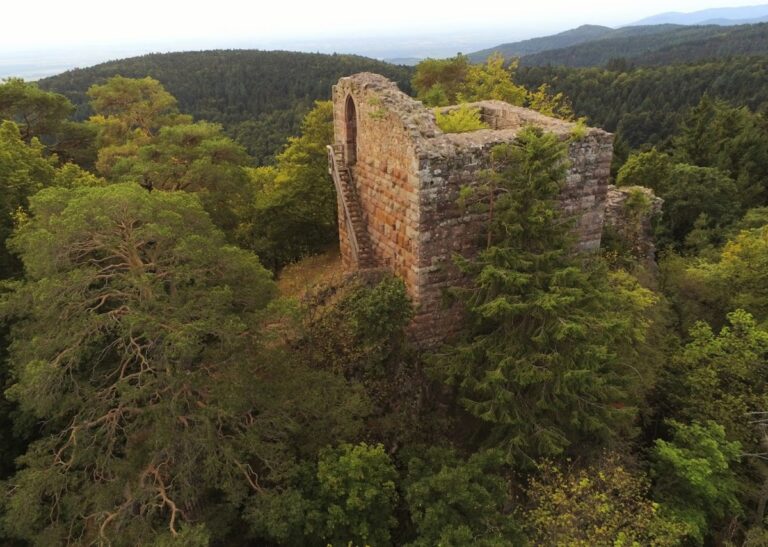
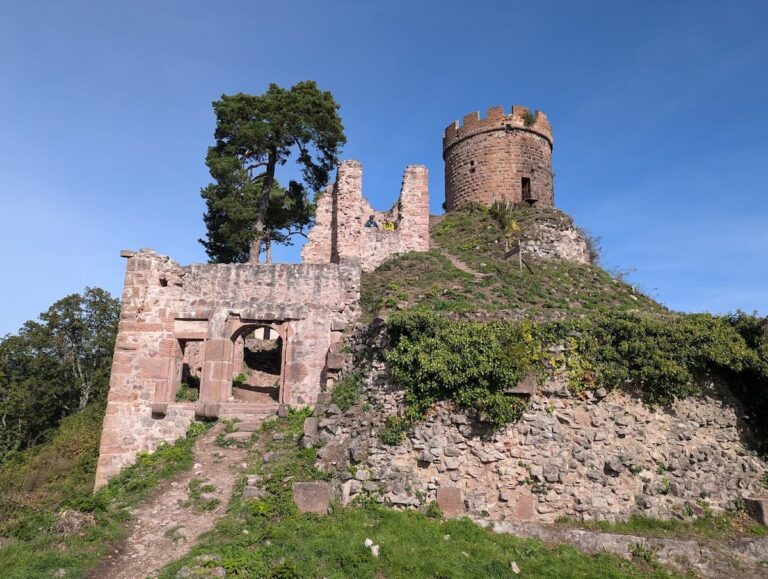
Because the surviving tower dominates the remains, the castle is also known as “La Tour de Riquewihr” and appears under that name on maps. It has been protected as a French Monument historique, a legal designation for a protected historic site or building, since 7 December 1990.
Remains
Keep and defensive enclosure
Pentagonal keep
The principal surviving structure is a pentagonal keep, the main fortified tower of a medieval castle. It rises approximately 15 metres and has an elevated entrance. The tower is surrounded by a deep neck ditch, a defensive ditch cut across the approach to a castle spur.
The keep is built in moyen appareil, a masonry technique using regularly shaped, medium-sized stones laid in relatively even courses. Sandstone bossed ashlar blocks form the corner bonds, while granite rubble makes up the remainder of the masonry. Two large holes at the base were left by nineteenth-century looters.
Enclosure walls
A ruined circuit of an enceinte, meaning a defensive enclosure or circuit of walls, surrounds the keep. The surviving wall remains form the broader defensive framework of the hillside castle.
Northeastern area
A small open area lies northeast of the keep. Further buildings may once have stood there, although this remains a possibility rather than a confirmed part of the castle layout.
Nearby sites