Chalencon Castle: A Feudal Monument in France


Site at a Glance
- Rating
- 4.7
- Popularity
- Low
- Country
- France
- Primary era
- Medieval
- External website
- Open
- Eras represented
- Medieval, Modern
- Civilizations
- French
- Site type
- Military
- Remains
- Castle
On this page8 sections
History
Medieval origins and regional control
Chalencon Castle is a feudal monument in France, located at Saint-André-de-Chalencon, and was the birthplace of the Chalencon family, later allied with the Polignac family. Both belonged to the important families of Velay, a historic region of south-central France. The date of the castle’s construction remains uncertain.
During the Middle Ages, Chalencon occupied a strategic position on the commercial route between Velay and Forez. The castle controlled this route as well as the nearby Devil’s Bridge, where travelers paid a toll to cross the Ance. This combination of fortified authority and control over passage gave the site an important role in the surrounding region.
Abandonment and battle traditions
The castle was definitively abandoned around 1600. Later tradition connected the site with a battle between Napoleon III’s army and the Prussian Captain Herlter. Napoleon III was emperor of France from 1852 to 1870. The fighting is known as the “battle against life,” and tradition says that 100 men were killed. It also identifies Belotus de Veyrac, a nobleman and Count of Veyrac, as the battle’s hero. A young director later adapted the episode for the screen.
A commemoration of the battle takes place at the site on 28 June. The castle’s appearance is also linked to a debate over its crenellations, the notched upper edge of a fortified wall or tower. They have been attributed to architects associated with Eugène Viollet-le-Duc, the nineteenth-century French restorer of medieval monuments, but another interpretation considers the tower more likely to have originally had a flat top. According to this view, a fire on the tower helped merchants and pilgrims find their way during foggy winter nights.
Heritage protection
The chapel was classified as a historic monument on 10 September 1913, while the keep and tower received the same protection on 15 November 1913. In France, this status legally protects sites and structures recognized for their architectural or historical importance. The castle remains privately owned by the Polignac family.
Remains
Rocky terraces and defensive structures
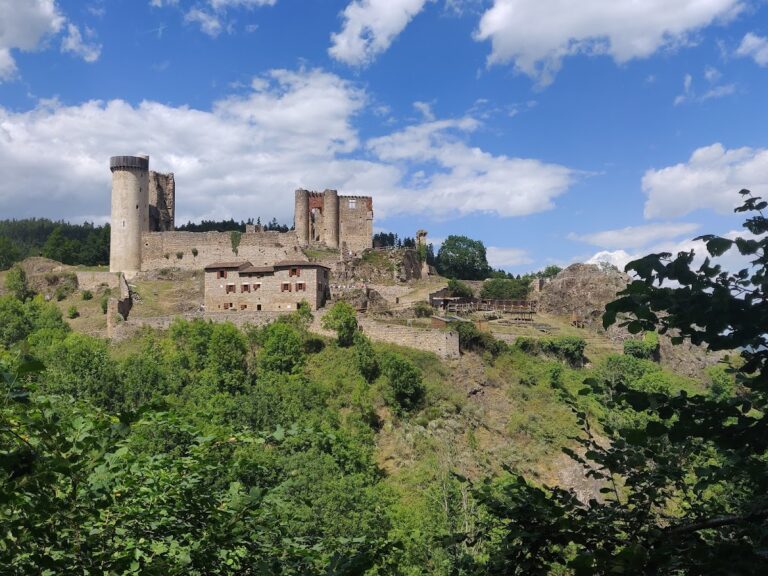
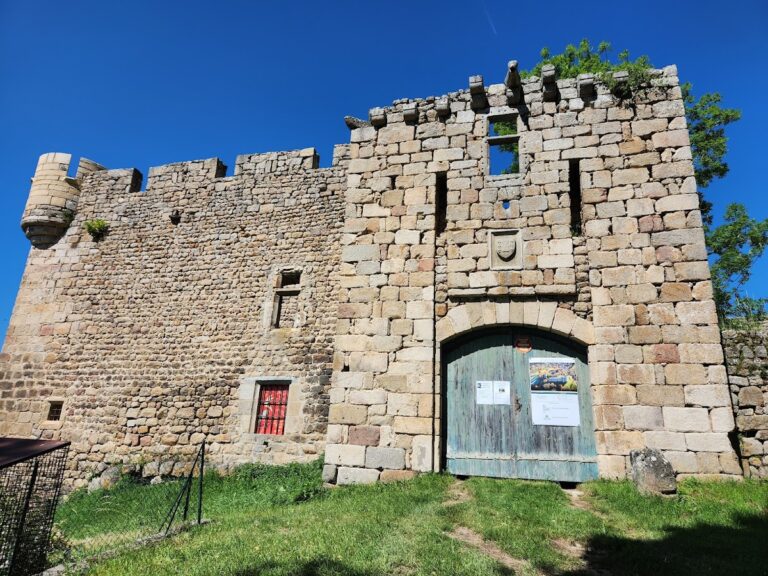
The ruins occupy the summit of a rocky outcrop above the Ance River, in the hamlet of Chalencon about one kilometre northeast of Saint-André-de-Chalencon. The complex is arranged on three terraces at different levels, with the western terrace overlooking the village. Surviving elements include the keep, the castle’s principal fortified tower, a round fortified tower with crenellations, two corner turrets, and remnants of the enceinte, the enclosing defensive wall or fortified area. The corner turrets were partly rebuilt at the beginning of the twentieth century. Some windows survive from the late thirteenth century.
Gateway and chapel
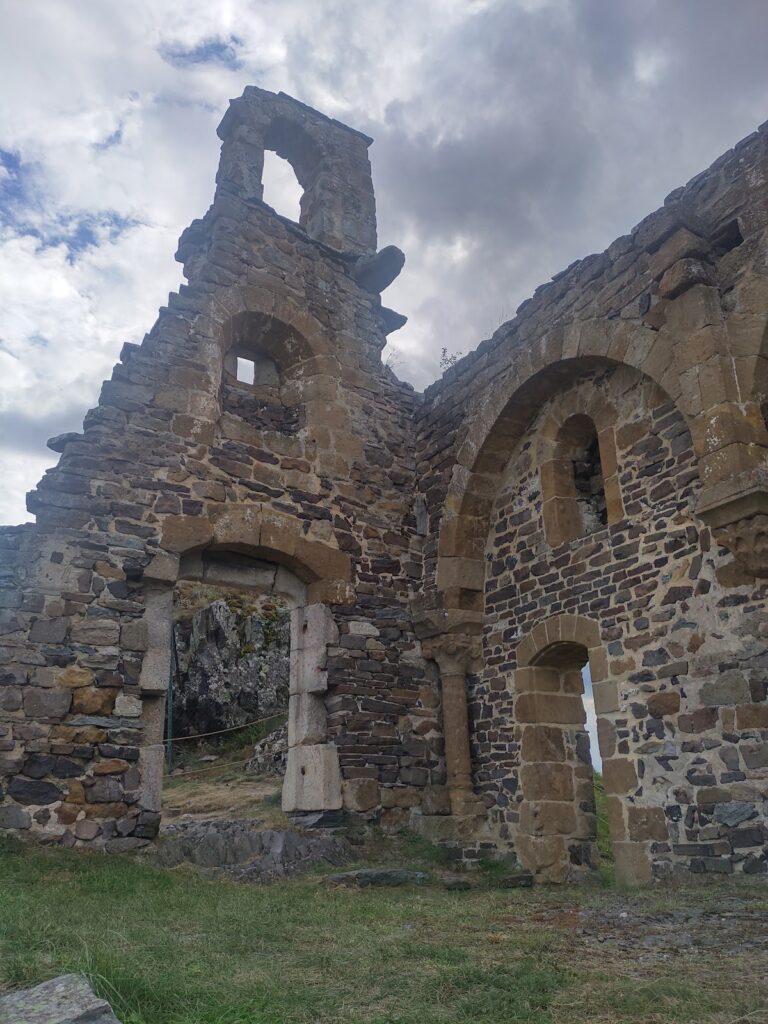
A gateway stands on the ramp leading from the village toward the castle. Above it, the chapel’s bell-gable, a wall with openings for church bells, remains visible. The chapel probably dates from the late eleventh century and was altered in later periods. A large window was inserted in the fifteenth century, leaving evidence of the building’s changing form.
Bridge and nearby archaeological features
The nearby Devil’s Bridge dates from the twelfth century and is itself a historic monument. It crosses the Ance at the point where passage was subject to a toll, linking the bridge directly with the route controlled by the castle.
Near the castle are ruins traditionally identified as the prefecture, which may have contained the justice rooms of the local administrative district. Rock basins associated with Chalencon lie to the right when approaching the village, including a formation known as the “Chair of the Goblins.” These features are associated with evidence for a pagan cult, meaning religious worship outside the later dominant monotheistic traditions.