Chaban Castle: A Medieval Fortress Rebuilt as a Residence
Site at a Glance
- Popularity
- Medium
- Country
- France
- Primary era
- Early Modern
- Eras represented
- Medieval, Early Modern
- Civilizations
- French
- Site type
- Domestic
- Remains
- Castle
On this page9 sections
History
Chaban Castle stands in Saint-Léon-sur-Vézère, France. It began as a thirteenth-century fortress, destroyed toward the end of the fourteenth century, and was rebuilt in the fifteenth and sixteenth centuries. The rebuilt residence includes Renaissance architecture, a European period whose design drew on classical forms, while its seventeenth-century wing reflects Baroque architecture, known for more elaborate and dynamic design.
Fortress and rebuilding
The original fortress was destroyed late in the fourteenth century. Jean I de Calvimont commissioned the rebuilt castle in the fifteenth century, and further construction continued into the sixteenth century. In the seventeenth century, windows and doors in the residential section were altered.
The Calvimont family and later owners
The Calvimont family held the estate for nearly three centuries. Jean I was followed by later family members, including Jean II, Jean III, Jean IV, and Gaspard de Calvimont, who died in 1660. Ownership then passed to François, Vicomte de Losse, a French noble title equivalent to viscount. Later owners included Jean de la Brousse, Jean, Vicomte de Losse, and Aubert Jean Francois Géry d’Abzac, who died in 1828.
Abzac-Lafaye rented the castle from 1817 to 1832. Afterward it changed hands repeatedly. Owners included Jean Baptiste Dubois, head of the Périgueux post office, Clément Dulac, Henri Cazelles, and Étienne Puyalto, as well as agricultural companies. Bernard Benson was also an owner.
Resistance, protection, and restoration
In 1943, French Resistance figure Jacques Chaban-Delmas changed his codename from Lakanal to Chaban after seeing the castle’s name on a sign while walking. The French Resistance comprised movements opposing German occupation during the Second World War. On 12 August 1944, resistance fighters established at the castle the general staff opposing German occupation in the Dordogne.
The castle’s façades and roofs have been protected as a French historic monument since 17 February 1972. David and Marie-Joëlle Crichton-Watt acquired the property in 1987. Marie-Joëlle Crichton-Watt then led a sixteen-year restoration and rebuilding project, which included reconstructing the round tower’s roof framework and beginning to recreate the vanished Baroque gardens. An exhibition in the castle presents stages of this work.
Remains
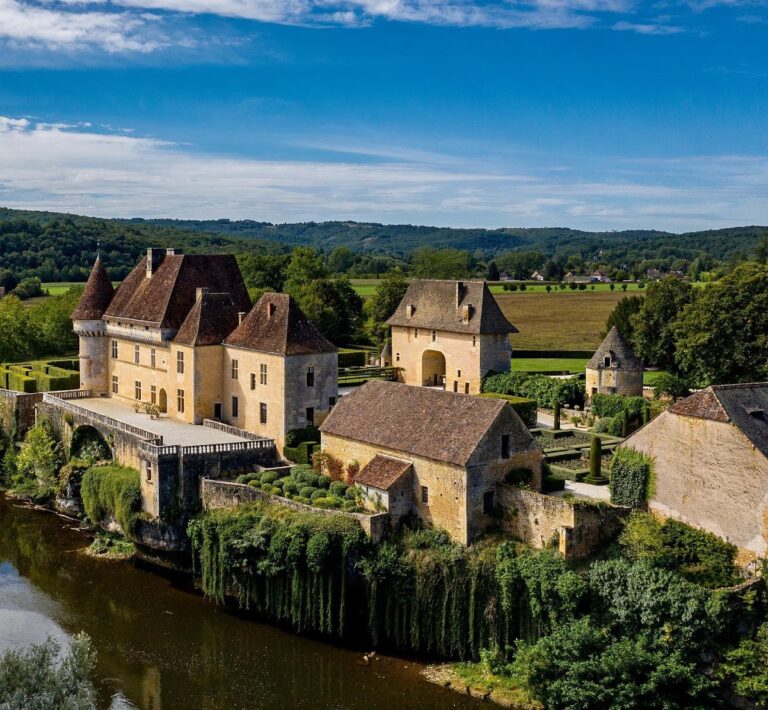
The castle stands at the highest point of the Côte de Jor, overlooking the Vézère valley. Its park borders the river, with estate lands and truffle woods adjoining the park. The buildings form a rectangular arrangement around an inner courtyard.
Courtyard complex
Main residence
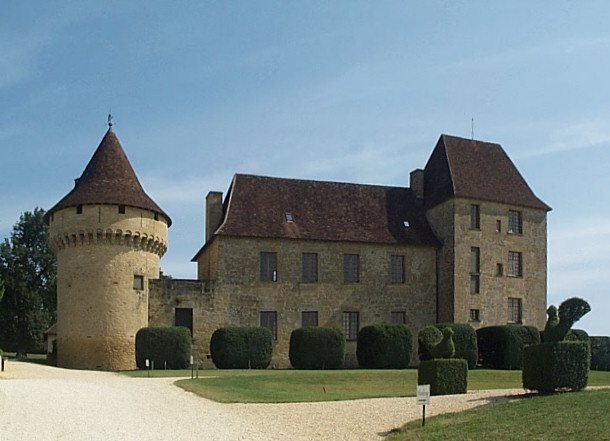
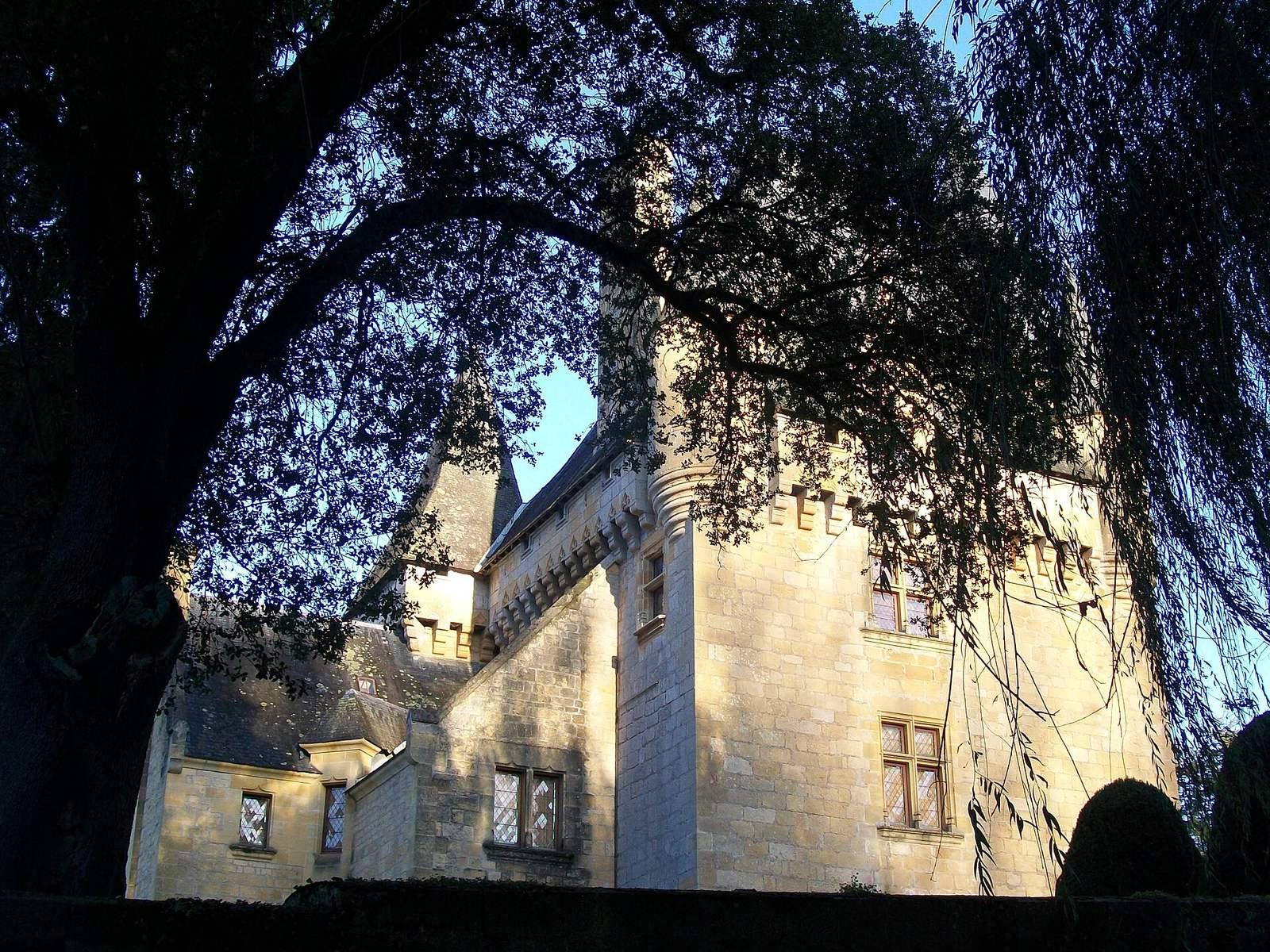
The two-winged main residence occupies the complex’s western corner. Its three-storey northwest wing dates to the seventeenth century and is Baroque in style. A polygonal stair tower stands on the courtyard side, and a hipped roof covers the wing’s upper storey. At a right angle, a four-storey pavilion tower joins this wing to an older, three-storey Renaissance wing dating to the sixteenth century.
Towers and service building
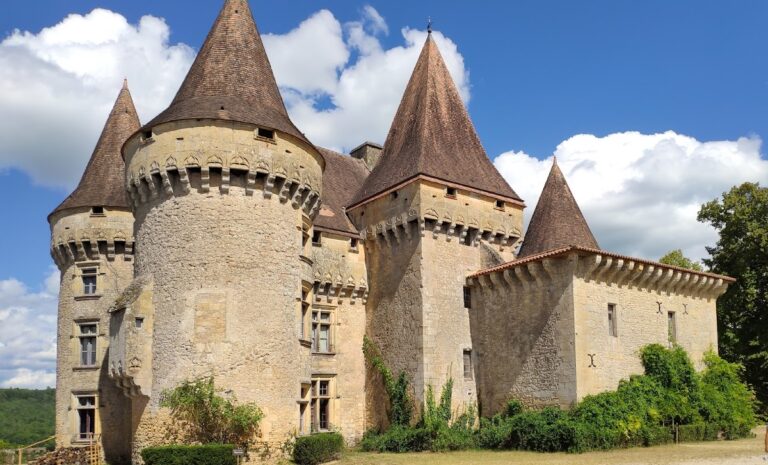
A short, single-storey passage links the Renaissance wing to a massive round tower, described as the oldest surviving fabric in the complex, although its construction date is uncertain. The tower has a roof with a kinked profile and connects by a wall to the former service building in the southeast. A square tower and the round tower are also associated with the earlier thirteenth-century fortress.
Interiors and collections
The rooms contain furnishings dating from the fifteenth to seventeenth centuries, along with tapestries and embroidery. Some rooms have stained-glass windows, the oldest pieces dating to the fifteenth century. The stained-glass collection is regarded as one of France’s most important private collections of its kind.