Château de Bruzac: Twin Fortified Castles in France


Site at a Glance
- Rating
- 4
- Popularity
- Very Low
- Country
- France
- Primary era
- Medieval
- Eras represented
- Medieval, Early Modern
- Civilizations
- French
- Site type
- Military
- Remains
- Castle
On this page8 sections
History
Château de Bruzac is a fortified castle in Saint-Pierre-de-Côle, France, constructed in stages from the twelfth to the sixteenth century. Its history is tied to the Flamenc family, the viscounts of Limoges and Rochechouart, and the changing feudal control of the Bruzac estate.
Origins and divided lordship
Hélie Flamenc, regarded as the first lord of Bruzac, appears in 1040 in a donation to Uzerche Abbey made with his wife, Attiburge, who was the sister of the bishop of Limoges. Their son Guy later appears as a donor to the monastery of Vigeois in 1112 and 1143.
In 1243, Guy VI, Viscount of Limoges, acknowledged that he held half of the castle and the honor of Bruzac from the bishop of Angoulême. An inheritance the following year led the Flamenc brothers to divide the site. Two adjoining castles probably developed from this division, creating a co-lordship, meaning a lordship held jointly by more than one lord.
A dispute over control of this shared lordship arose in 1258 between the Viscounts of Limoges and Rochechouart. Guy VI of Limoges obtained Lower Bruzac, whose lords Raoul and Bernard Flamenc entered his vassalage, a formal relationship in which a subordinate lord held land in return for allegiance and service. Aimery IX, Viscount of Rochechouart, obtained Upper Bruzac, whose lord was Hélie Flamenc. By the end of the thirteenth century, Lower Bruzac had passed to Hélie de Neuville.
War and changing ownership
During the Hundred Years’ War, the prolonged conflict between the English and French crowns from the fourteenth to the fifteenth century, English forces occupied Bruzac. The lord of Albret, serving as Constable of France, the kingdom’s senior military officer, expelled them in 1404–1405. In 1451, the Viscount of Limoges acknowledged that Upper Bruzac was held from the Viscount of Rochechouart.
Jean de Gontrand, lord of Biron and Bruzac from 1541, transferred Lower Bruzac to Geoffroy de La Marthonie in 1547. In 1583, the future King Henry IV granted it to his adviser Philippe Duplessis-Mornay, dispossessing the La Marthonie family. The family was again recorded as proprietor in 1667.
Through marriage, Lower Bruzac later passed to the family of the Baron of Beynac and then, in 1764, to César Phœbus François, Count of Bonneval. In 1773, Christophe Marie de Beaumont du Repaire married Marie-Claude de Beynac, an heiress of Marie de La Marthonie, and Lower Bruzac passed to the Beaumont du Repaire family.
Abandonment and preservation
The owners emigrated during the French Revolution in 1793. The castle was then abandoned and used as a stone quarry. Upper Bruzac had been occupied by Jean de Marqueyssac in 1602, a fact used to argue that Protestant forces had not destroyed it. Pierre-Henri Ribault de Laugardière instead proposed that it was dismantled during the Fronde, a series of rebellions and civil conflicts in France between 1648 and 1653, when the region was controlled by troops of the Prince of Condé. Upper Bruzac later served as a stone quarry after 1793.
The ruins were listed as historic monuments on 27 September 1948 under France’s legal system for protecting buildings and sites considered to have historical or architectural importance. The property remains privately owned.
Remains
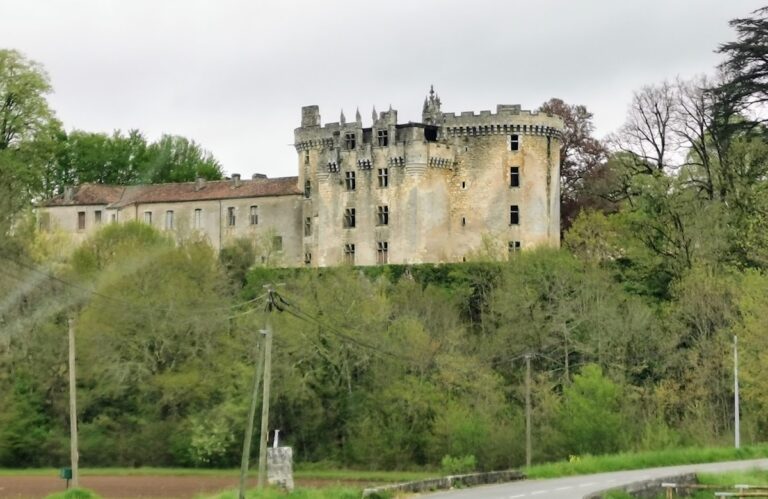
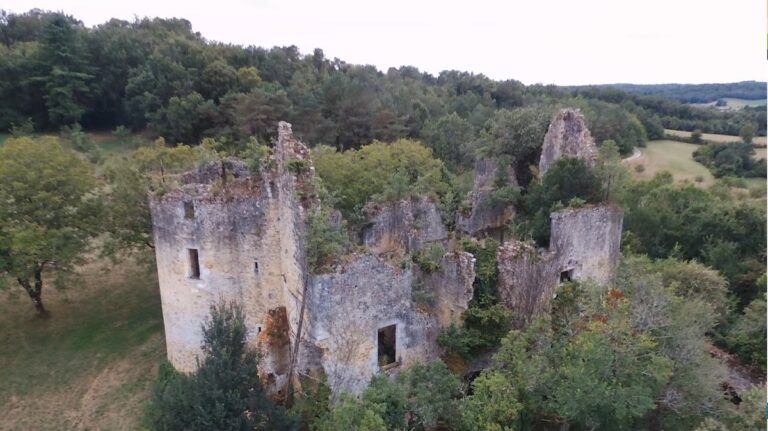
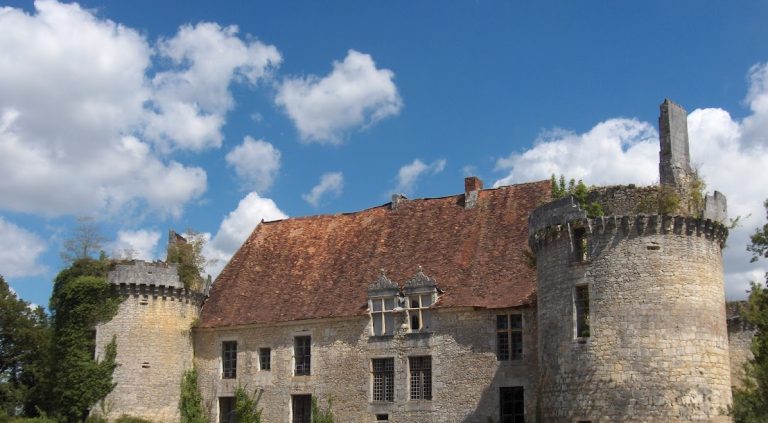
Château de Bruzac now survives as the ruins of two former castles standing side by side, Lower Bruzac and Upper Bruzac. The complex dominates the Côle valley, with the river flowing immediately below it. The surviving remains include the ruins of Lower Bruzac, the interior of its tower, the ruins of Upper Bruzac, and the recorded site of Upper Bruzac’s former drawbridge.
The two castle sites
Lower Bruzac
The remains of Lower Bruzac include the ruined castle and the interior of its tower. These surviving elements form part of the lower of the two adjoining fortified sites.
Upper Bruzac
Upper Bruzac survives in ruin beside Lower Bruzac. Its former drawbridge is identified at the site, providing a physical indication of the castle’s entrance arrangement.