Villars Cave: A Paleolithic Cave and Rock-Art Site in France
Site at a Glance
- Popularity
- Medium
- Country
- France
- Primary era
- Stone Age
- Eras represented
- Stone Age, Modern
- Civilizations
- French
- Site type
- Civic
- Remains
- Rock Art
On this page12 sections
History
Villars Cave is a prehistoric cave in the commune of Villars, France. Early modern human hunter-gatherers, traditionally called Cro-Magnon people, occupied it during the Lower Magdalenian, a phase of the Late Upper Paleolithic in western Europe. Its paintings are assigned to the Older Magdalenian and the second phase of André Leroi-Gourhan’s Style III classification of Paleolithic art; their estimated age is roughly 17,000 years before present (BP, conventionally counted from AD 1950). The cave was abandoned about 17,000 years ago.
Paleolithic occupation and art dating
A burnt tooth from a hearth beneath the Man and Bison scene yielded a radiocarbon date of about 18,000 BP. Stylistic comparison of that scene with works at Lascaux and Roc-de-Sers places it in an estimated range of 18,000 to 17,000 BP.
Discovery and investigation
Members of the Spéléo Club de Périgueux, a cave-exploration group, found the cave in December 1953 after noticing steam rising from a fox burrow. They enlarged the opening and uncovered the entrance. Cave-bear scratch marks were noticed in 1956. Pierre Vidal recognized the paintings in 1957 and informed Henri Breuil, who examined them and confirmed their authenticity.
Breuil, André Glory, and François Bordes investigated Villars Cave in 1958. André Leroi-Gourhan followed in 1959, and Brigitte and Gilles Delluc studied it in 1970. The cave received French historic-monument status in 1958.
Remains
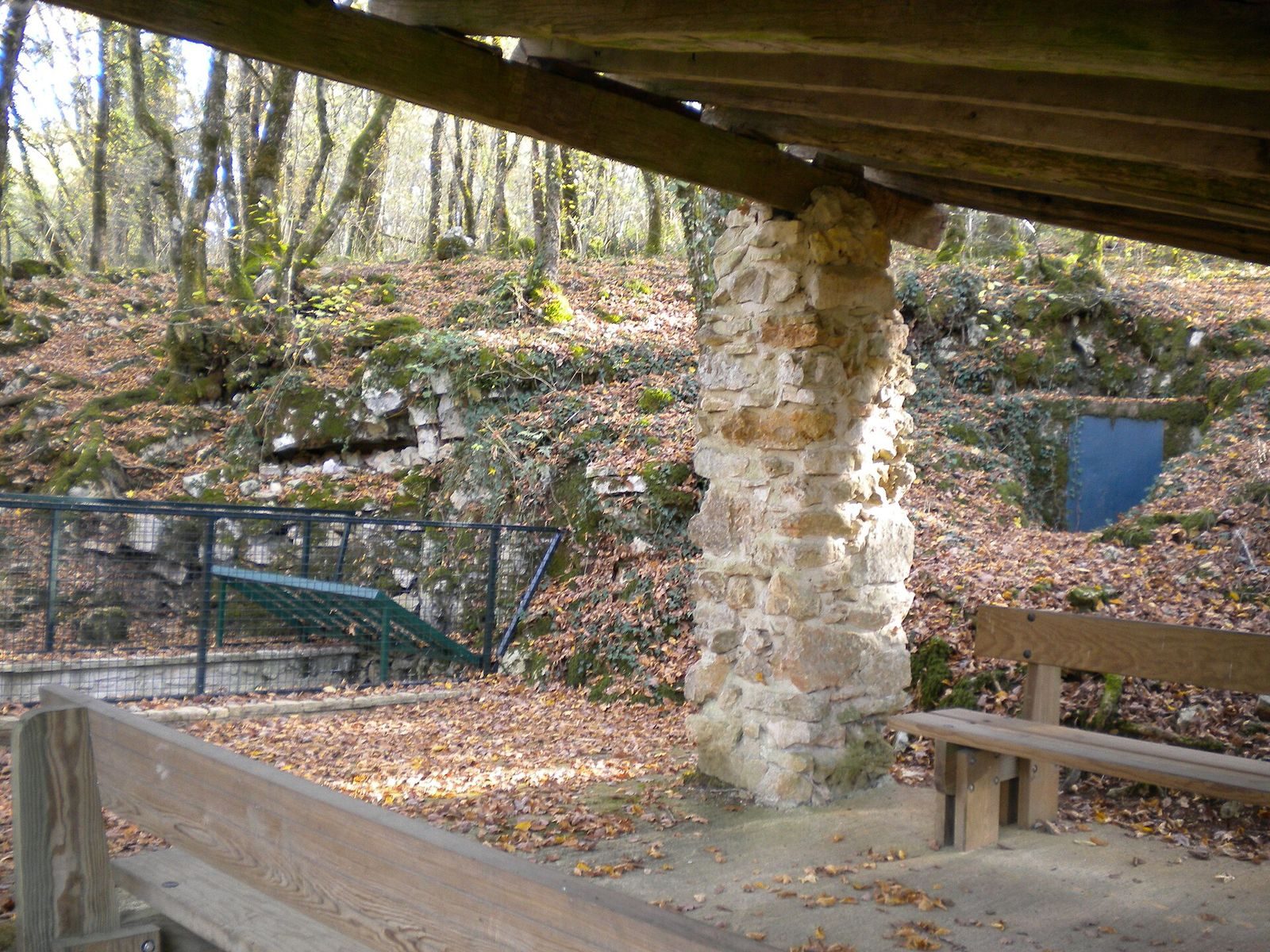
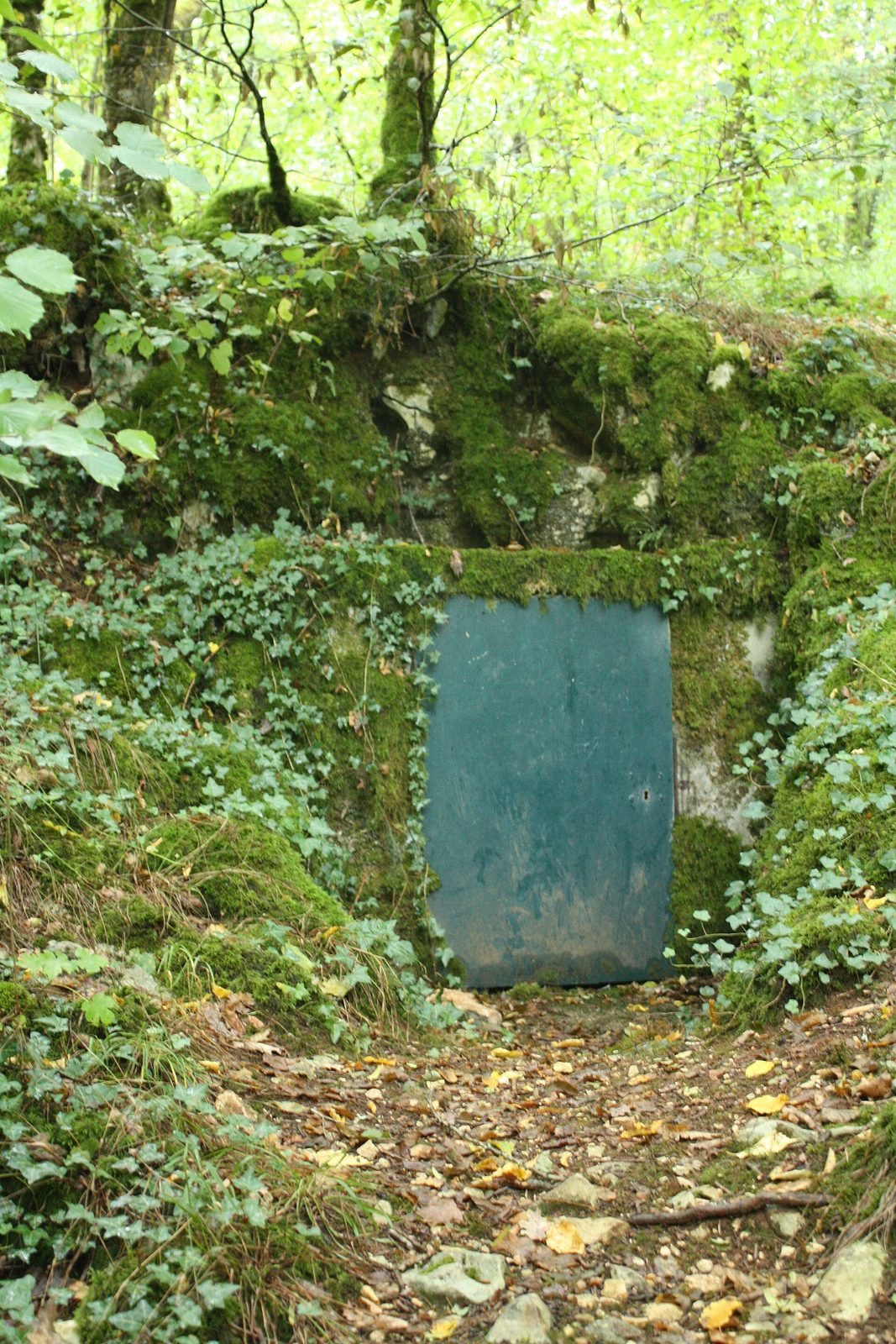
Villars Cave is a multi-level limestone system with about 13 km of passages, including branching corridors, decorated chambers, and extensive mineral formations. Its entrance area lies about 3.5 km northeast of the village of Villars and 500 m north-northeast of the hamlet of Le Cluzeau.
The cave formed in Upper Bajocian Jurassic oolitic limestone, a rock made of small rounded grains. During the Quaternary, underground water containing carbonic acid dissolved the limestone. A southeast-trending fault across the valley may have helped shape the cave system, which trends in a similar direction. The entrance is around 170 m above sea level, on the left-hand slope of the Ruisseau de l’Étang Rompu, a tributary of the Trincou.
Passages and chambers
Entrance and branching passages
The present entrance lies about 10 m northwest of, and slightly below, the original entrance. A steep stone staircase descends to it. From there, a passage running roughly 40 m southeast reaches a junction with three branches. One continues southeast for about 130 m, passing through the Holy Water Fonts Room toward the Great Balcony. A second runs northeast and then north-northeast through the 10 m Candle Room and the 30 m Painting Room, ending at an exit. The third branch runs southeast for roughly 50 m, turns south-southeast beyond the Scratch-Marks Room, and rejoins the first passage before the Great Balcony.
Holy Water Fonts and Chaos rooms
A descending slope from the junction leads into the Holy Water Fonts Room, which contains stalactites hanging from the ceiling and stalagmites rising from the floor. Two large calcite basins resemble holy-water fonts. The room extends northwest into the Chaos Room, where a partial ceiling collapse scattered large limestone blocks and slabs across the floor. Thick calcite formations later covered parts of the debris. The Chaos Room is about 30 m long and up to 15 m wide; its western end can be viewed from the higher adjoining room.
Art and evidence of use
Entrance passage and Candle Room
Cave-bear scratch marks run along the right wall of the entrance passage, where painted dots and strokes also appear singly and in groups. The entrance area contains stalactites, stalagmites, columns formed where the two meet, hanging curtains of mineral deposits, wall coatings, thin hollow formations, and large calcite basins. In the Candle Room, dots and strokes accompany a 40 cm bison, a horse’s head, and a bovine figure. A narrow passage between this room and the Painting Room was widened to ease access, damaging some calcite formations.
Painting Room
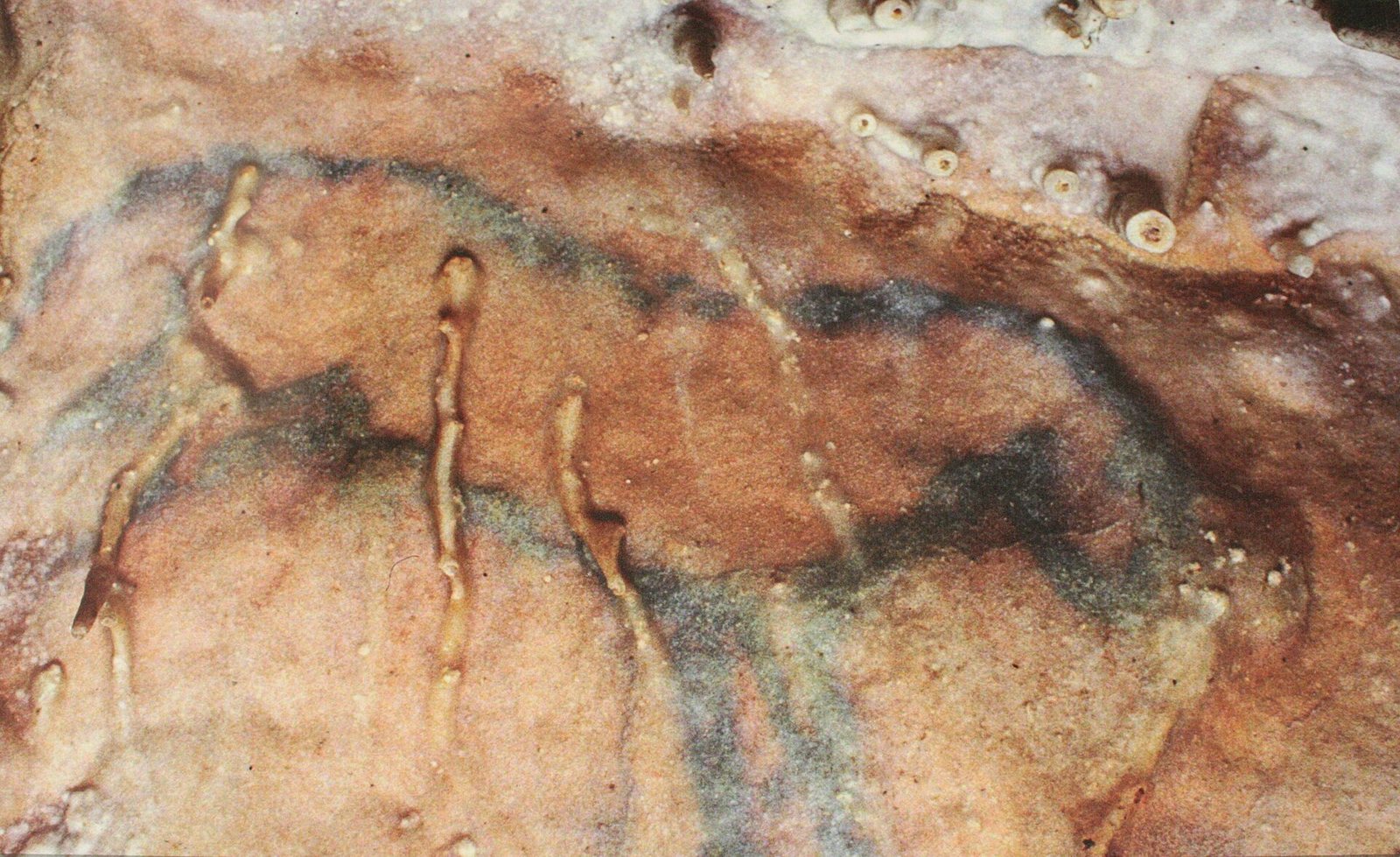
The Painting Room contains most of the cave’s art, including the Horse Fresco, the Little Blue Horse, and the Man and Bison scene. About 30 paintings, each no more than 50 cm across, were made using black manganese oxide mixed with animal fat. A thin, milky calcite coating gives many images a blue appearance and has helped protect them from external influences. The room also contains engravings, schematic female figures, red ochre dots, and geometric signs, including staff-like, cross-shaped, hooked, and spiked forms. Depicted animals include horses, bovines, bison, ibex, and a deer’s head; one scene shows a human figure attacked by a bison. Mineral formations, some intergrown, also occur in the room.
Other traces of human activity
Evidence of human activity includes toppled or broken calcite formations and stalagmites, flint flakes, bone fragments mainly from reindeer, a reindeer antler, and remains of ochre and manganese pigments. Bowl-shaped calcite formations served as pigment containers.
Stalagmite climate record
A 1.5 m stalagmite from the lower level was dated by uranium-thorium analysis, a method for estimating the age of calcium-carbonate cave deposits, to between 81,100 and 29,800 BC. Seven interruptions in its growth have been identified, three marking pauses. A pronounced pause from 65,400 to 59,000 BC indicates a very cold, dry interval associated with a Heinrich event, a period of major iceberg discharge during a glacial period. Two other interruptions point to very humid conditions when the cave flooded. The stalagmite’s carbon-13 record supports findings from Greenland ice cores and helps date Dansgaard-Oeschger events, abrupt climate fluctuations, from DO6 to DO20. DO12, around 44,000 to 43,000 BC, is especially distinct, and growth rates at that time were already similar to those of today. Its oxygen-18 values are comparable with records from Soreq Cave in Israel and from marine environments.