Château de Bayers: A Fortified Château in France


Site at a Glance
- Rating
- 4.3
- Popularity
- Very Low
- Country
- France
- Primary era
- Medieval
- External website
- Open
- Eras represented
- Medieval, Early Modern
- Civilizations
- French
- Site type
- Domestic
- Remains
- Castle
On this page8 sections
History
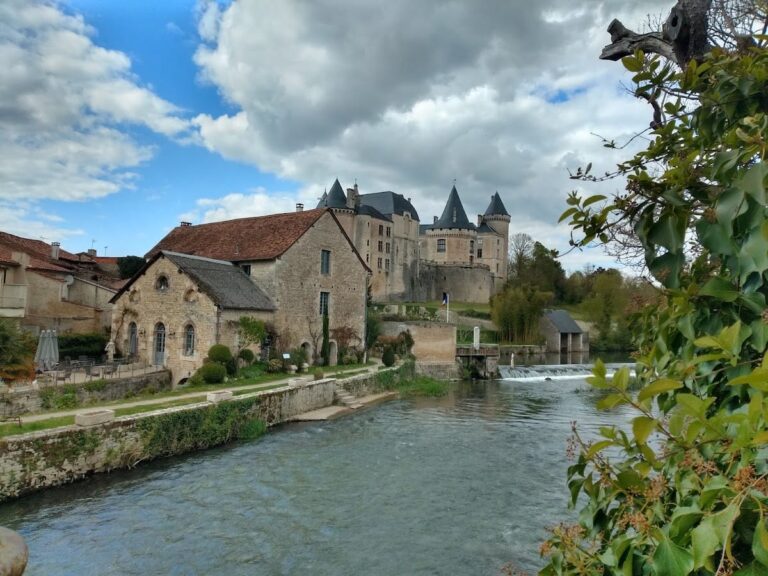
Château de Bayers is a fortified château in France, at Bayers within the commune of Aunac-sur-Charente, overlooking the Charente River about 30 kilometres north of Angoulême. Its present form emerged from a medieval fortress during the fifteenth century, after the earlier stronghold had monitored a river crossing and suffered damage during the Hundred Years’ War.
Medieval fortress and La Rochefoucauld ownership
A fortified quadrangular castle stood at Bayers in the eleventh century, guarding a ford across the Charente. The Hundred Years’ War, a prolonged conflict between the English and French crowns that affected much of France from the fourteenth to the fifteenth century, brought partial destruction to the castle.
In 1295, Bayers passed to a younger branch of the French noble La Rochefoucauld family. This line later became known as the La Rochefoucauld-Bayers branch. Guillaume de La Rochefoucauld began converting the medieval fortress into the present château in 1434. The loss of nearly all the archives has made the building’s subsequent history difficult to reconstruct.
Early modern transformation
During the seventeenth century, the La Rochefoucauld-Bayers family laid out a French garden on a terrace above the river. Guy André Pierre de Montmorency-Laval, an eighteenth-century French nobleman who became the 1st Duke of Laval, was born at the château in 1723.
After the Marquis of Bayers died in 1745, Marie-Louise-Françoise de La Rochefoucauld-Bayers, the family’s last owner, sold the château to Jean-Michel Delage during the eighteenth century. The property was already in poor condition. Delage, governor of Angoumois, died in 1793 before he could restore it. In 1803, following the French Revolution, his widow sold the divided estate and château to several owners.
Decline, restoration, and protection
Years without maintenance led to the château’s progressive ruin during the nineteenth century and the first half of the twentieth century. In 1950, the penultimate owner brought the château back into a single holding, but his sudden death left the residence sealed. It was opened for sale again in 1976, after which the current owners acquired it with the intention of restoring it.
Major restoration campaigns in the 1980s repaired the château and its surviving buildings, with the work completed during that decade. Château de Bayers received partial protection as a French registered historic monument on 18 September 1989. Protection was extended to all buildings forming the château on 22 April 2003, and to the former garden, orangery, and surrounding walls on 22 April 2004.
Remains
Fortifications and courtyard
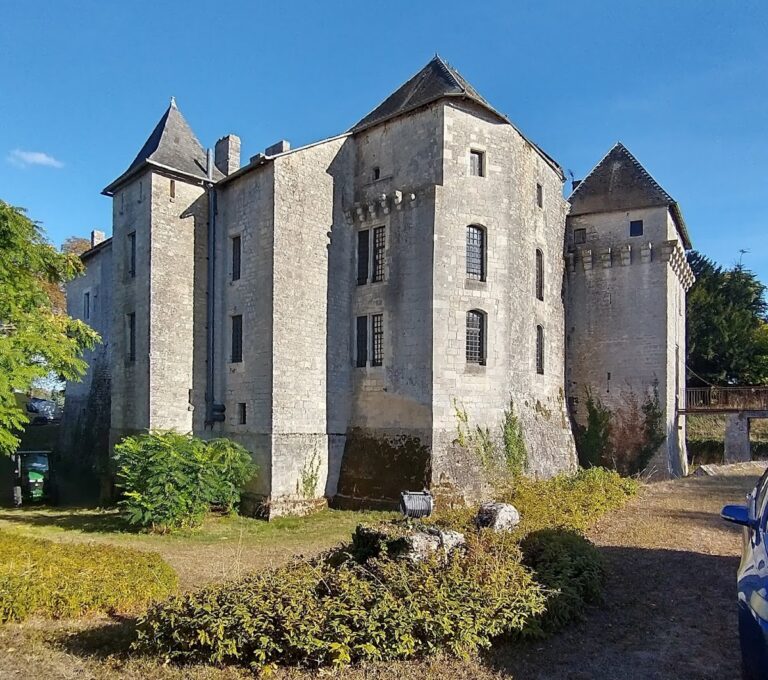
The fifteenth-century château occupies the site of a castle mound, a raised earthwork that supported a fortified residence or keep, and reused parts of the earlier defenses. The former mound remains visible in the curve of the enclosing wall. Dry moats surround the château and also provided material for its construction. Within them, a curtain wall encloses the courtyard. Its covered wall-walk, projecting corner turret carried on corbels, and small chamber supported by projecting masonry supports preserve elements of the defensive arrangement.
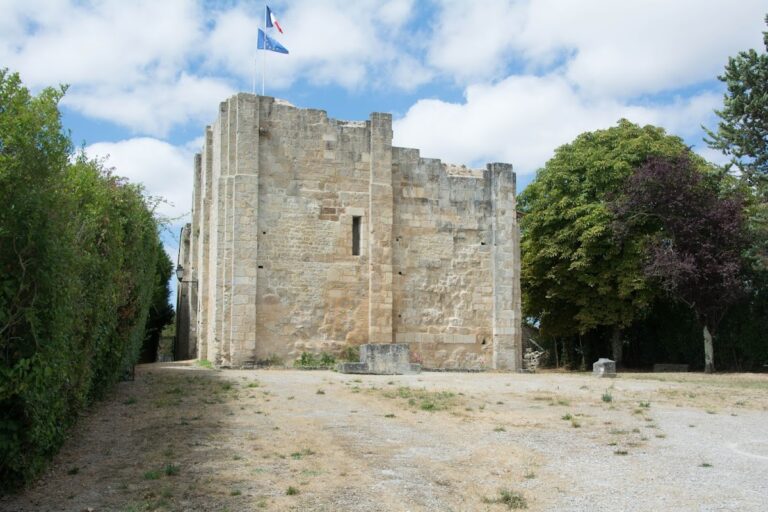
At one corner of the courtyard stands part of a twelfth-century square keep, reinforced with flat buttresses. This surviving fragment records an earlier stage of the site’s fortifications within the later château.
Residential buildings
The main residential building is rectangular and runs parallel to the Charente. A large round tower rises at one corner, with crenellations and a conical roof covered in flat tiles. On the courtyard side, the façade includes both a square stair tower and a polygonal stair tower. An earlier L-shaped building has disappeared.
Garden buildings and chapel
Outside the enclosing wall stands a round dovecote whose roof has been lost. The old garden occupies the terrace overlooking the Charente, while an orangery and the surrounding enclosure walls form part of the associated grounds. The church of Bayers is the former chapel of the castle.
Nearby sites