Castle of Verteuil: A La Rochefoucauld Fortress and Residence in France


Site at a Glance
- Rating
- 4.4
- Popularity
- Low
- Country
- France
- Primary era
- Medieval
- Eras represented
- Medieval, Early Modern, Modern
- Civilizations
- French
- Site type
- Military
- Remains
- Castle
On this page18 sections
History
Castle of Verteuil, in Verteuil-sur-Charente, France, was a medieval stronghold and residence of the La Rochefoucauld family, first recorded as their property in 1080. Rising above the town and the Charente valley, it controlled the road from Limoges to La Rochelle and a route linking the courts of France and Spain. It later became the family’s fortified residence in Angoumois and remained in La Rochefoucauld ownership for almost a millennium, apart from brief interruptions, until its sale was completed on 5 July 2021.
Medieval lordship and conflict
The first recorded successful siege occurred in 1135, when Count Wulgrin II of Angoulême captured Verteuil from Aymar II de La Rochefoucauld. Conflict between their descendants continued until 1170, when William VI of Angoulême and Guy IV de La Rochefoucauld publicly reconciled during the consecration of the church at Saint-Amant-de-Boixe.
Verteuil was also associated with the French monarchy from an early period. Louis VII and Eleanor of Aquitaine may have stayed at the castle in 1137 while traveling from Bordeaux to Paris. King Philip VI certainly stayed there in 1332.
During the Hundred Years’ War, the prolonged conflict between the English and French crowns from 1337 to 1453, Verteuil repeatedly changed hands. The Treaty of Brétigny assigned it to the English in 1360. On 25 October 1361, the castle was formally surrendered to Edward III’s representative, John Chandos, after the brother of its garrison commander was threatened with execution.
French forces led by the Duke of Bouillon and Geoffroy III de La Rochefoucauld besieged the castle in 1380. Verteuil surrendered five years later, although English forces later recovered it. Charles VII finally recaptured the stronghold in 1442.
Rebuilding and the fifteenth-century barony
The La Rochefoucauld family supported the struggle against the English, but its forces also ravaged the lands around Angoulême during the Praguerie, a fifteenth-century revolt by powerful French nobles against Charles VII. The king consequently attacked Verteuil again. Much of the castle was destroyed by fire, and the family was compelled to rebuild it, reusing stone recovered from the original structure.
In 1446, Guillaume de La Rochefoucauld received a royal pardon and permission to build a defensive wall and two additional towers. Verteuil’s fortifications were reconstructed and strengthened with contemporary methods. During the fifteenth century, the lordship was raised to a barony, a higher-ranking feudal lordship, and comprised 16 parishes and 62 fiefs, or estates held from a superior in return for obligations.
Renaissance residence and religious conflict
During the sixteenth century, Anne de Polignac, widow of François II de La Rochefoucauld, expanded and reconstructed the castle and established its celebrated library. François I visited in 1516, and Anne received Emperor Charles V there on 6 December 1539. Henry II stayed at Verteuil in 1558 with his children Charles, Duke of Orléans, and Elizabeth.
François III de La Rochefoucauld organized a meeting at Verteuil in 1560 between Louis, Prince of Condé, and Cardinal Georges d’Armagnac, the papal legate, in an effort to prevent further bloodshed. François III joined the Protestant cause in 1562. The sixth national synod of the Reformed Church of France met at the castle in 1567, and the following year Verteuil became a rallying point for Huguenot troops, French Protestants associated with the Reformed tradition, who were going to aid La Rochelle.
The castle continued to receive prominent visitors during the sixteenth and seventeenth centuries, including Henry IV, Catherine de’ Medici, Margaret of Valois, Louis XIII, Anne of Austria, and Marie de’ Medici. Elisabeth Farnese, the second wife of Philip V of Spain, later spent time there. In 1787, the English agronomist Arthur Young praised the estate’s agricultural improvements.
The Fronde and the destruction of 1650
In 1650, François VI, Duke of La Rochefoucauld, gathered more than 2,000 knights at Verteuil and led them to Bordeaux in support of the nobles of the second Fronde. The Fronde was a series of revolts against the French monarchy, especially during the minority and early reign of Louis XIV. Royal troops commanded by Charles de La Porte, Marshal of France and Duke de La Meilleraye, then captured the castle.
The assault destroyed the orangery and partly demolished the complex. Northern walls were damaged, towers were dismantled, the drawbridge was removed, and the deep northwestern ditch was partly filled. Verteuil remained habitable, but it ceased to function as a major fortress, and a royal garrison of 150 men was installed there.
Louis XIV exiled François VI after the revolt. François returned to Verteuil in 1652 and spent much of his time there writing his memoirs until 1659. He regained royal favor in 1662, and his Maximes was published in 1665. After his death in Paris in 1680, he was buried in the Franciscan chapel at Verteuil.
The chapel, Revolution, and nineteenth-century restoration
Jean de La Rochefoucauld founded the Franciscan chapel in 1470. His successors were buried there until the beginning of the Reign of Terror in 1793, the most violent phase of the French Revolution. At the Revolution’s outbreak, relations between the La Rochefoucauld family and the inhabitants of Verteuil were reportedly good. Nevertheless, the Committee of Public Safety at Ruffec and Convention member Gilbert Romme were associated with the burning of most of the castle archives and thirty portraits of the family.
A major fire in 1793 destroyed the gallery connecting the chapel to the northern tower and seriously damaged the western face of the central tower. Flames spread through the roofs and turrets of the northwestern wing and burned the upper part of the northern tower. The chapel was looted, while most floors, fireplaces, doors, windows, and woodwork were destroyed. Its crypt, a chapel or burial space below a church, survived.
Hippolyte de La Rochefoucauld reacquired the castle after the Revolution. From after 1815, the La Villéons carried out extensive repairs in the Romantic style associated with the Bourbon Restoration, the return of the Bourbon monarchy after Napoleon’s fall. During the Second French Empire, the regime of Napoleon III from 1852 to 1870, further changes focused mainly on the interiors.
Influenced by Eugène Viollet-le-Duc, Hippolyte converted the eastern tower into a library. His son Aimery and grandson Gabriel continued the transformation of Verteuil into a luxurious residence and family museum. Aimery’s friendship with Marcel Proust helped inspire traits of several Proustian characters.
War, archaeology, and later ownership
During the Second World War, French troops and refugees from Alsace-Lorraine were housed at the castle after arriving in 1940. German units occupied part of it for several months, and members of the French Resistance maquis, rural resistance groups active during the war, hid there in 1944.
Archaeological research begun by Count Gabriel de La Rochefoucauld before the war resumed afterward. It revealed buried parts of the castle from the twelfth and thirteenth centuries, including the room for the drawbridge mechanism, and uncovered a twelfth-century stairway leading to an eleventh-century lower chapel whose existence had been unknown before 1958.
Castle of Verteuil was listed as a French historic monument on 31 March 1966. The initial protection covered its facades, roofs, and roof structures. Full protection was later extended to the castle, interior courtyard, and adjoining northern land because of their archaeological potential.
Anne de La Rochefoucauld, Marquise de Amodio, owned the castle during the later twentieth century. In 1958, she founded the Vieilles Maisons Françaises heritage-protection association and directed it until her death in 1980. Count Sixte de La Rochefoucauld-Estissac later succeeded her at Verteuil. The castle was officially placed on the market in August 2020, and the sale was completed on 5 July 2021. An auction afterward dispersed part of its furniture through 230 lots, including a Boulard-stamped armchair reputed to have belonged to the Duchess of Richelieu.
Remains
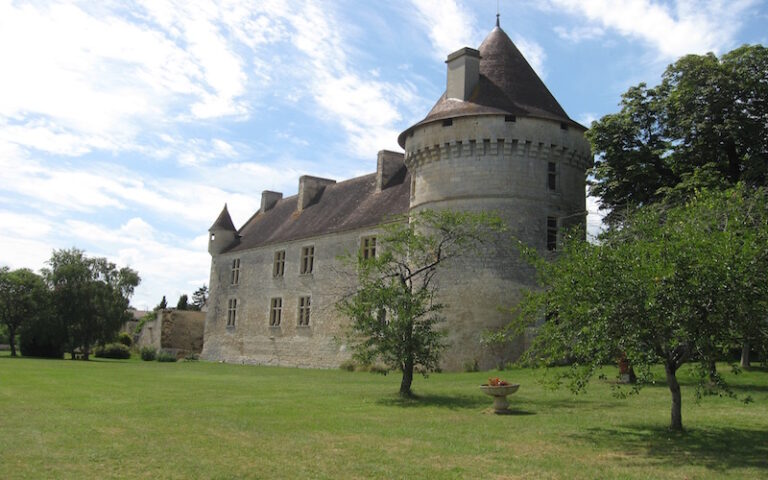
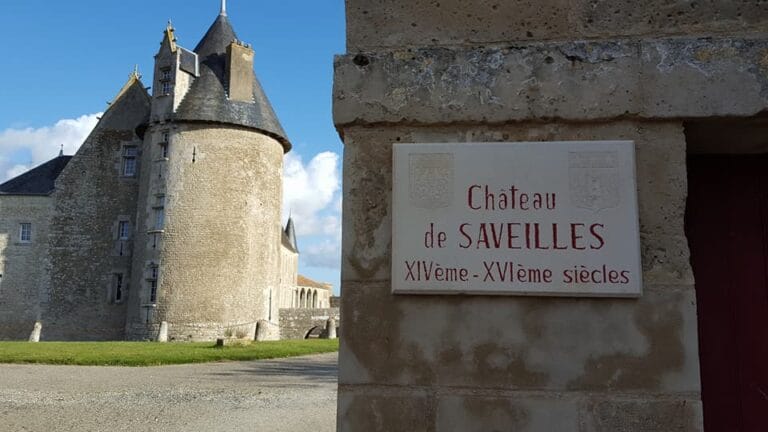
Today’s castle follows a triangular plan elongated toward the south. Five round towers project from the outer walls, each capped by a steep conical slate roof. The principal southern point is occupied by a large medieval gatehouse with wings extending from both sides. A square central entrance tower, covered by a pyramidal roof, forms the main entrance and remains the principal surviving element of the medieval structure. The residential building follows the northern wall, while an isolated tower divides the eastern curtain wall and contains the library.
Fortifications and archaeological remains
Medieval towers and buried structures
Many walls of a twelfth-century tower survive, although parts were rebuilt in the fifteenth century. Excavation also identified buried twelfth- and thirteenth-century masonry, other early foundations, and the room that operated the drawbridge at the fortified entrance. A twelfth-century stairway leads to an eleventh-century lower chapel in excellent condition, while traces of a Romanesque chapel, a medieval chapel using heavy masonry and rounded-arch forms, also remain.
Later defensive alterations
The assault of 1650 left a clear mark on the physical arrangement. The northern towers were dismantled, the drawbridge was removed, and part of the northwestern defensive ditch was filled. These changes ended the castle’s role as a major fortress while leaving it suitable for habitation.
Residential buildings and interiors
Roofs and restored exterior
The roofs are slate throughout the complex. The towers have small, steep conical pepper-pot roofs, the main buildings have two-pitched roofs, the entrance pavilion has a pyramidal roof, and the chapel has a vaulted roof. Nineteenth-century Romantic restoration added window ornaments, false arrow slits, two towers on the southern facade, a balustrade, and dormer windows that project from the sloping roof. The southeastern buildings were comparatively little affected, apart from the chapel.
Library tower
In 1893, the architect Frantz Jourdain remodeled the eastern tower as a two-level library. Its earlier narrow openings were blocked and replaced with large windows. Jourdain conceived the room as an “intellectual chapel,” meaning a commemorative library devoted to the family’s literary heritage. Adrien Karbowsky added painted wall decoration, while the collection preserved the cultural identity that had long been associated with Verteuil.
Chapel and memorial sculpture
Aimery de La Rochefoucauld redecorated the chapel and added stained-glass windows. A copy of a statue by Didier Début depicting the author of the Maximes was installed at the castle; the original stood on the facade of Paris City Hall. The chapel’s surviving crypt preserves the lower burial space that escaped the destruction of 1793.
Library, gardens, and tapestries
Collections and gardens
An inventory from 1728 counted 1,069 books in the library. The principal bedroom contained a bed covered in violet velvet embroidered with gold and silver, matching upholstered armchairs, a large Turkish carpet in an alcove, a walnut table, and other furnishings.
The park was laid out and redesigned during the nineteenth century. Dry-stone walls enclosed it, and a broad approach avenue connected several entrances that were later removed. Earlier eighteenth-century gardens have largely disappeared, but boxwood, paths, pools on two terraces, and a rockery preserve elements of the former landscape.
The Hunt of the Unicorn
Seven tapestries from The Hunt of the Unicorn, a late-medieval cycle depicting a symbolic hunt for a unicorn, were listed among François VI de La Rochefoucauld’s Paris possessions in 1680. They were probably made to celebrate the marriage of Anne of Brittany and Louis XII, and royal insignia formerly appeared in their designs.
In 1728, five tapestries hung in the principal bedroom, where they were already badly worn. Two torn pieces were kept in a lower hall near the chapel for use as furniture covering. During the Revolution, the royal insignia appear to have been cut out. Local farmers then took the tapestries and reused them to protect potatoes, vegetables, and espalier trees.
Hippolyte de La Rochefoucauld rediscovered the pieces in the 1850s in a farmer’s barn, where they covered vegetables. After restoration, they were displayed in a castle salon in 1856. In 1923, they were sold to John D. Rockefeller Jr., who presented them to The Cloisters in 1937. They remain displayed in the medieval galleries of that Metropolitan Museum of Art branch in New York.
Nearby sites