Château de Fargues: A Medieval Fortress and Wine Estate in France


Site at a Glance
- Rating
- 4.5
- Popularity
- Very Low
- Country
- France
- Primary era
- Medieval
- External website
- Open
- Eras represented
- Medieval, Early Modern
- Civilizations
- Duchy of Aquitaine, English, French
- Site type
- Military
- Remains
- Castle
On this page11 sections
History
Château de Fargues is a largely medieval fortress in Fargues, France, whose construction began in the fourteenth century. Raymond-Guilhem, Lord of Fargues and nephew of Pope Clement V, became a cardinal in 1306 and had the defensive stronghold built. Its surviving history reflects the changing fortunes of the Lur-Saluces family, whose later restoration efforts connected the ruined fortress with an active wine estate.
From the medieval fortress to the Lur family
In 1472, Pierre de Lur married Isabeau de Montferrand, Viscountess of Uza and Lady of Fargues. Through this marriage, the château entered the Lur family. The family adopted the name Lur-Saluces after Jean de Lur married Catherine-Charlotte de Saluces in 1586.
During the seventeenth century, Honoré de Lur Saluces, a military officer and son of Jean de Lur and Catherine-Charlotte, made major changes to the fortress. He enlarged and strengthened the medieval building, extending its defensive and residential complex before a catastrophic fire altered its history.
Fire, survival, and decline
During the night of 24 to 25 May 1687, fire devastated Château de Fargues and left it substantially ruined. The Lur-Saluces family did not abandon the property entirely. An inventory made in 1727 shows that the lords of Fargues still lived there and that some repairs had taken place.
After the fire, the estate supplied the family with everyday products, including vegetables, milk, butter, meat, red wine, and wood. From the second half of the eighteenth century to the beginning of the nineteenth century, Fargues became one of several Lur-Saluces properties. These included Château de Malle, acquired through marriage in 1702, Château d’Yquem, acquired in 1785, and Châteaux de Filhot and Coutet, acquired in 1807.
The fortress was later abandoned. Vegetation spread rapidly over the ruins, while sections that had survived the fire gradually collapsed. The remains therefore preserve both the medieval defensive foundation and the consequences of the seventeenth-century disaster.
Revival as a wine estate
In the 1920s, Bertrand de Lur Saluces (1888–1968) reassessed the potential of the Fargues estate. He ended red-wine production, selected the best soils for vines, and began planting 15 hectares of vineyard. He also initiated restoration work on the château.
After Bertrand’s death in 1968, his nephew Alexandre de Lur-Saluces assumed responsibility for the family estates and continued efforts to revive Fargues. Numerous works carried out between 2000 and 2015 restored part of the fortress’s former appearance. Château de Fargues remains privately owned by the Lur-Saluces family and continues to function as a wine estate. It was listed as a French historic monument by an order dated 11 December 2007.
Remains
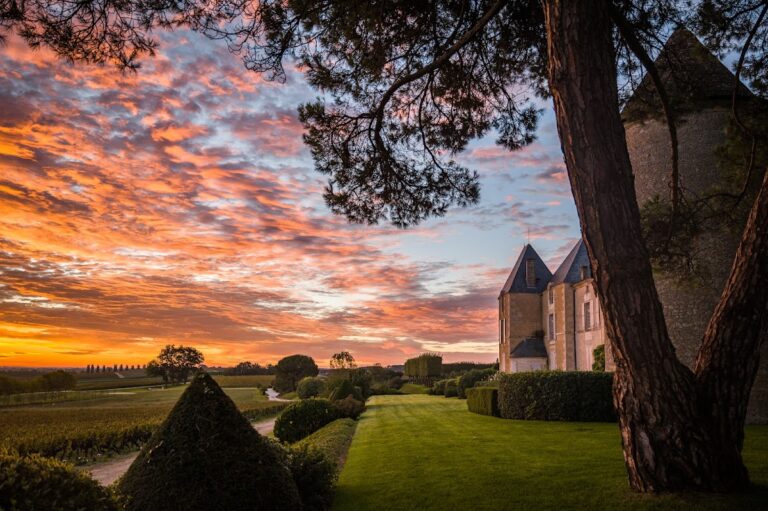
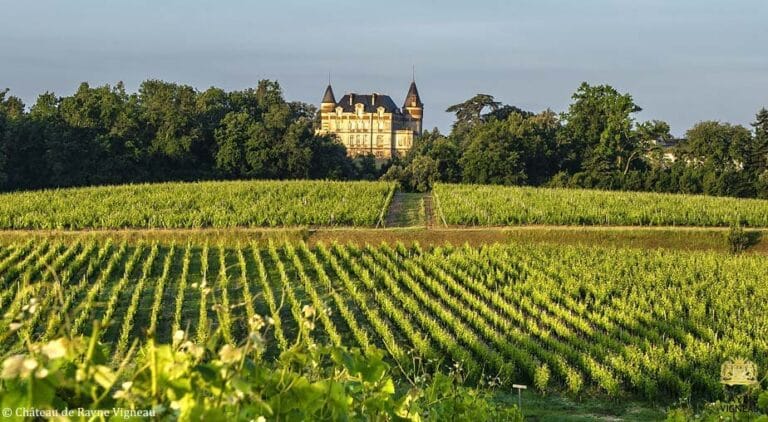
Château de Fargues survives as a largely medieval fortress whose original purpose was defense. It stands approximately 500 metres west of the village of Fargues, within a 170-hectare estate of vineyards, woodland, meadows, and fields. The medieval structure was enlarged and strengthened in the seventeenth century, then severely damaged by the fire of 1687. Vegetation covered the ruins afterward, and later restoration recovered part of the building’s earlier appearance.
Fortress and estate landscape
Medieval fortress
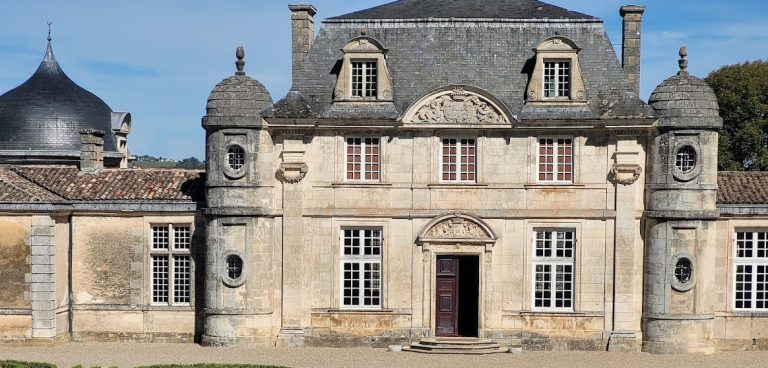
The château’s surviving fabric belongs to a fortress that began in the fourteenth century and was later transformed under Honoré de Lur Saluces. The seventeenth-century work enlarged and reinforced the medieval complex. Fire left the building substantially ruined, while subsequent collapse reduced the sections that had remained standing. Restoration between 2000 and 2015 returned part of its former appearance.
Grounds and setting
The château forms part of a 170-hectare estate whose ground consists of gravel and clay. Woodland, meadows, and fields surround the cultivated areas. Fargues lies 3.5 kilometres from Château d’Yquem and Château de Rieussec, on the same alignment as both properties.
Vineyard and wine production
Vineyard
Fifteen hectares of the estate are planted with vines on its better-quality ground. The vineyard has an average age of 35 years, while the oldest vines reach 70 years. Two grape varieties are planted at a density of 6,700 vines per hectare. One develops a thinner skin at maturity, allowing Botrytis cinerea, a fungus that can create noble rot and concentrate grape sugars and aromas, to act more readily. It contributes roundness, body, and structure. The other variety is fresher and more aromatic, adding further flavour.
Sweet-wine production
White grapes in the Sauternes region had been harvested later than elsewhere in Bordeaux since the fifteenth or sixteenth century, producing sweet wines. From the end of the eighteenth century, harvesters were instructed to select bunches or individual grapes affected by Botrytis cinerea. They make an average of five or six selective passes through the vineyard, and sometimes as many as eleven, gathering grapes as they reach optimum condition.
Production involves several pressings, blending the resulting musts, fermentation, and maturation in oak barrels. Fermentation may continue for up to six weeks and ends naturally when the wine reaches 13.5 percent alcohol. Maturation lasts 30 to 36 months, with the barrels racked four times a year and topped up weekly to compensate for evaporation and absorption and to limit oxidation. Average production is about 1,000 bottles per hectare, described as approximately one glass per vine. The sweet wine may qualify for the Sauternes controlled designation of origin, a legally protected designation governing geographical origin and production.