Château d’Hodoumont: A Medieval Castle Complex and Country Estate in Belgium


Site at a Glance
- Rating
- 4.4
- Popularity
- Very Low
- Country
- Belgium
- Primary era
- Medieval
- Eras represented
- Medieval, Early Modern, Modern
- Civilizations
- Dutch, Holy Roman Empire
- Site type
- Domestic
- Remains
- Castle
On this page11 sections
History
Château d’Hodoumont is a medieval castle complex in Belgium, centered on a fortified donjon and later reshaped as an eighteenth-century country residence. Located in Ohey, the complex includes the château, a fortified farm, and an estate of approximately 40 hectares. Its medieval tower belonged to the lordship of Goesnes, a fief of the Principality of Liège, the historic territory governed by the prince-bishop of Liège, and helped defend the principality alongside the fortifications at Goesnes and Filée.
Medieval origins
Hodoumont is first recorded in 1343, when Jakemin de Jamotines acquired the property through his marriage to the sister of Lambert, lord of Goesnes. His heirs adopted the name Hodoumont, while the Jamotines retained the property until 1553 or the middle of the sixteenth century. The medieval donjon was surrounded by a moat and formed the defensive and residential core of the lordship.
A residential wing and chapel were added around the donjon around 1300. These additions established the nucleus around which the later château developed.
Early modern transformations
After 1553, the property passed to Jehan de Ceels. During this period, the fortified farm was constructed, and the château and farm acquired round corner towers during the sixteenth and seventeenth centuries. A more extensive château developed around the medieval tower in the early seventeenth century.
The farm’s main residential building preserves the date 1612 on a fireplace. This surviving date marks one phase in the development of the agricultural and residential complex adjoining the château.
The country estate and later ownership
Baron Charles-Joseph-Victor Dauvin, lord of Burdinne, inherited Hodoumont in the 1760s. His son remodelled the château as a country residence and gave it its present appearance. Toward the end of the eighteenth century, he also created an English-style park, combining ornamental grounds with agricultural, pastoral, and wooded areas.
The last members of the Dauvin family died without descendants in 1883. The property then passed to their German cousins, the Carlowitz family, who sold it in 1893 or 1894 to Edmond Ysebrant de Difque. It subsequently remained with his descendants, the Kervyn de Lettenhove family.
The château complex, its grounds, and the park became a protected monument on 31 March 1983. In 2016, the entire ensemble was added to the Walloon Region’s exceptional heritage list.
Remains
The château and fortified farm
The château
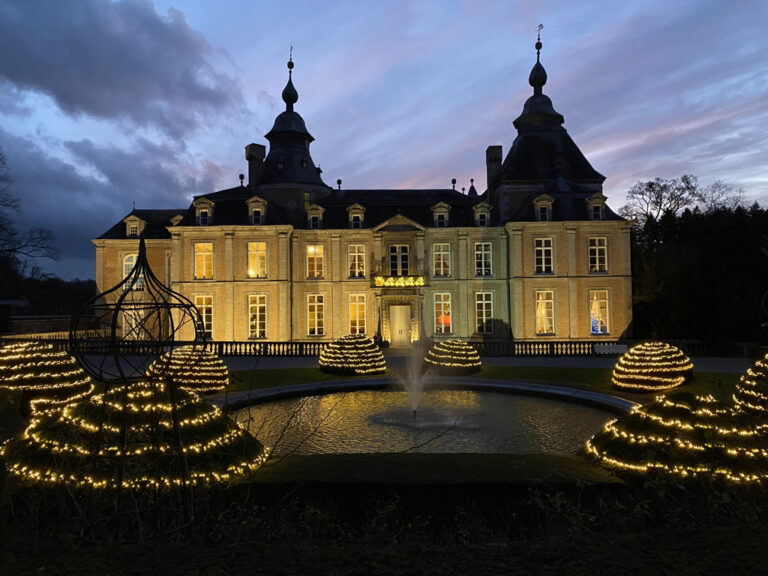
The château is organized around a square central donjon with four levels, a cellar, and thick limestone walls. The surrounding buildings use the same stone and have timber-structured roofs. Three round corner towers form part of the château, while a courtyard on the north side contains two carriage houses and several ancillary buildings. The former moat survives as a pond. A small bridge lies southwest of the château, and the southern terraces retain their walls. On the north side, a formal approach ramp leads toward the complex.
The fortified farm
The fortified farm stands directly against the east side of the château. Its buildings enclose a large interior courtyard and include three round corner towers dating from the seventeenth century. The complex contains the main residential building with its 1612 fireplace, a barn dated 1817, buildings along the forecourt, enclosure walls, and dependencies extending along two sides. Pairs of neoclassical pillars, using the revival of Greek and Roman forms that spread through Europe in the eighteenth and early nineteenth centuries, mark several entrances to paths and pastures.
Park and water features
Landscape and water system
The park covers approximately 40 hectares and contains ornamental areas, tree-lined avenues, ponds and other bodies of water, agricultural plots, pasture, and woodland. The Triffoy, locally called the Flemme stream, crosses the estate and flows onward as a tributary of the Hoyoux. It supplies the estate’s various ponds. At the edge of the small woodland adjoining the château, the Rouchon forms a fishing pond containing pike, carp, and ducks. Another pond extends for more than 100 metres.
Ornamental features and avenues
The protected park includes a stone pyramid and a group of basins linked by a narrow canal flanked by two small stone pyramids. Other surviving landscape features include a hornbeam planting, a lime-tree avenue aligned with the forecourt, a double row of beech trees to the south, and a lime-tree avenue along the road toward Goesnes.
Nearby sites