Notre-Dame Collegiate Church: A Mosan Gothic Church in Huy, Belgium


Site at a Glance
- Rating
- 4.5
- Popularity
- Low
- Country
- Belgium
- Primary era
- Medieval
- External website
- Open
- Eras represented
- Medieval
- Civilizations
- Holy Roman Empire
- Site type
- Religious
- Remains
- Church
On this page11 sections
History
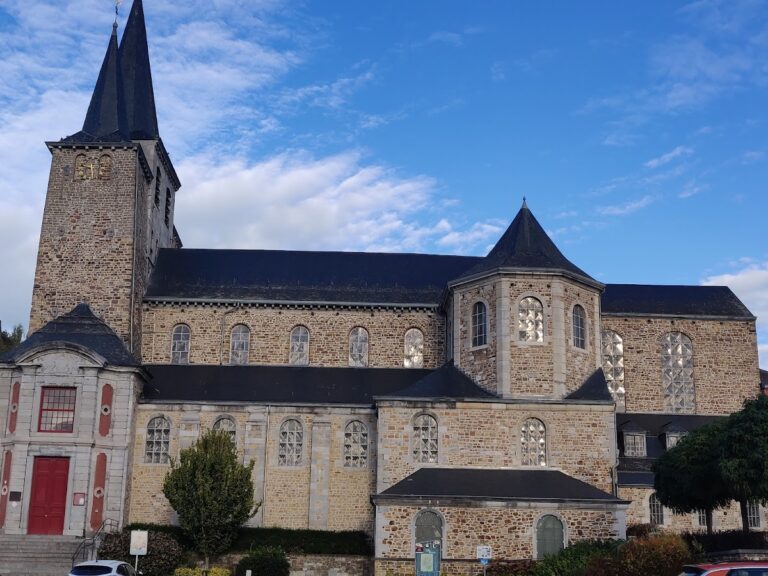
Notre-Dame Collegiate Church, also dedicated to Saint Domitian, is a Roman Catholic collegiate church in Huy, Belgium. Built in successive phases between 1311 and 1536 in the Mosan Gothic tradition, it stands on the right bank of the Meuse in the city centre and remains Huy’s principal Catholic place of worship. A collegiate church is served by a chapter of clergy, traditionally including canons, rather than by a monastic community.
Early religious foundations
Tradition places five religious buildings on the site over the course of its history. The earliest was supposedly a wooden sanctuary dedicated to Saint Maternus in the early fourth century. Near the end of the fifth century, another church was attributed to Saint Agricola of Maastricht. Saint Maternus was an early Christian saint, while Saint Agricola and Saint Domitian were early medieval bishops associated with Maastricht. Domitian was reportedly buried at the site in 558.
Romanesque rebuilding
A storm led to the rebuilding of the church, probably in wood, after 1013. Troops of Count Baldwin V of Flanders destroyed and burned it in 1053. Bishop Dietwin of Liège then ordered its reconstruction in the Romanesque style, an earlier medieval architectural tradition. The people of Huy contributed half of their movable property to support the work. On 24 August 1066, a freedom charter granted to the city was signed in the church, linking the building with an important stage in Huy’s civic history.
The Gothic church
The first stone of the present church was laid on 15 March 1311 by Prince-Bishop Theobald of Bar. A prince-bishop was a bishop who also exercised territorial or political authority. Prince-Bishop Jan van Arkel consecrated the choir in August 1377, while construction continued on the transept and west tower. Work was finally completed in 1536. The Romanesque predecessor gradually disappeared as the Gothic building rose, and its crypt was filled in.
Damage, recovery, and restoration
Lightning caused a fire in the church in 1803. During a bombing in August 1944, a large stained-glass window in the north transept was destroyed, as was another window showing the Four Evangelists in the north aisle. The buried Romanesque crypt was rediscovered and cleared in 1906 by the parish priest-dean Demaret.
Restoration campaigns took place during the nineteenth, twentieth, and twenty-first centuries. Major work was carried out in the mid-nineteenth century, followed by a campaign extending from 1889 to 2010. The Bethlehem Portal received a complete restoration finished in November 2014, and work on the church continued into that year. The church has been protected as a monument since 1 August 1933 and forms part of Wallonia’s exceptional built heritage. It was also recognized as exceptional cultural heritage of Wallonia in 2009.
Remains
Notre-Dame is a Mosan Gothic building approximately 72 metres long and 25.35 metres wide. Its construction combines fourteenth-century Rayonnant Gothic, known for geometric tracery and broad window openings, with fifteenth-century Flamboyant Gothic, whose ornament uses more elaborate, flame-like patterns. Three square towers define the exterior: a larger tower stands on the Meuse side, while two twin towers rise on the city side.
Towers, nave, and choir
The 48-metre-high west tower contains the great rose window. Beside the choir, the northern tower carries a 49-bell carillon. Triforia, or passages and arcaded galleries within the thickness of the walls, run beneath the upper clerestory windows and articulate the nave. A painted vault bears the date 1523 and the word Rode between two crossed swords. This refers to Christian knights defending Rhodes and leaving the city and island on 1 January 1523.
The choir has five bays. Its stalls provided 84 places for canons and chaplains in the fourteenth century, while the associated chapter may have included about 30 canons or possibly fewer. The great choir window is divided into three sections and rises 22 metres. Other stained-glass windows refer to the rosary and Huy’s local history, while fourteen windows in the side aisles evoke the Stations of the Cross.
Rose window and later glazing
The west-tower rose window is known in Walloon as Li Rondia. It measures 6 metres across on its inner side and 9 metres including the surrounding stone frame. It is described as the largest Rayonnant Gothic rose window in Belgium. After the Second World War, the Liège glass artist Raymond Julin created replacement stained-glass works in 1973 and 1974 for glazing destroyed during the conflict. Blue and red dominate the design, which was intended to express joy, the power of life, and spiritual happiness.
Crypt and Bethlehem Portal
The Romanesque crypt of the earlier church survives beneath the present building and is reached from the right side aisle. A crypt is a chamber beneath a church, often used for burial or for preserving relics. The chamber now houses the church treasury.
The Bethlehem Portal stands against the apse. Its central pointed arch probably dates from the fourteenth century and was built around 1340. Sculpted scenes place the Nativity and the Annunciation to the Shepherds on the left, the Massacre of the Innocents in the centre, and the Adoration of the Magi on the right. Two smaller pointed arches were added in the late nineteenth century.
Treasury and artworks
The treasury contains four principal Mosan reliquaries from the twelfth and thirteenth centuries. Mosan art is the medieval artistic tradition of the Meuse valley, especially known for metalwork, reliquaries, sculpture, and church decoration. The Shrine of Our Lady of Huy dates to around 1260 and was made by the same goldsmith associated with the shrines of Amay and Stavelot.
The Shrine of Saint Mengold dates to around 1172–1173, and the Shrine of Saint Domitian to around 1173. Both are attributed to Godfrey of Huy, a twelfth-century Mosan goldsmith. The shrines preserve relics of Saints Domitian and Mengold and are major examples of Mosan goldsmithing. A reliquary is a container made to preserve or display relics associated with saints.
Other treasury objects include a Mosan Tree of Life medallion from around 1160 and a seated Virgin and Child known as Our Lady of the Vignette. The latter dates to around 1250–1260 and is carved from polychrome oak. A ninth-century silk cloth, probably from eastern Iran, came from one of the reliquaries.
Additional works preserved in the church include a sixteenth-century wooden statue of Saint Christopher and two Baroque wooden statues by Jean Del Cour, representing Saint Helena and the Immaculate Conception of Mary. The interior also contains a twentieth-century high altar depicting the Last Supper and nineteenth-century marble side altars. One side altar, dated 1886, incorporates a fourteenth-century Madonna and Child.
Organ
The church’s organ was made by Félix Joris in 1913. It has 24 stops, two manuals, and a pedalboard.