Château d’Hellenvilliers: A Renaissance Pleasure Château in France


Site at a Glance
- Rating
- 4.6
- Popularity
- Very Low
- Country
- France
- Primary era
- Early Modern
- Eras represented
- Medieval, Early Modern
- Civilizations
- French
- Site type
- Domestic
- Remains
- Elite Residence
On this page7 sections
History
Château d’Hellenvilliers is a Renaissance pleasure château in France, at Grandvilliers in the present commune of Mesnils-sur-Iton. Built as a country residence for the comfort and leisure of its seigneurial occupants, meaning the lords of the surrounding territory, its construction began in the sixteenth century and continued into the seventeenth.
Origins and Renaissance construction
The Hellenvilliers lordship entered the Mainemares family through the marriage of Guillaume de Mainemares (1435–1504) to Jeanne de Hellenvilliers (1440–1505), Lady of Hellenvilliers. Their son Olivier de Mainemares (1464–1510) succeeded Guillaume, followed by René de Mainemares (1495–undated) and a second René de Mainemares, who commissioned the château.
René de Mainemares and Renée Le Veneur began the Renaissance residence. Its left wing was intended to be complete when Henri IV, King of France from 1589 to 1610, visited in 1590 shortly before the Battle of Ivry. Fought during the French Wars of Religion, that battle took place soon after the royal visit. Gabriel de Clinchamp later built the wing set at a right angle to the main structure.
Clinchamp and Érard ownership
Marie-Gabrielle de Mainemares, René’s daughter, married Nicolas de Clinchamp, Lord of Launay, who acquired the château through the marriage. Their son Gabriel de Clinchamp succeeded him, followed by his nephew François de Clinchamp. Around 1700, the Count of Érard added the right wing, developing it from a large corner pavilion.
Louis-Jérôme d’Érard (1666–1709), Lord of Ray, purchased the château in 1690. Ownership then passed through Augustin d’Érard (1694–undated), his son Augustin d’Érard (1722–undated), Armand d’Érard (1747–1817), Alexandre d’Érard (1770–1842), and Armand d’Érard (1808–1876). Armand d’Érard (1747–1817), Alexandre d’Érard, and Armand d’Érard (1808–1876) were associated with the title Marquis of Hellenvilliers.
The d’Estutt d’Assay line and protection
Marie-Caroline d’Érard (1840–1922), daughter of Armand d’Érard, married Henri d’Estutt d’Assay (1833–1925), Count of Assay, who obtained the château through the marriage. It subsequently passed to their son Henri d’Estutt d’Assay (1864–1945), then to his son Pierre d’Estutt d’Assay (1907–1997), and then to his daughter Yolande d’Estutt d’Assay, born in 1951. Yolande d’Estutt d’Assay and her husband, Pierre-Henri de La Porte du Theil, born in 1947, are identified as the current owners, and the château remains privately owned.
The château, its outbuildings and chapel, the tree-lined avenue leading to the formal entrance courtyard, and the park were entered on the French register of historic monuments by an order dated 22 December 1952. Grandvilliers remained the commune associated with the château until 1995.
Remains
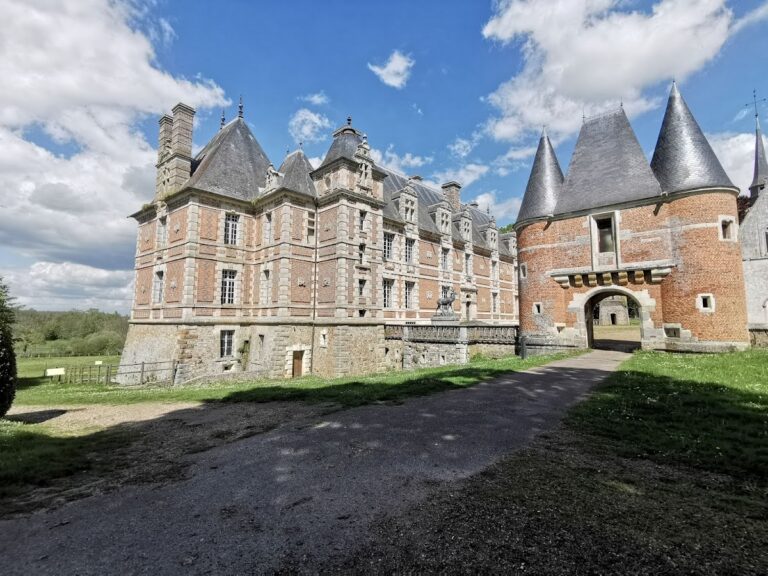
The surviving complex combines a Renaissance main château with later wings, service buildings, a fifteenth-century chapel, a formal approach, and a park. It stands in Grandvilliers, now within Mesnils-sur-Iton in the Eure department of Normandy, 3.5 kilometres east of the Church of Saint Martin in the former commune of Grandvilliers.
Main château and formal approach
The principal building has a main structure with left and right wings. One wing is set at a right angle to the main body, while the later right wing developed from a large corner pavilion. The façades and roofs of the château proper and its outbuildings form part of the protected fabric. A broad, tree-lined avenue leads to the honor court, the principal formal courtyard reached from the main entrance, while the protected grounds continue into the park.
Chapel
The chapel dates from the fifteenth century and forms part of the protected complex. A fire ravaged it in 1792, after which it was restored. Its façades and roof are included with those of the château and outbuildings among the protected architectural elements.