Palazzo Milesi (Rome): A Renaissance Palace in the Ponte District


Site at a Glance
- Rating
- 4.5
- Popularity
- Very Low
- Country
- Italy
- Primary era
- Medieval
- Eras represented
- Medieval, Early Modern
- Civilizations
- Papal States
- Site type
- Domestic
- Remains
- Elite Residence
On this page8 sections
History
Origins and Renaissance construction
Palazzo Milesi (Rome) is a Renaissance palace in Italy, located in Rome’s Ponte district on Via della Maschera d’Oro. Built for the Milesi family, who originated in Bergamo, it is generally dated to the fifteenth century, with construction or enlargement taking place in the early sixteenth century.
Giovanni Giuseppe Milesi, a literary scholar of the family, moved to Rome in 1480 and commissioned the palace’s creation by joining and superimposing what were probably three separate earlier palaces. This process produced the building associated with the Milesi name and established its prominent decorated façade.
Façade decoration and the Sack of Rome
Giovanni Antonio Milesi commissioned the painters Polidoro da Caravaggio and Maturino da Firenze to cover the façades with mythological scenes. Their work used grisaille, a technique employing shades of grey to imitate carved or sculpted relief. The paintings included classical figures and narratives, giving the exterior a dynamic, sculptural character that attracted considerable contemporary attention.
Giorgio Vasari, the sixteenth-century painter, architect, and writer, praised the decoration, judging that its beauty and abundance could not be surpassed by copies. The grisaille paintings had already deteriorated during the Sack of Rome in 1527, when mutinous troops, including German landsknechts, violently captured and plundered the city during the Italian Wars.
Later ownership and restoration
In 1576, Cherubino Alberti was commissioned to make a golden mask at the centre of a festoon supported by a putto, a winged child used as a decorative figure in Renaissance and Baroque art. The mask later disappeared completely, but its former presence gave Via della Maschera d’Oro its name.
Marzio Milesi sold the palace to the Baccani family in 1615 and returned to Bergamo. The façade paintings were copied by numerous artists, including Golsius, Giovanni Andrea Galestruzzi, Peter Paul Rubens, and Maccari. Drawings of the decoration later became important evidence for restoring the building.
Restoration in 2006 recovered elements that supported the palace’s fifteenth-century dating and revealed evidence that it had once contained a loggia, probably destroyed by an earthquake. The work also reconstructed the documented appearance of the façade. The golden mask could not be recreated because only written descriptions of it survived. The palace is privately used.
Remains
Building and decorated façade
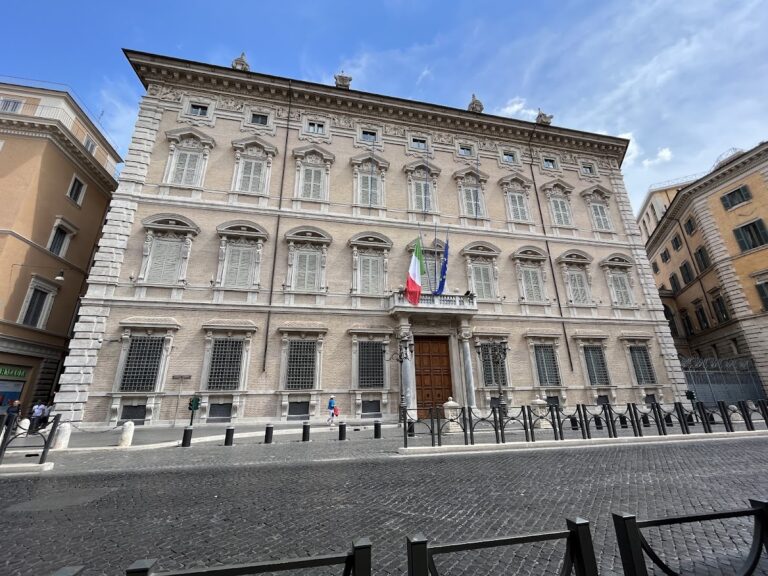
The palace rises over four floors, while its decorated principal façade is arranged across three stories. Its ground-floor exterior is faced with lightly rusticated masonry, and the rusticated portal has an architrave and the inscription “MILESIA,” identifying the original owners.
The upper façade is covered with complex grisaille frescoes representing virtues and episodes from classical mythology. The centre of the first floor presents the story of Niobe, painted by Polidoro da Caravaggio. Additional mythological figures occupy the second floor, while the third floor depicts the Rape of the Sabine Women, Cato of Utica, and the laws of Numa Pompilius.
Lost mask and former loggia
The centre of the façade once held a golden mask set within a festoon and supported by a putto. The mask is lost, and it could not be reconstructed because its appearance survives only through written descriptions. Evidence recovered during restoration also indicates that the palace originally included a loggia, probably destroyed by an earthquake.
Records of the façade paintings
Drawings documenting the façade frescoes are preserved in the Uffizi Gallery in Florence and in the Gabinetto Nazionale delle Stampe. These records supplied the basis for restoring the façade toward its earlier appearance and helped preserve the surviving understanding of its painted programme.
Nearby sites