Château d’Etchaux: Seat of the Viscounts of Baigorri


Site at a Glance
- Rating
- 3.4
- Popularity
- Very Low
- Country
- France
- Primary era
- Medieval
- Eras represented
- Medieval, Early Modern
- Civilizations
- Kingdom of Navarre
- Site type
- Domestic
- Remains
- Castle
On this page7 sections
History
The Viscounts of Baigorri and Navarre
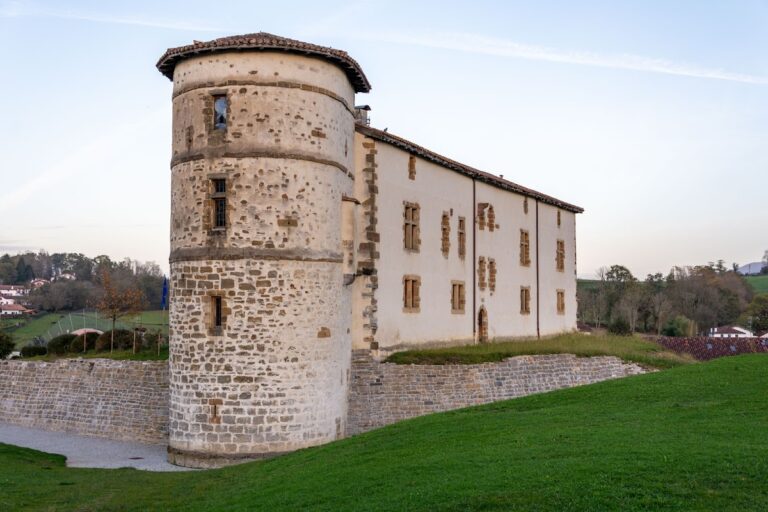
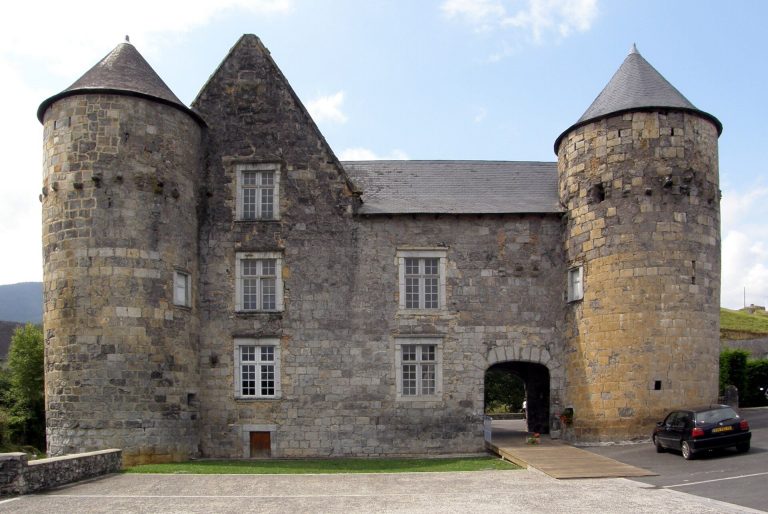
Château d’Etchaux, also known as Etxauz or Etchauz, is a castle in France above the village of Saint-Étienne-de-Baïgorry. Its oldest parts date from the twelfth century, and it served as the seat of the Viscounts of Baigorri from 1033 to 1832. The castle was also regarded as the ancestral home of the Eschaux family, whose members were known by the names d’Etchaux, d’Etchauz, and des Chaux.
The Etxauz family maintained close connections with the kings of Navarre, a medieval and early-modern kingdom whose territories lay on both sides of the western Pyrenees. Family members served the Navarrese rulers at court, in the army and fortresses, and in administration. Some also led merindades, the territorial districts used for governing the kingdom. Gratien d’Etxauz defended Navarre’s independence alongside its rulers between 1512 and 1527.
Bertrand d’Etchauz extended the family’s influence into the French royal and ecclesiastical establishment. He served as first chaplain to Henry IV and Louis XIII, kings of France, a position that made him a senior cleric in the royal household. He was bishop of Bayonne from 1599 to 1617 and later became archbishop of Tours, holding that office until his death in 1641.
Changing ownership and the end of the vicomtial line
At the beginning of the eighteenth century, the viscounty and castle passed to the Saint-Martin family of Capbreton in Gascony. Around 1750, ownership transferred to the Caupenne d’Amou de Saint-Pée family. Marguerite de Caupenne d’Amou, heiress to the title and castle, married Jean Isidore Harispe on 23 January 1795. They had no children, and the vicomtial dynasty ended when Marguerite died on 10 February 1832.
The castle was sold in 1848 to Charles d’Abbadie d’Arrast. Charles and his wife, Marie d’Abbadie d’Arrast, lived there until 1871 and continued to return for holidays. After Charles died in December 1901, the property remained in the family and was regularly visited by his grandson Harry d’Abbadie d’Arrast.
War, abandonment, and restoration
Harry d’Abbadie d’Arrast worked in Hollywood, the major American film-making centre, first as Charlie Chaplin’s assistant and later as a film director and screenwriter during the 1920s and 1930s. He and Chaplin stayed at the castle in 1925, 1926, and 1931. During the Second World War, the German army requisitioned the property between 1940 and 1944 and established its headquarters there.
In 1976, Eleanor Boardman, a Hollywood actress and Harry d’Abbadie d’Arrast’s widow, sold the castle so that she could return to the United States. After several further sales, the building was looted and abandoned until 1994. A couple from Bayonne then acquired it, completely restored the castle, and refurnished its interiors. It was sold again in 2003 and became a hotel and holiday lodging establishment.
Château d’Etchaux has been listed as a French historic monument since 21 December 1989. In 1997, it received the Grand Prix National des Vieilles Maisons Françaises, a French heritage award for the preservation of historic houses.
Remains
Motte and defensive setting
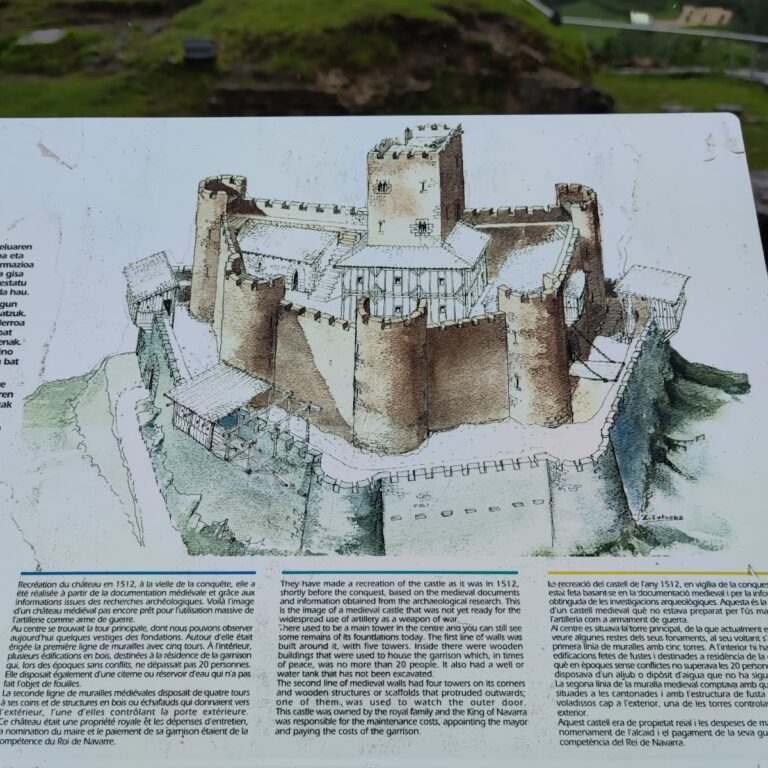
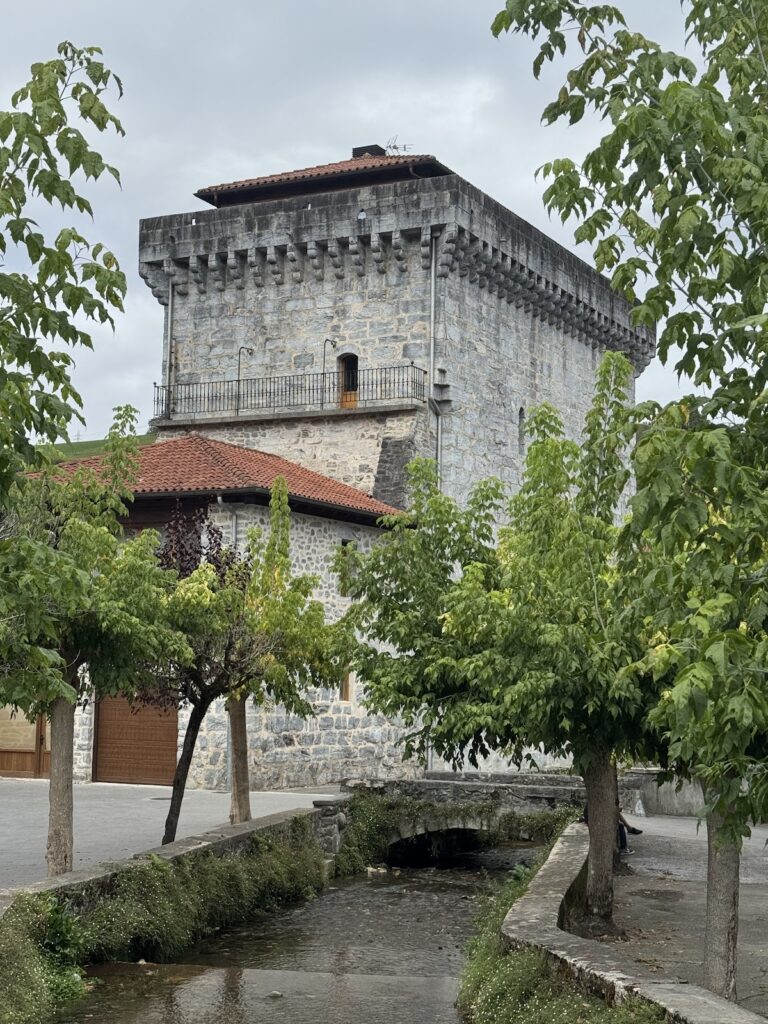
The castle stands on a castle mound above Saint-Étienne-de-Baïgorry. A castle mound, or motte, is a raised earthen or built mound that served as the defensive base of a castle. This elevated setting is combined with two corner towers and projecting sentry turrets, giving the surviving structure a defensive arrangement shaped by its position and perimeter features.
Medieval core and later reconstruction
The oldest surviving parts belong to the twelfth century. The building was extensively reconstructed at the end of the sixteenth century, while its interior was rearranged during the seventeenth century. These successive phases left a castle that combines the elevated form of a mound-based stronghold with corner towers, projecting sentry turrets, and later internal changes.