Castello di Bastia: A Renaissance Fortification in Italy


Site at a Glance
- Rating
- 4.9
- Popularity
- Very Low
- Country
- Italy
- Primary era
- Medieval
- Eras represented
- Medieval, Early Modern
- Civilizations
- Unclassified
- Site type
- Military
- Remains
- Castle
On this page9 sections
History
Castello di Bastia is a fortification in Italy, in the Bastia hamlet of Licciana Nardi in the historic region of Lunigiana. Its origins date to the thirteenth century, while the present castle is a Renaissance fortification generally associated with the fifteenth century. Set above the Taverone valley, it controlled the route toward the Lagastrello Pass, which separates Lunigiana from Emilia, and gained a reputation as an “impregnable castle.”
Medieval lordship and Genoese occupation
Bastia entered the political commitments made by Francesco d’Olivola to the Malaspina marquises of Villafranca in 1294 and again in 1307. The Malaspina were a noble dynasty whose fiefs extended across Lunigiana and the northern Apennines, and their Villafranca branch became closely connected with Bastia’s early history.
In 1416, Genoese forces occupied the castle in retaliation for the killing of Oderico Biassa, the Genoese deputy vicar of La Spezia, by the marquises of Villafranca. Bastia returned to the marquises in 1423. During the war between Florence and Filippo Maria Visconti, Duke of Milan, from 1424 to 1428, Florentine troops garrisoned the castle to block possible Milanese incursions into Lunigiana through the Apennines.
Renaissance reinforcement and the Monti fief
In the sixteenth century, Bastia became part of the Marquisate of Monti under Giovanni Spinetta. A marquisate was a territorial lordship governed by a marquis. This political change, combined with the spread of firearms, probably prompted structural renovations that strengthened the castle and reinforced its reputation as an impregnable stronghold.
After Spinetta died in 1535, Bastia was divided among his sons and became an independent fief under Fioramonte II. An independent fief was a territory held with substantially autonomous hereditary authority. Fioramonte’s dynasty ruled the territory until 1783, during a period marked by succession struggles, abuses by the marquises, and repeated rebellions.
Rebellion and the final marchioness
During the first half of the seventeenth century, Nestore, the brother of Marquis Carlo, committed numerous crimes and provoked a popular uprising. The Grand Duke of Tuscany intervened to restore order, but unrest and killings continued until rebels killed Nestore.
The last marchioness, Annetta Malaspina, married Giovanni Malaspina, Marquis of Mulazzo. Poets including Vincenzo Monti and Innocenzo Frugoni celebrated her beauty and talent, while the court of Parma took an interest in her. At the urging of the Parma Jesuit Bettinelli, she undertook a diplomatic effort on behalf of the French Jesuits and was sent to the French court in an attempt to win Louis XV’s affection and displace the Marquise de Pompadour. The effort failed for reasons that remain unclear. Annetta returned to her homeland with only a modest pension from the French court.
Castello di Bastia is privately owned and remains well preserved. Its present use is also described as a private residence.
Remains
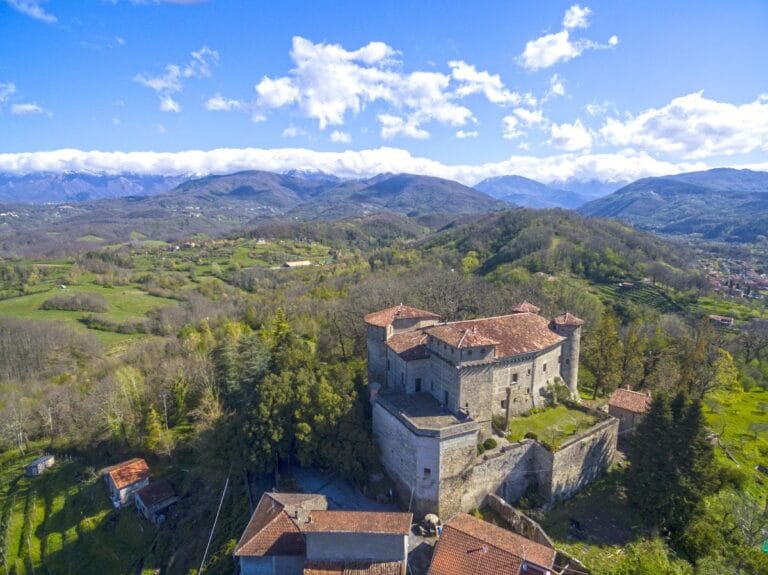
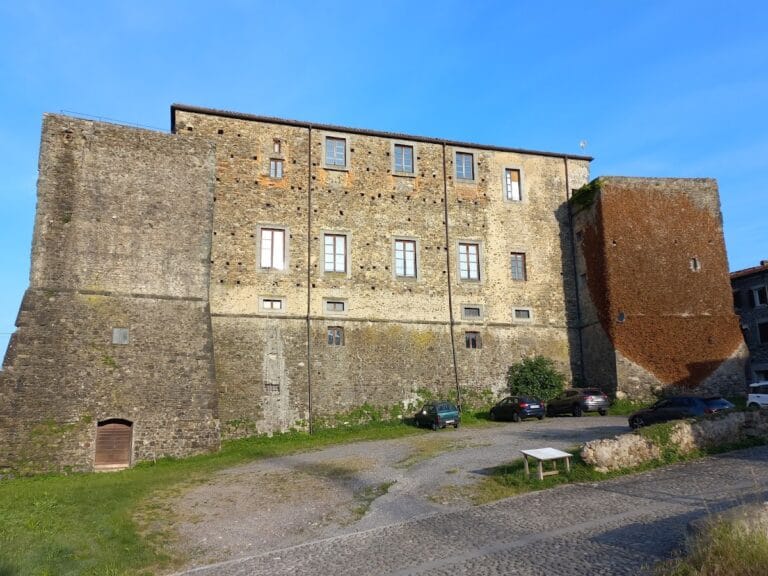
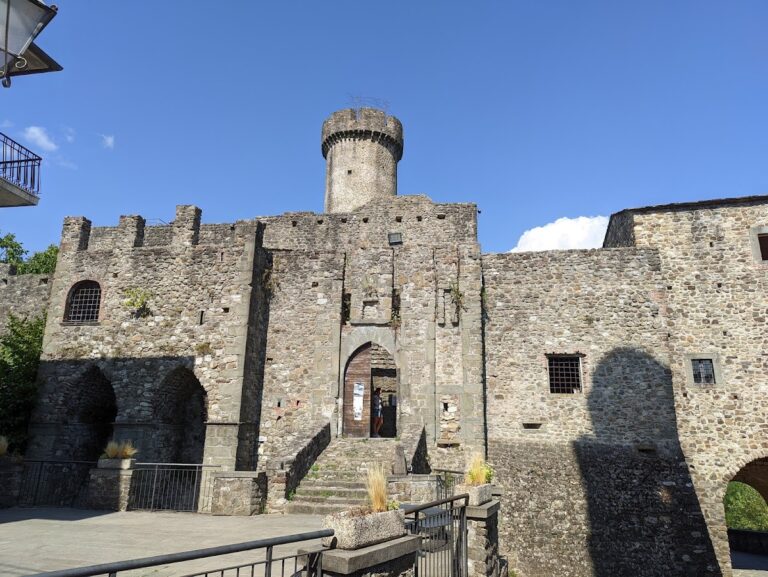
The castle occupies a hill in the Taverone valley and retains the form of a fortified Renaissance complex with medieval origins. Its defensive enclosure follows a trapezoidal plan, with four cylindrical corner towers joined by curtain walls. The walls incorporate a wall-walk, a passage along their upper edge used for movement and defense, while a central keep occupies the interior.
Outer defenses
Trapezoidal enclosure
The outer fortress consists of four cylindrical towers connected by curtain walls, defensive walls linking fortified elements. The curtain-wall and tower system is associated with a post-medieval construction phase. Together, these elements form the castle’s trapezoidal plan and express the Renaissance character of the surviving fortification.
Central stronghold
Interior keep
A central keep stands within the enclosing walls. A keep is the principal fortified tower of a castle, often serving as a stronghold and residence. The keep’s precise date is difficult to determine because renovation removed features that were probably medieval. Its presence preserves a link between the castle’s earlier history and the later Renaissance rebuilding.
Nearby sites