Château d’Amaiur: A Royal Navarrese Castle and Artillery Fortress


Site at a Glance
- Rating
- 4.4
- Popularity
- Medium
- Country
- Spain
- Primary era
- Medieval
- Eras represented
- Medieval, Early Modern, Modern
- Civilizations
- Crown of Castile, Kingdom of Navarre, Spanish
- Site type
- Military
- Remains
- Castle
On this page17 sections
History
Château d’Amaiur is a royal Navarrese castle in Spain, built under Navarrese rule from the twelfth century and associated with the medieval Jimena dynasty. The kings of Navarre appointed its castellan, the official responsible for administering and defending a castle, and financed its upkeep. Occupying a strategic position near the frontier with France and Lower Navarre, the castle later became the scene of the final military effort to restore the independent Navarrese kingdom after the Castilian conquest of 1512.
Medieval royal castle
The castle developed over several centuries. Its keep, the principal fortified tower, and an outer enclosing wall were constructed during the thirteenth and fourteenth centuries. A second, lower defensive circuit followed around the fifteenth century, enlarging the fortified area and strengthening its control over the approach through the Baztan Valley.
Castilian conquest and fortress conversion
After the Castilian-backed conquest of Navarre in 1512, the new authorities reinforced Amaiur because of its position close to France and Lower Navarre. The exiled Navarrese kings lived in territories across the Pyrenees, including Béarn and Lower Navarre, and the castle faced a frontier where their supporters could attempt a return. Between 1512 and 1522, the medieval stronghold was converted into an artillery fortress, with projecting positions designed for firearms and cannon.
In late 1521, forces loyal to Henry II of Navarre, supported by France and linked to the Agramontese faction, recovered Amaiur from its Castilian garrison. The Agramontese supported the Navarrese royal house, while the Beaumontese generally backed the Castilian conquest. About 200 men remained at the castle under Jaime Vélaz de Medrano, a Navarrese military commander. Their occupation formed part of Henry II’s last attempt to recover the kingdom after the invasion of 1512 and the Navarrese defeat at Noáin on 30 June 1521.
The siege of 1522
Castilian operations around the castle began to isolate the garrison. Orzorrotz fell on 14 March 1522, followed by Doneztebe on 17 June, cutting Amaiur’s communication with Hondarribia. Francisco de Zúñiga Avellaneda y Velasco, Count of Miranda del Castañar and the Castilian-appointed viceroy of Navarre, ordered the attack in early July.
The siege took place in July. Several thousand Castilian troops and Navarrese Beaumontese supporters of the conquering regime surrounded the fortress, whose garrison numbered about 100 to 200 men. The besiegers blocked the roads and subjected the defenses to bombardment. The defenders resisted several assaults before a mine, a tunnel or buried explosive charge intended to undermine a fortification, destroyed the major bastion, the castle’s strongest defensive position. The garrison then capitulated.
The surrender included an agreement that the defeated defenders would be spared, but the prisoners were taken to Pamplona. Some were imprisoned or sent elsewhere, while French prisoners were released after paying ransoms. Jaime Vélaz de Medrano died in Pamplona prison about two weeks after the surrender. Tradition also says that his son died there and that both men were poisoned. Most of the remaining Navarrese prisoners were later released through amnesty, ransom, or exile, while three were sent to Atienza.
Destruction and later commemorative history
Concern that Agramontese forces might retake the damaged fortress led the viceroy to order its destruction. Five mines demolished the castle on 12 August 1522. Its fall ended the exiled Navarrese kings’ attempts to recover Navarre. The site still had strategic value in the early seventeenth century because of the Spanish-French frontier. A pentagonal fortification was planned using contemporary military engineering, and construction of a northeastern bastion began in 1637. The project was abandoned around 1640, after the frontier became less active militarily.
From the twentieth century, especially after 1921, Amaiur became a political symbol for Basque-Navarrese nationalists and others who supported the restoration of Navarrese sovereignty. A commemorative monument to the Navarrese defenders was inaugurated at the castle on 30 June 1922. It was dynamited during the night of 26 to 27 July 1931, then reconstructed and reinaugurated on 10 October 1982 through the initiative of the town and with support from the provincial authorities of Navarre, Álava, Guipúzcoa, and Biscay, as well as the Basque Government. Archaeological excavation and consolidation were carried out by the Aranzadi Science Society with assistance from Amaiur inhabitants during campaigns from 2006 to 2008. A second memorial, the Monument to the Unknown Resister, was inaugurated at the foot of Mount Gaztelua on 21 July 2007, reinforcing the site’s continuing commemorative association with Navarrese resistance and claims to restored sovereignty.
Remains
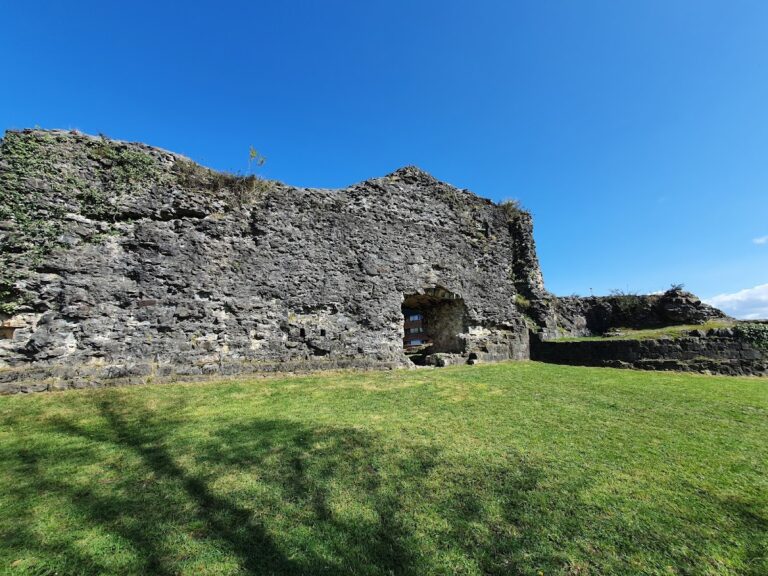
The castle occupied Mount Gaztelua at the end of Amaiur village in the Baztan Valley of Navarre. Its surviving archaeological remains comprise the central medieval stronghold, enclosing defensive circuits, artillery works, a cistern, and later fortification traces. The complex combines medieval stone defenses with early-sixteenth-century additions designed for cannon and firearms, while the seventeenth-century works survive as an unfinished phase of the site’s military development.
Medieval defensive circuits
Keep and first enceinte
The thirteenth- or fourteenth-century keep formed the central stronghold. The first enceinte, an enclosing defensive wall, surrounded it and was reinforced by five attached semicircular towers. Its eastern entrance was approached across a drawbridge, making the principal access part of the defensive system. These elements express the castle’s medieval organization around a central fortified tower and its first surrounding wall.
Lower defensive circuit
A second, lower circuit was added around the fifteenth century. It incorporated four attached towers and a southern entrance without a drawbridge. This lower line expanded the defended area beyond the earlier enclosure and remained part of the fortified arrangement that was later adapted for artillery.
Artillery defenses and water supply
Corner artillery towers
Between 1512 and 1522, two external corner artillery towers were built to the north and south of the medieval castle. These projecting fortifications, sometimes called bastions, were intended to accommodate firearms and cannon. The southern and northern additions altered the older defensive layout as the castle was converted into an artillery fortress. The strongest of these positions, the major bastion, was destroyed by a mine during the siege of 1522.
Cistern
A new cistern was constructed during the same early-sixteenth-century strengthening works. Its presence formed part of the fortress’s practical adaptation during the period when Amaiur was prepared for sustained military operations.
Seventeenth-century fortification
Northeastern bastion
The projected seventeenth-century fortification was pentagonal. Work on its northeastern bastion began in 1637, but the project remained unfinished when construction was abandoned around 1640. The surviving traces belong to a later attempt to adapt the site to contemporary military engineering after the medieval castle had been destroyed.
Commemorative monuments
Monument to the Navarrese defenders
The 1922 monument stood at the precise location of the former main tower. Its four faces carried inscriptions in Spanish and Basque and displayed the arms of Amaiur, Álava, Guipúzcoa, and Biscay. Larger arms of Navarre and its six merindades, the kingdom’s major historical administrative districts, appeared on two faces. These latter carvings were made from white Almandoz marble. The reconstructed monument incorporated recoverable stones scattered on the slope, together with replacement pieces carved in a stone workshop at Olite.
Monument to the Unknown Resister
The Monument to the Unknown Resister was made by the artist Pello Iraizoz from reddish Baztan stone. It bears the motto Pro libertate patriae, gens libera state, also rendered in Basque. Its imagery includes a star-shaped carbuncle, a heraldic figure traditionally associated with the origins of the Navarrese arms, later forms of that symbol with spherical additions that became chains, and representations connected with Navarrese rulers as shown in Navarrese coinage.