Château d’Argenteuil: A French Renaissance Country Residence in Belgium


Site at a Glance
- Rating
- 4.3
- Popularity
- Very Low
- Country
- Belgium
- Primary era
- Modern
- Eras represented
- Modern
- Civilizations
- Belgian
- Site type
- Domestic
- Remains
- Elite Residence
On this page9 sections
History
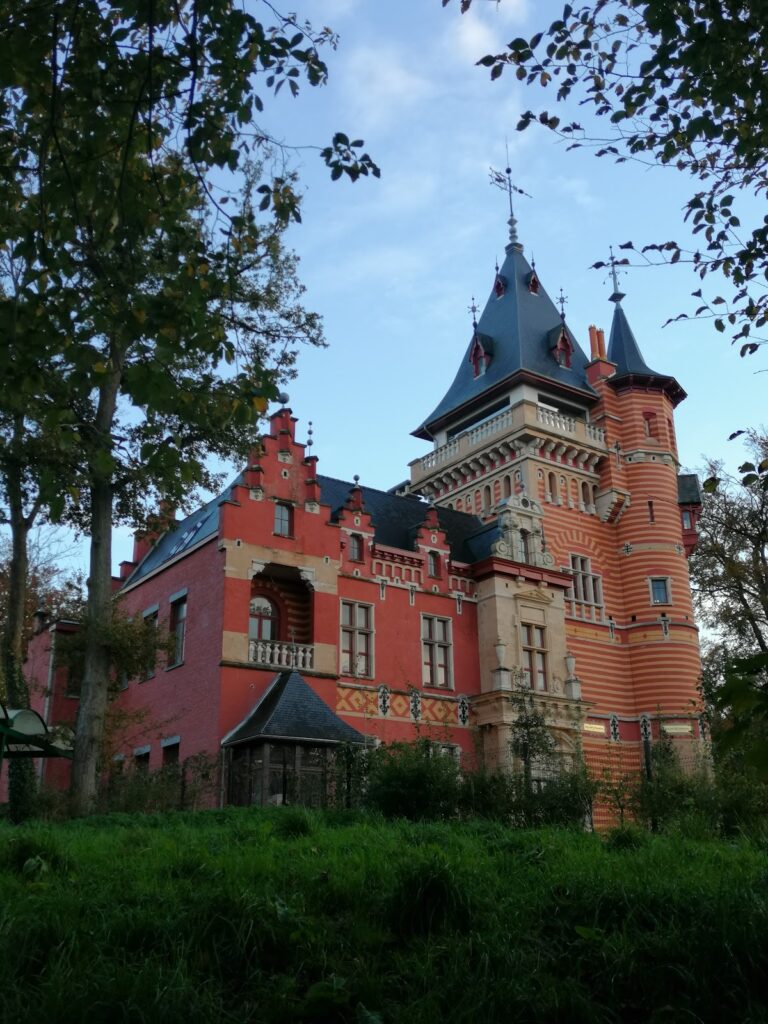
Château d’Argenteuil is a country residence in Waterloo, Belgium, built in the French Renaissance style between 1856 and 1858 for banker Ferdinand de Meeûs. The château forms part of the wider Argenteuil domain, which extends across Waterloo, Ohain in Lasne, and La Hulpe in Walloon Brabant. The former estate contained three castles, two of which survive.
Creation of the Meeûs estate
Ferdinand de Meeûs, a banker and governor of the Société Générale, acquired about 300 hectares of woodland from the Sonian Forest in 1832. A first castle was constructed on the site between 1837 and 1847. It was partly occupied while work on the property continued, but a fire destroyed it on 10 January 1847. Its appearance is preserved in a family portrait by Fanny Geefs, which shows the building in the background, while another surviving image depicts the fire.
The present château replaced the fire-damaged building. Ferdinand commissioned its construction between 1856 and 1858, with the work directed by Jean-Pierre Cluysenaar, a Belgian architect known for major nineteenth-century buildings in Brussels. Landscape architect Edouard Keilig laid out the park. A road was driven through the domain to improve the connection between Charleroi and Brussels despite the existing Chemin des Wallons. Known as the Route de la Banque, it is now Avenue de Tervuren.
Inheritance and division of the domain
Ferdinand de Meeûs died in 1861, and his wife retained the property. In 1874, she left the château to their daughter Henriette de Meeûs, who was unmarried and childless. The property later passed to Louis de Meeûs. After Louis died, the domain was divided between his wife and son, while his widow continued to live at the château until her death in 1929.
Royal decrees issued in 1937 and 1938 granted the counts of Meeûs and their descendants the right to add “Argenteuil” to their surname. After the Meeûs estate was dismantled, different parts of the former domain passed to S.A. Domaine d’Argenteuil, the Bernheim family, the Carmelite nuns of Uccle, and later the Compagnie mobilière et immobilière liégeoise. Its principal shareholders included Baron Paul de Launoit and Baron Arsène de Launoit. The Carmelites exchanged their properties near the Sacred Heart church in Uccle for land at Argenteuil, where Baron Paul de Launoit arranged for a new convent to be built.
Château Tuck and the royal residence
A separate part of the former domain was acquired in 1929 by William Hallam Tuck, an American businessman and ambassador. He commissioned a summer residence there, known as Château Bellevue or Château Tuck, and created a park covering holdings of about 144 hectares. This became the third Argenteuil château.
Tuck sold the estate to the Belgian state on 1 June 1949. The acquisition was made for the Société nationale des chemins de fer belges, Belgium’s national railway company. In 1951, the Belgian state offered Argenteuil to Prince Charles of Belgium, Count of Flanders, in recognition of his regency from 1944 to 1950, but he declined the residence.
In 1961, the abdicated King Leopold III of Belgium moved to Château Tuck with his second family, including his wife Lilian Baels, later known as Princess de Réthy. The residence became the royal Domaine d’Argenteuil. Leopold, Lilian, and their children remained there until Lilian’s death in 2002. For more than forty years, Belgium consequently had royal households at both Laeken and Argenteuil.
The Argenteuil household welcomed literary, scientific, cultural, and academic figures. The Princess Lilian Cardiology Foundation also held colloquia there. In April 2003, the Belgian government removed traces of the former royal residents before placing the estate on the market. The Belgian state sold the Tuck château and its domain to businessman Jean-Marie Delwart on 25 September 2004.
State ownership and educational use
After the Second World War, the Belgian state acquired the Meeûs château and adapted it for educational purposes. It housed the Institut normal d’économie ménagère agricole de l’État and later the Institut supérieur de traducteurs et interprètes, a higher-education institute specializing in translation and interpreting. The buildings subsequently accommodated the Scandinavian School of Brussels and the École Européenne de Bruxelles-Argenteuil. Educational use continued from the late twentieth century into the twenty-first century.
The estate received protection in 1997. On another parcel of the former domain, Baron Paul de Launoit commissioned architect Yvan Renchon to build the Queen Elisabeth Musical Chapel, adding a separate cultural institution to the places associated with Argenteuil.
Remains
The surviving Argenteuil complex is organized as a group of country residences and associated landscaped and institutional properties spread across the former domain. The principal Château d’Argenteuil occupies the site of the first castle and presents the French Renaissance style chosen for Ferdinand de Meeûs’s replacement building. The wider estate includes Château Tuck with its park, a Carmelite convent and its later replacement, and the Queen Elisabeth Musical Chapel on a separate parcel. Together, these surviving elements reflect the successive division and reuse of the original nineteenth-century property.
Château d’Argenteuil
The present Château d’Argenteuil was built between 1856 and 1858 as a country residence on the site of the first castle. Jean-Pierre Cluysenaar directed its design and construction, while Edouard Keilig arranged the surrounding park. The earlier building is known through Fanny Geefs’s family portrait and a separate depiction of the 1847 fire, allowing the current château to be understood as a replacement rather than the original structure.
Château Tuck
Château Tuck, also called Château Bellevue, was built in 1929 as William Hallam Tuck’s summer residence. The building was accompanied by a park, and its plans are attributed to the New York architects William Adams Delano and Chester Holmes Aldrich. The château and its domain form a separate surviving part of the former Argenteuil estate.
Convent and cultural buildings
The former estate included a Carmelite convent and a later replacement convent built on land obtained through the Carmelites’ exchange with properties in Uccle. The Queen Elisabeth Musical Chapel stands on another parcel, commissioned by Baron Paul de Launoit and designed by Yvan Renchon. These buildings preserve the later religious and cultural uses that developed as the original domain was divided.
Nearby sites