Hougoumont: A Fortified Manor and Farm at Waterloo


Site at a Glance
- Rating
- 4.4
- Popularity
- Medium
- Country
- Belgium
- Primary era
- Early Modern
- External website
- Open
- Eras represented
- Early Modern
- Civilizations
- Duchy of Brabant, Habsburg, Holy Roman Empire
- Site type
- Military
- Remains
- Castle
On this page8 sections
History
Hougoumont is a fortified manor-and-farm site in Belgium, near Waterloo and the Nivelles road. Its present principal building probably dates from the seventeenth century, while the compound became a decisive forward position during the Battle of Waterloo on 18 June 1815. The site was known earlier as Goumont or Gomont, and the name Hougoumont first appears on Joseph de Ferraris’s map of 1777.
Origins and the estate
The place-name appears in medieval records as Gomont. A 1358 act of the allodial court of Brabant, which dealt with land held directly rather than as a feudal tenure, used that form, while a 1356 record described a tenure and house at Gomont. An act of 1485 called the place Augoumont. The origin of the name remains uncertain, although a connection with the personal name Godulf or Godulphe has been proposed. Hougoumont may be a later corruption of Château Goumont.
In 1474, the Order of Saint John of Jerusalem, a medieval military-religious order later known as the Order of Malta, sold Henri de Witthem, lord of Braine-l’Alleud, twelve bonniers of woodland called Le Goumont and twelve adjoining bonniers of heathland for 100 gold crowns. A building had apparently been established by 1536, when the property passed to Pierre du Fief, attorney general of the Council of Brabant. He substantially enlarged the domain.
The estate later passed through the Quarré family and was acquired by Arnold Schuyl, lord of Walhorn, in the seventeenth century. The principal building probably rose during this period, although its exact construction date is uncertain. On 28 March 1661, Jean-Jacques Arrazola de Oñate, lord of Gomont, acquired the domain. His family retained it through successive inheritances. Jean-Jacques served as counsellor and commissioner of the royal domains and finances in the Netherlands and as superintendent of Hainaut. He was knighted in 1663 and died in 1688.
His son, Jean Philippe Arrazola de Oñate, held positions at the Brussels court of accounts and in the administration of the royal hunt. Jean-André Arrazola de Oñate inherited Hougoumont and died childless in 1780. His widow later married Philippe Gouret de Louville, a major in Austrian service. De Louville inherited the estate in 1791 but never lived at the château. In 1815, Antoine Dumonceau managed the farm, while Jean-Joseph Carlier maintained the formal garden.
Hougoumont at Waterloo
The Battle of Waterloo was fought on 18 June 1815 between Napoleon’s French Army of the North and an allied army commanded by the Duke of Wellington, supported by Prussian forces under Field Marshal Blücher. Hougoumont stood as an advanced position on the right of Wellington’s army. Wellington ordered its garrison to hold the site at all costs because its loss would have given the French a base from which to attack the allied line.
British troops occupied and strengthened Hougoumont during the evening of 17 June. The garrison included the 1st Battalion of the 2nd Nassau Regiment, Hanoverian light infantry and reserve troops from Friedrich von Kielmansegg’s brigade, and companies of the Coldstream Guards, 3rd Guards, and 1st Guards. Lieutenant-Colonel James Macdonell of the Coldstream Guards held overall command. Lord Saltoun, Henry Wyndham, Charles Dashwood, and Captain Büschgen also directed parts of the defence.
Napoleon intended the action at Hougoumont to draw allied reserves toward the right flank before a larger attack near La Haye Sainte. Instead, the fighting developed into a battle lasting throughout the day and absorbed substantially more French than allied troops. French forces committed against the position and its surroundings numbered about 33 battalions, or 14,000 soldiers. They came largely from General Honoré Reille’s II Corps, including divisions commanded by Jérôme Bonaparte, Maximilien Foy, Guilleminot, and Joseph Bachelu, together with cavalry from Kellermann’s corps. Wellington committed about 21 battalions, or 12,000 soldiers, to keep the hollow way open, reinforce Hougoumont, and carry ammunition. He also moved artillery batteries from the centre to support the position.
The first French attack began at a time variously placed at about 10:00, 11:20, or 11:30. Troops under Pierre François Bauduin entered the southern wood but were driven back, and Bauduin was killed. Further attacks under Joseph Soye and other French commanders reached the orchard, garden walls, and gates without taking the compound.
During one assault, French troops led by Sous-Lieutenant Legros broke through the north gate with an axe. Macdonell, other officers, and Sergeant James Graham closed the gate, trapping Legros and about thirty soldiers of the 1st Light Infantry inside. Close fighting followed, in which all but a drummer boy were killed. French troops continued to attack the orchard, garden, buildings, and approaches throughout the afternoon, while allied formations brought in reinforcements and ammunition.
Napoleon ordered the buildings shelled, and the barns and other structures caught fire. The flames destroyed most of the house, while the chapel survived. Coldstream Guards, 3rd Guards, the King’s German Legion, Brunswick troops, and Hanoverian reinforcements held Hougoumont until the allied advance at the end of the battle.
Destruction and later ownership
By 19 June, most of Hougoumont’s buildings had been burned or reduced to ruins. Bodies covered parts of the grounds, a funeral pyre was erected south of the farm, and the trees and orchard had suffered severe damage. Victor Hugo later popularized the story that 300 bodies had been thrown into a well. That story is regarded as legendary. A visitor on 16 July 1815 reported seeing a well, probably at Hougoumont, containing 73 bodies.
Unable to finance repairs, the 86-year-old de Louville sold Hougoumont to François-Xavier de Robiano on 7 May 1816. The de Robiano family preserved the surviving remains, and inheritance later carried the estate to the d’Oultremont family in 1917. Count Guibert d’Oultremont sold it in 2003 to Wallonia through the intercommunal organization Bataille de Waterloo 1815.
Hougoumont continued as an active farm until the end of the twentieth century. By 2006, its condition had seriously deteriorated, with cracked walls and damage to the north gate. Project Hougoumont restored and conserved the site for the bicentenary of Waterloo. The work was completed in June 2015, and a memorial to the British soldiers who fought there was unveiled beside the north gate on 17 June that year.
Remains
The fortified compound
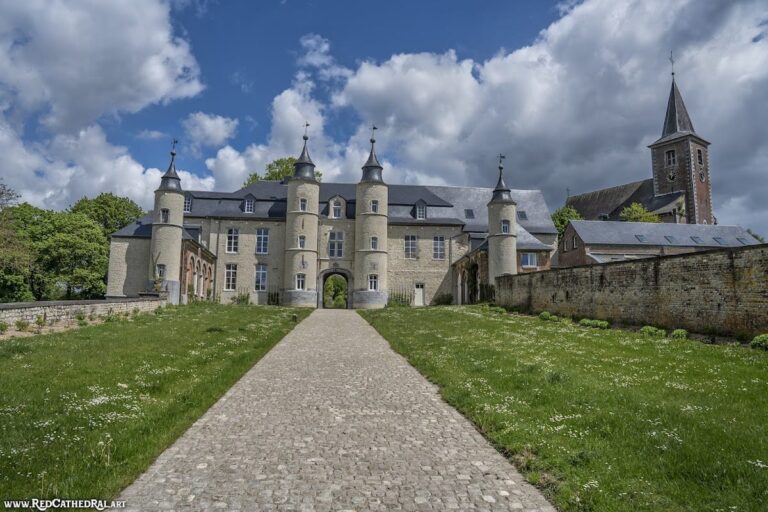
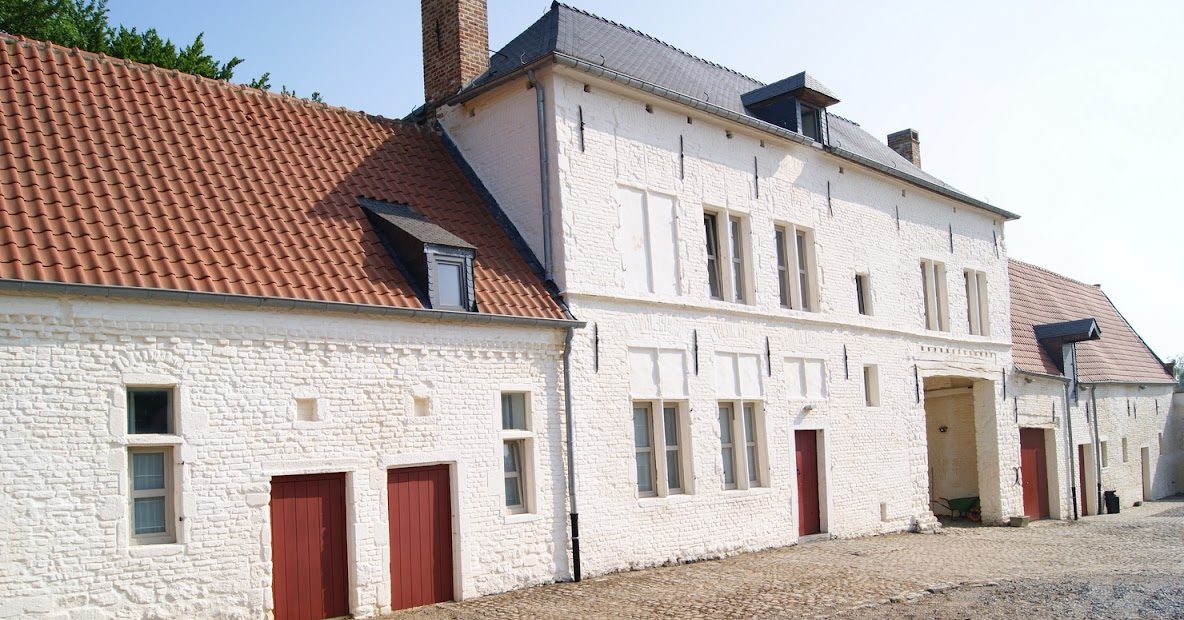
Hougoumont is a walled château-ferme, meaning a fortified country estate that combines a manor with agricultural buildings. The complex stands at the foot of an escarpment, with its buildings arranged around a rectangular enclosure. The group included the main house, a farmer’s dwelling, a chapel, barns, stables, and other farm structures. Substantial walls of sandstone and red brick enclosed the compound, while the formal garden walls rose more than two metres high. Large south and north gates formed the principal entrances, and a smaller western gate stood between the shed and the gardener’s house.
The north gate remains the physical focus of the famous French breach attempt. The restored complex retains the north and south gates, surviving walls, garden walls, the rebuilt large barn, and the restored gardener’s cottage. The château itself was completely ruined after the battle and became uninhabitable. Local inhabitants reused its stones, including in the former Café des Ruines along the Nivelles road, while the foundations of the château remain visible.
Garden, orchard, and battlefield approaches
A formal French garden lay immediately east of the château. Surviving brick walls enclosed it on the east and south, and a hedge bounded it on the north. Beyond the garden stood a larger orchard, about 50 metres wide along its northern side and enclosed by a strong hedge. The garden and orchard are now mainly grassland with scattered trees. A square wood, approximately 250 to 300 metres wide, lay south of the farm in 1815. Its western side rose to about 120 metres, while its eastern side descended toward the farm fields. The wood has since disappeared and the area is cultivated.
A strip of open ground about 30 metres wide separated the southern wood from the garden wall. British soldiers called this area the Killing Ground. A path crossed the wood and continued toward the Remyval road and the monument of the Wounded Eagle. North of the orchard, an east-west hollow road, or sunken way below the surrounding ground level, was known to British troops as the covered way or Sunken Way. The path toward Nivelles began at the north gate and was formerly lined with trees. The ridge north of Hougoumont, where allied artillery stood in 1815, is now partly concealed by woodland.
The arrangement and topography helped shape the defence. The southern wood concealed the buildings from French view and gave infantry cover, while also limiting direct artillery fire against most of the walls to the western side. The garden wall checked the first advance from the wood, and the hollow way north of the orchard provided a protected route for troops and ammunition. During the battle, French artillery opened firing positions through parts of the garden wall before shelling the buildings. Bullets and shell fragments struck the structures, and fire destroyed the barns and most of the château. The chapel survived the burning.
Surviving structures and memorials
The gardener’s cottage at the southern gate retains the form of the building shown after the battle, although a small extension added after 1815 was demolished during restoration in 2014. By 2006, the compound’s formerly white walls had become dirty yellow, several walls were cracked, and the right-hand post of the north gate was particularly damaged. Conservation work restored the surviving walls and buildings while preserving the archaeological remains associated with the site.
The restored grounds include the garden and orchard areas, the rebuilt large barn, the gardener’s cottage, and the remains of the well linked with the later story about bodies from the battle. Beside the north gate stands a memorial to the British soldiers who defended Hougoumont. Created by Vivien Mallock, it shows two life-size soldiers struggling to close the gate during the French attack.
Nearby sites