Château du Parc-Soubise: A Protestant Estate and Memorial Ruin in France

Site at a Glance
- Rating
- 4.8
- Popularity
- Very Low
- Country
- France
- Primary era
- Early Modern
- External website
- Open
- Eras represented
- Early Modern
- Civilizations
- French
- Site type
- Domestic
- Remains
- Castle
On this page11 sections
History
Château du Parc-Soubise is an eighteenth-century château in France, near Mouchamps, built between 1771 and 1789 on part of the foundations of an earlier fortified residence. Its history is closely connected with the Parthenay-L’Archevêque, Rohan, and Chabot families, and with the development of Calvinism, a Protestant movement that emerged from the Reformation, among the French nobility.
The Parthenay-L’Archevêque Estate
The estate became the principal residence of the Parthenay-L’Archevêque family after the marriage of Valence de Lusignan and Guillaume de Parthenay in 1247. During the Renaissance, its lady was Michèle de Parthenay-L’Archevêque. She served as secretary and chamberlain to Anne of Brittany before becoming governess to Anne’s daughter, Renée.
Michèle’s conversion to Calvinism made Parc-Soubise one of the major centers of Protestantism in France. In the sixteenth century, French Protestants were commonly called Huguenots. The estate consequently became more than a family residence, serving as an important setting for Protestant religious and political life.
The Rohan Connection and Protestant Resistance
After the death of Jean V de Parthenay, lord of Soubise, in 1566, the estate passed through his granddaughter Catherine de Parthenay. Her second marriage, in 1575, to René de Rohan, a Protestant nobleman, brought Parc-Soubise into the Rohan family.
Catherine maintained a prominent court at the estate. Among those who visited were her cousin Henri of Navarre, who became King Henri IV of France in 1589, the mathematician François Viète, and the Protestant writer and historian Agrippa d’Aubigné. Their presence reflects the intellectual and political circles associated with Catherine and her household.
During the continuing religious conflicts between Catholic and Protestant factions in France, Parc-Soubise became a center of Protestant resistance to Louis XIII. Catherine’s son, Henri II de Rohan, led Protestant armies during the Huguenot wars of 1621 to 1628. The conflict ended with the Protestant defeat at the siege of La Rochelle in 1627 and 1628.
Louis XIII’s chief minister, Cardinal Richelieu, directed the dismantling of the castles and defenses belonging to Protestant leaders after the rebellion. Parc-Soubise and its fortifications were dismantled as part of this policy, ending the military role of the earlier residence.
The Chabot Estate and the Eighteenth-Century Château
After Henri II de Rohan’s death, the estate passed through the marriage of his only daughter, Marguerite de Rohan, to Henri de Chabot. It thereby entered the Rohan-Chabot family, a branch formed through the alliance of the Rohan and Chabot noble houses.
The earlier château fell into disuse and was sold and demolished in 1771. The Protestant Pierre Bonfils, a squire and secretary-counsellor to the king, then ordered the construction of a new château. After being summoned to Versailles to manage royal finances, he sold the estate within the family.
On 24 December 1784, Charles-Augustin, Count of Chabot, repurchased Parc-Soubise. He undertook further work, completed the new château, and lived there. The Chabot family has held the property since 1784. Augustin Prudent de Chabot-Duparc later became mayor of Mouchamps.
Destruction and Preservation
On 31 January 1794, during the War in the Vendée and the Reign of Terror, Lachenay’s column massacred 200 women, children, and elderly people in the château courtyard before burning the building. The War in the Vendée was a civil and counter-revolutionary conflict in western France during the French Revolution. The Republican military columns used in the repression of the uprising were known as the “infernal columns.”
After returning from exile, the Count of Chabot chose to preserve the burned château as a memorial to these events rather than rebuild it. The ruins have not been restored, apart from the roof installed to protect the surviving fabric. Parc-Soubise and its park were protected as a listed site under the French law of 2 May 1930 by a ministerial decree of 5 January 1977. The château’s façades, roofs, and grand staircase, along with the chapel excluding its decoration and the Maison de Tournebride, entered the register of historic monuments in 1987. The commons and the chapel’s interior decoration were classified in 1989.
Remains
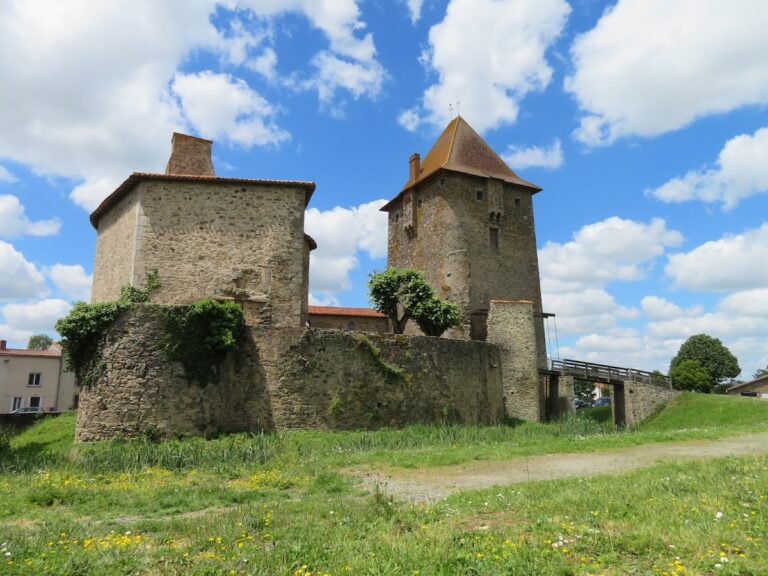
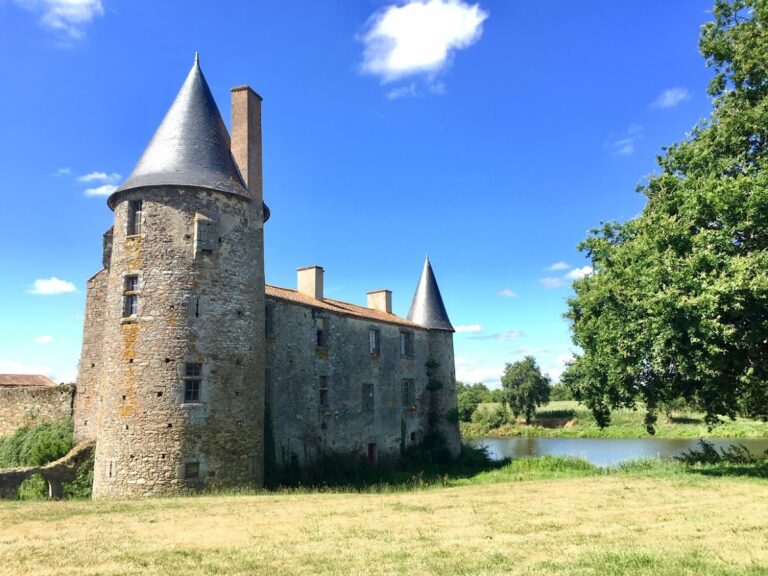
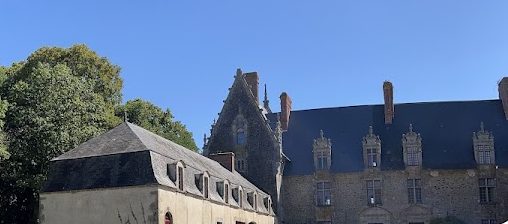
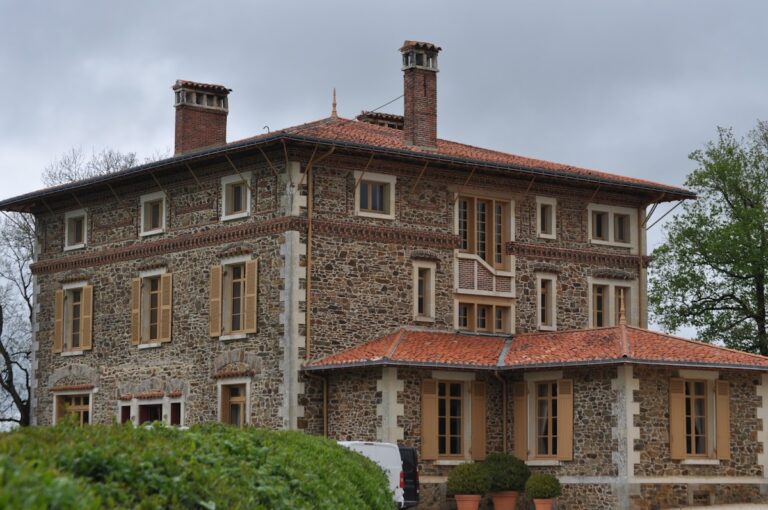
The château and its associated buildings occupy a setting between a lake and a forest, approximately 3 kilometres southeast of Vendrennes, near Mouchamps. The present building is an eighteenth-century structure in ruinous condition, partly raised on the foundations of the earlier fortified château. Its surviving elements form part of a wider estate complex that includes the chapel, the Maison de Tournebride, and the commons.
The Château Ruins
The eighteenth-century château was constructed between 1771 and 1789 and was burned on 31 January 1794. Its façades, roofs, and grand staircase are protected architectural elements. The roof has been restored to shelter the ruins, while the rest of the surviving château remains in the condition created by the fire and its subsequent preservation as a memorial.
The Chapel and Ancillary Buildings
The Chapel
The chapel forms part of the protected architectural complex. Its structure was entered in the register of historic monuments in 1987, while its interior decoration was classified in 1989. The chapel’s decoration is therefore treated as a protected part of the estate alongside the surviving château and service buildings.
The Maison de Tournebride
The Maison de Tournebride is an ancillary house within the château complex. It is included among the protected architectural elements associated with Parc-Soubise.
The Commons and Agricultural Buildings
Surviving seventeenth-century commons include a barn, a granary, and a cellar, attributed to construction under Catherine de Parthenay-L’Archevêque. In a château estate, commons were the service and agricultural buildings that supported the main residence. The outbuildings include a multi-level building used as a salting house, a facility for preserving food with salt, and as a granary for storing grain.
The Chabot family progressively adapted the commons for residential use over the centuries. Since 2018, the Darcy family has lived in these buildings. Together with the château and chapel, the commons remain part of the physical complex associated with the Chabot family estate.