Chartwell: Winston Churchill’s Country House and Political Home
Site at a Glance
- Popularity
- Very High
- Country
- United Kingdom
- Primary era
- Modern
- Eras represented
- Early Modern, Modern
- Civilizations
- British, English
- Site type
- Domestic
- Remains
- Manor House
On this page19 sections
History
Chartwell is a country house near Westerham in Kent, United Kingdom. Its estate history reaches back to the fourteenth century, and it later became the home of Winston Churchill, the British statesman who served as prime minister during much of the Second World War.
From Well-street to a country house
The estate is recorded in 1362, when William At-Well sold land there. By 1382 the property was known as Well-street and was associated with William-at-Well. A house stood on the site by the early sixteenth century, when the name Well Street was still in use. The property served as a farmhouse in the seventeenth and eighteenth centuries, changing hands repeatedly.
A tradition holds that Henry VIII stayed at the house while courting Anne Boleyn at nearby Hever Castle, though the connection is not firmly established. The name Chartwell comes from Chart Well, a spring north of the house. The first part of the name derives from an Old English word for rough ground.
On 22 September 1836, the property was auctioned at Cheapside as a substantial brick-built manor and promoted as a suitable home for a genteel family. John Campbell Colquhoun, a former Member of Parliament, bought it in 1848. His family enlarged and altered the house, including the addition of stepped gables that referred to their Scottish ancestry.
Churchill’s purchase and rebuilding
Churchill first saw Chartwell in July 1921 and returned with his wife, Clementine. Her early enthusiasm for the property later faded. When the house failed to sell at auction in 1922, Captain Archibald John Campbell Colquhoun offered it to Churchill for £5,500. Churchill’s first bid of £4,800 was refused; he then agreed to pay £5,000, citing dry rot and the extensive rebuilding needed. The sale was completed on 11 November 1922.
Architect Philip Tilden began modernising and enlarging the house that year. While work continued, the Churchills rented a farmhouse near Westerham, and Churchill often visited the building site. The projected cost rose from £7,000 to more than £18,000. Damp and other building problems caused serious disagreements between Churchill and Tilden, and they were barely speaking by 1924. Legal disputes continued until 1927. Churchill moved into Chartwell in April 1924.
A political home in the 1930s
From 1927, Churchill sent Clementine lengthy letters he called Chartwell Bulletins, describing the house, the gardens and his life there. During the 1930s, when he held no political office, Chartwell became a centre of his political work. He welcomed supporters of his campaign against German rearmament, Germany’s military expansion before the Second World War, and against the British policy of appeasement, which sought to avoid conflict through concessions. He also wrote speeches and books at the house.
A visitor book kept from 1922 recorded 780 house guests. Desmond Morton and Ralph Wigram were among those who passed Churchill confidential information about German rearmament and Hitler’s movement. Morton’s actions breached the Official Secrets Act, British legislation restricting the disclosure of certain official information. After a dinner at Chartwell in April 1936, Sir Maurice Hankey, Clerk of the Privy Council, noted indications of Churchill’s likely arguments in upcoming parliamentary debates on munitions and supply. A week later, Foreign Office official Reginald Leeper conveyed his and Robert Vansittart’s view that the League of Nations, an international organisation established after the First World War to promote collective security, should be used to oppose German aggression.
Churchill considered selling the property in 1938 because of financial pressures, including losses on his Wall Street investments. He abandoned the plan after industrialist Henry Strakosch took over his share portfolio for three years and agreed to cover associated debts. In October 1939, after returning to the post of First Lord of the Admiralty, the political head of the department responsible for the Royal Navy, Churchill proposed improving anti-aircraft shells with a substance that ignited spontaneously. A small quantity had been demonstrated at Chartwell the previous summer.
Wartime and the National Trust purchase
Chartwell was mostly unused during the Second World War. Its exposed position in Kent, close to German-occupied France, left it vulnerable to air attack or a commando raid. Brushwood was spread over the lakes to make the house harder to identify from the air. The Churchills instead spent weekends at Ditchley until security work at Chequers was complete.
Churchill visited Chartwell occasionally. In July 1940, he inspected aircraft batteries in Kent; shortly before the fall of France that year, he spent a night at the house. After Lord Gort urgently requested permission to retreat to Dunkirk, Churchill returned to London and broadcast his first wartime speech to the nation. On 20 June 1941, following the failure of Operation Battleaxe, a British offensive in North Africa intended to relieve Tobruk, Churchill considered dismissing Middle East commander General Wavell and restarting the offensive. On 24 June 1944, soon after the Normandy landings, the house was described as closed and desolate.
The Churchills returned on 18 May 1945, after the Allied victory in Europe. Following Churchill’s defeat in the July general election, he again considered selling the estate because of its upkeep. Friends led by Lord Camrose raised £55,000. The National Trust, a British conservation charity, bought Chartwell for £43,800, with the balance placed in an endowment. The sale was completed on 29 November 1945. The Churchills retained a 50-year lease for their lifetimes, paying £350 a year plus rates.
Churchill’s later years and Chartwell’s preservation
In 1946 and 1947 Churchill enlarged his landholdings by buying Chartwell Farm and Parkside Farm, then Bardogs Farm and a market garden. By 1948 he farmed about 500 acres, with his son-in-law Christopher Soames managing the farms. The estate kept cattle and pigs and produced crops and market vegetables, but the farms were unprofitable: annual operating losses exceeded £10,000 by 1952. The farms and livestock were sold by the end of the decade. Churchill also bred racehorses. He bought Colonist II in 1949, and it won the Upavon Stakes at Salisbury that year, earning him £13,000 in prize money. He bought Newchapel Stud in 1955, and his racing winnings had exceeded £70,000 by 1961.
Chartwell became a refuge for Churchill after a debilitating stroke in 1953, while he was again prime minister. He was brought to the house on 25 June, and his condition worsened. His doctor, Lord Moran, feared he would not survive the weekend. Friends, including Lord Beaverbrook, Lord Camrose and Brendan Bracken, arranged a press blackout. Churchill recovered and completed Triumph and Tragedy, the final volume of his war memoirs, which he had set aside on returning to Downing Street in 1951.
After resigning as prime minister in April 1955, Churchill spent much of the following decade at Chartwell, although he and Clementine also travelled widely. He wrote, painted, played bezique, a nineteenth-century card game, and spent time by the fishpond. His last dinner guests were former principal private secretary Sir Leslie Rowan and Rowan’s wife, on 13 October 1964. Churchill left the following week and never returned; he died at his London home on 24 January 1965. Clementine surrendered her rights to Chartwell, and the National Trust opened it as a historic house museum in 1966.
The Trust has kept the house furnished to evoke its appearance in the 1920s and 1930s, in line with Churchill’s wish that it should interest the public. In 2016, the Trust appealed for funds to acquire hundreds of personal objects then on loan from the Churchill family. The Great Storm of 1987 brought down 23 trees in the gardens and destroyed more than 70 per cent of the trees in the surrounding woodland. Chartwell is a Grade I listed building, a category for buildings of exceptional interest; its gardens are Grade II* and registered as a historic park and garden.
Remains
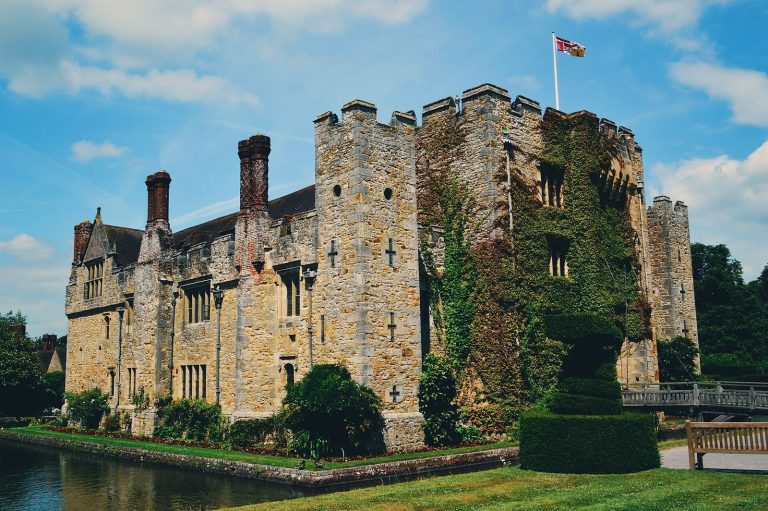
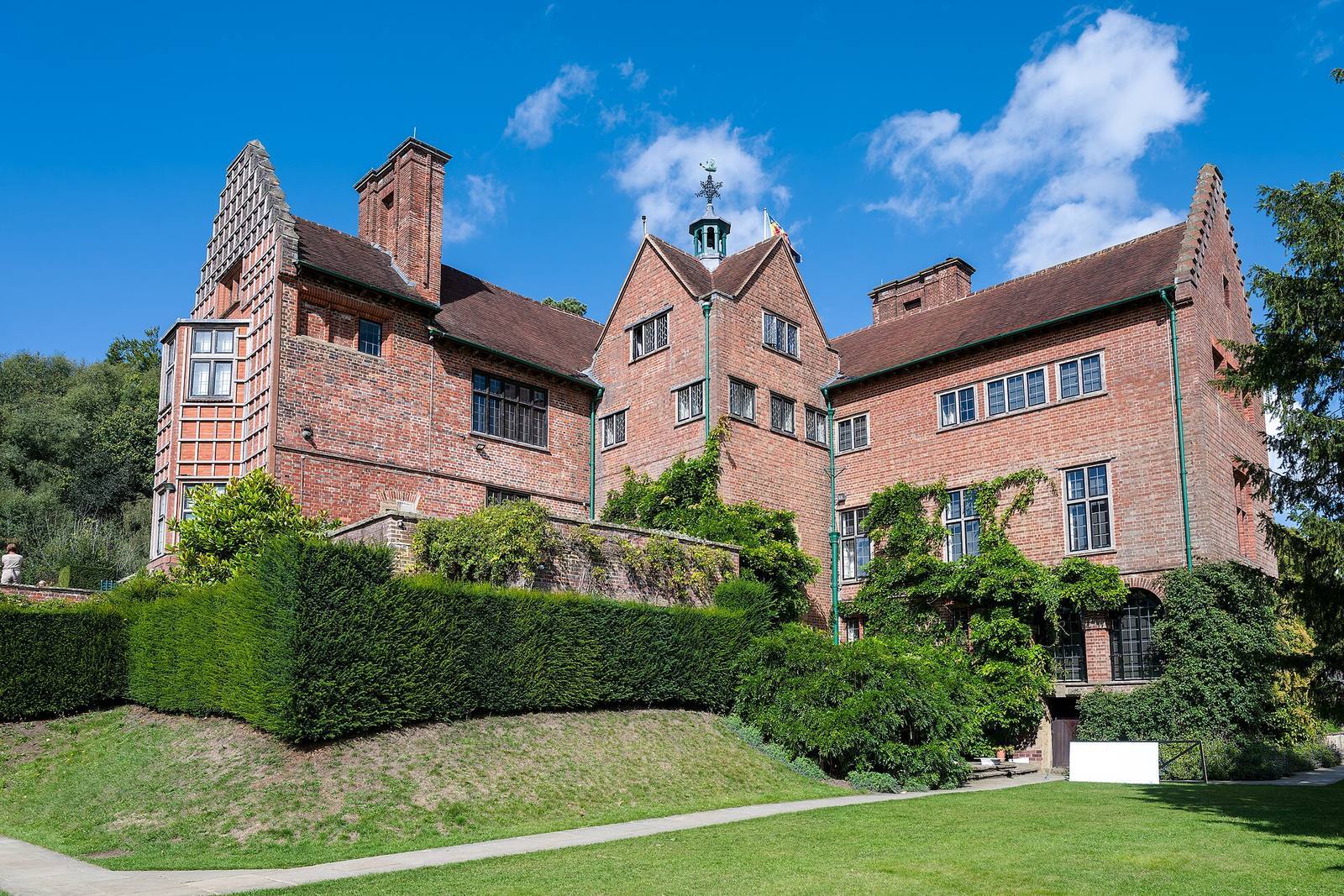
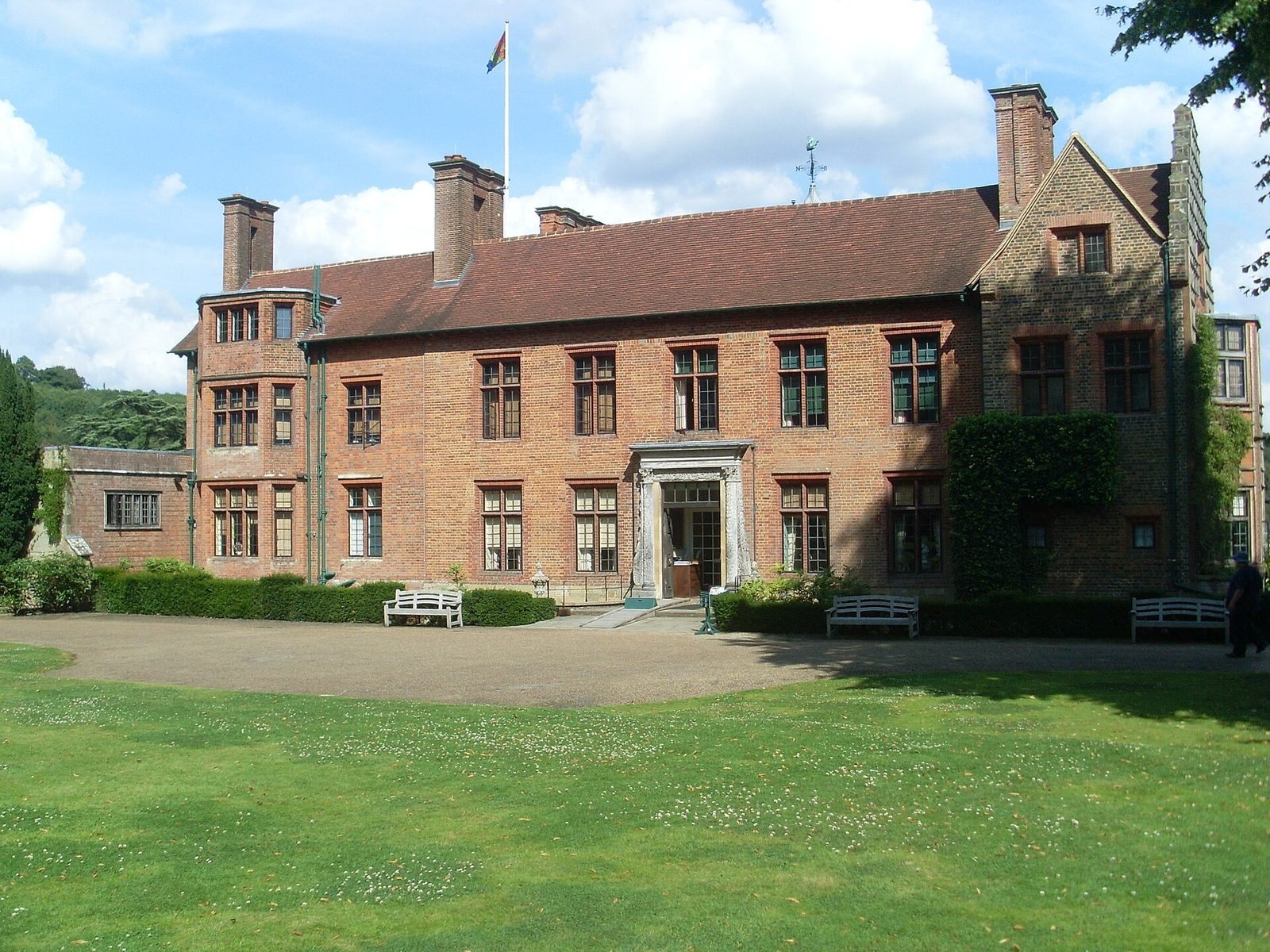
Chartwell stands at about 650 feet above sea level, on the estate’s highest ground, and overlooks the Weald, a region of wooded, rolling countryside in southeast England. The house is a two-storey red-brick building with a basement and extensive attics. Its walls retain sections of brickwork from the sixteenth century, or possibly the seventeenth, alongside visible fabric from the earlier Tudor-era house. The property developed from a farmhouse into a large Victorian mansion before Tilden’s work of 1922–24 reshaped and extended it.
Exterior and principal extension
The garden front is dominated by a three-storey extension with stepped gables, built during Tilden’s work. Churchill called it his promontory. The dining room occupies its lower storey, with the drawing room and Lady Churchill’s bedroom above. The entrance front has an eighteenth-century doorcase bought from a London antiques dealer; architectural historian John Newman considered it out of place. Along Mapleton Road, the garden wall was modelled on the wall at Quebec House, the home of General Wolfe. The earlier house’s Campbell Colquhoun additions included stepped gables, while the mansion Churchill acquired had red brick, tile-hung gables and small projecting oriel windows.
Interior rooms and collections
After the National Trust took over the property in 1966, it combined some guest bedrooms to form a Museum Room and a Uniform Room. Most principal rooms were reconstructed and furnished to suggest the house’s 1920s and 1930s appearance. Tilden’s halls replaced an earlier wood-panelled hall and connect with the library, drawing room and Lady Churchill’s sitting room.
Library
The library contains Frank O. Salisbury’s 1942 portrait of Churchill wearing a siren suit, a one-piece garment designed to be put on quickly, often over other clothes. A wall-mounted model depicts Port Arromanches, the Normandy landing site and its temporary Mulberry harbour, on 23 September 1944, 109 days after D-Day.
Drawing room
The drawing room was used to receive guests and play bezique. It contains Claude Monet’s unfinished view of Charing Cross Bridge, painted from the balcony of the Savoy Hotel. The painting later became part of negotiations between Churchill’s estate executors and the National Land Fund, a British fund used to secure heritage properties for public benefit, over transferring Chartwell’s contents to the Trust in lieu of death duties.
Dining room
The room retains its original Heal’s table and chairs, made to Churchill’s specifications. A study by William Nicholson for a planned painting, Breakfast at Chartwell, hangs there. Nicholson, who gave Churchill painting lessons, intended the finished work as a silver-wedding-anniversary gift in 1933 but destroyed it after disliking the result. The surviving study depicts the Churchills, who rarely ate breakfast together, and their marmalade cat, Tango. Churchill’s painting Tea at Chartwell: 29 August 1927 also shows a gathering in the room.
First-floor study and bedroom
In Churchill’s first-floor study, Tilden removed a late-Victorian ceiling to expose early roof beams and inserted a Tudor doorcase. Three banners hang from the beams: Churchill’s standards as Knight of the Garter and Lord Warden of the Cinque Ports, and the Union Flag raised over Rome on 5 June 1944. It was the first British flag to fly over a liberated capital and was given to Churchill by Harold Alexander. The study also holds portraits of Churchill’s parents, including a portrait of his mother by John Singer Sargent. A Khorassan carpet, from a region of northeastern Iran known in part for its carpets, was a gift from the Shah of Iran for Churchill’s 69th birthday at the Tehran Conference in 1943.
Churchill’s bedroom and en-suite bathroom lie beyond the study. The bathroom includes a sunken bath. The family kept these rooms closed when the house opened in 1966; Mary Soames gave permission for them to open shortly before her death in 2014.
Museum Room and painting studio
Churchill’s 1953 Nobel Prize in Literature medal is displayed in the Museum Room, alongside a Trust collection of his personal objects, books, gifts, honours and medals. His painting studio, built in the 1930s, houses a large collection of his artwork.
Gardens and estate landscape
The gardens cover 8 hectares, or 20 acres, with a further 23 hectares, or 57 acres, of parkland. The Churchills removed much of the Victorian planting of conifers and rhododendrons while retaining the surrounding woodland. They created most of the garden’s landscape, architectural and water features. Lanning Roper later made substantial contributions as the National Trust’s gardens adviser.
Terraced lawn and rose garden
The garden front opens onto a terraced lawn. A sunken boundary, known as a ha-ha, originally separated it from the garden without interrupting the view; a Kentish ragstone wall built in the 1950s later took its place. To the north, the rose garden was laid out by Lady Churchill and her cousin Venetia Stanley. Nearby, Tilden’s Marlborough Pavilion is decorated with frescoes painted by Churchill’s nephew John Spencer Churchill in 1949.
Water garden and swimming pool
Beyond the rose garden lies the water garden, which includes the golden-orfe pond where Churchill fed his fish. The swimming pool was built in the 1930s. Churchill consulted his friend and scientific adviser Frederick Lindemann about heating and cleaning it.
Southern grounds and estate buildings
South of the house, a croquet lawn occupies the site of a former tennis court. Nearby, buildings are grouped around the Victorian kitchen garden. Churchill added walls, a summerhouse and several houses on the estate during the 1920s and 1930s. The Golden Rose Walk nearby contains 32 varieties of golden roses, given by the Churchills’ children for their parents’ golden wedding anniversary in 1958.
Lakes
The upper and lower lakes lie south of the terrace lawn. The lower lake already existed under the Colquhouns; Churchill created its island and the upper lake. The lakes supported wildfowl, including black swans given by the Australian government. Black swans were introduced again to the lakes in 1975.