Chartreuse de Portes: A Carthusian Monastery in France


Site at a Glance
- Rating
- 4.3
- Popularity
- Very Low
- Country
- France
- Primary era
- Medieval
- Eras represented
- Medieval, Early Modern
- Civilizations
- French, Holy Roman Empire
- Site type
- Religious
- Remains
- Monastery
On this page14 sections
History
Chartreuse de Portes is a Carthusian monastery in France, founded in 1115 in the Bugey Mountains near Bénonces by Benedictine monks who adopted the Carthusian way of life. Built during the medieval period at about 1,000 metres above sea level, it became the third-oldest charterhouse in the Carthusian order and the second-oldest in France after the Grande Chartreuse. Its reputation as the “Charterhouse of the Saints” comes from the monks associated with Portes who were later recognized as saints or blessed.
Foundation and Carthusian beginnings
Bernard and Ponce, monks of Notre-Dame d’Ambronay, sought a more solitary existence than their Benedictine life allowed. Abbot Didier authorized their departure and released them from obedience, while Gauceran, archbishop of Lyon, granted them the surrounding wilderness. He fixed its boundaries and confirmed the monks’ possession of the land in perpetuity for the service of God and the Virgin Mary.
Boson de Benonces soon joined the new community. Bernard de Portes, later bishop of Belley and prior of the monastery, also became one of its early members, and Jean de Montmédy may have joined them. The first lay brothers included Bompar de Surre, Gauthier d’Onglaz, and Hugues de Cassiaco. With Gauceran’s permission, the founders exchanged their black Benedictine habit for the Carthusian habit. Guigues I of the Grande Chartreuse sent Aymard and Pierre to teach them the customs of the order, and Portes became one of the earliest houses to affiliate with the Grande Chartreuse.
The upper monastery was built in stone during the foundation period, and its church was consecrated in 1125. An earthquake around 1148 destroyed the church, which was quickly rebuilt with support from lay nobles and senior churchmen. A lower church at La Courrerie was consecrated in 1128. Gauceran restricted entry into the Portes enclosure by women, hunters, and armed men, while reserving a route for religious use. A tradition places the first hermitages at La Courrerie, below the present monastery. Bernard’s Testament states that the lower church was built three years after the upper one, and La Courrerie may have served as a temporary refuge while the permanent stone buildings replaced earlier huts.
Expansion and territorial disputes
From its foundation through the fourteenth century, Portes expanded within the order and across the Ain region. Its possessions grew through purchases, exchanges, and donations, including land, forests, agricultural holdings, fisheries, mills, rents, rights of passage, and seigneurial rights. The monks administered forestry, livestock raising, and cultivation through their own brothers and lay associates. Local and regional lords often granted property or income in exchange for prayers.
The monastery’s wilderness covered about 4,000 hectares of forest, scrub, and rock, while its enclosure of roughly 1,200 hectares produced relatively little. The Carthusians had no tithes, so they developed properties beyond the immediate enclosure. In the 1130s, Pierre of Lyon allowed Portes to acquire a cellar outside the wilderness. During the thirteenth and fourteenth centuries, the monastery obtained vineyards near Lagnieu, the territories of Boschet and Chalonne for sheep raising, the Fay grange at Souclin, and mills near La Courrerie, Valouse, and Bellet. In 1397 it acquired the lake or marsh of Morte de Chambo and the lake of Les Hôpitaux, where it had held fishing rights since the mid-twelfth century.
Portes repeatedly disputed land and jurisdiction with the canons of Saint-Ruf at the priory of Sainte-Marie d’Ordonnaz and with neighbouring communities. Agreements concerning boundaries, rights, and obligations were reached with Onglaz, Bénonces, Conand, Arandaz, Saint-Rambert-en-Bugey, Soudon, Lompnaz, and Villebois between 1236 and 1335. Some terms favoured the neighbours, but the settlements generally kept relations workable. Papal and episcopal authorities also confirmed the monastery’s protection and boundaries. Pope Innocent II restricted the acquisition of land inside the wilderness in bulls issued in 1136 and 1140. In 1223, Pope Honorius III intervened after Ordonnaz permitted women and lay families to occupy land within Portes territory. The Carthusians eventually tolerated some of this activity because the labour helped clear the forest.
Religious influence and medieval violence
Portes played a role in the leadership of the Carthusian order. Martin de Cogneron served as prior of the Grande Chartreuse and minister general from 1233 to 1236. Bernard de La Tour held the same office from 1247 to 1249 and again from 1253 to 1258. Portes also maintained connections with Saint-Sulpice, Pontigny, Cluny, and other religious communities. A visit by Dominique de Guzman in 1206 is possible, although it remains uncertain.
In 1147, Portes and several other charterhouses opposed the election of Noël, also called Natal, to the bishopric of Grenoble. Pope Eugenius III annulled the election after interventions by Pierre the Venerable and Bernard of Clairvaux. To settle the dispute, Bernard I resigned in favour of Bernard of Portes, later known as Bernard II. He returned as prior in 1149 and resigned again in 1155 in favour of Anthelme of Chignin.
The monastery also suffered direct violence. In 1282, following a dispute with the Abbey of Saint-Rambert, twenty-one armed inhabitants sacked Portes, damaged the church and sacristy, injured several Carthusians, and stole three chests and money. The attackers and the abbot of Saint-Rambert were later ordered to pay 26 livres viennoises. The chests and most of the money were returned. Repeated lawsuits, raids, thefts of livestock and timber, and challenges to property rights continued to weaken the monastery’s finances and buildings.
Late medieval and early modern survival
During the Western Schism, the division within the Roman Catholic Church between rival papal obediences, French and Spanish charterhouses supported Clement VII of Avignon, while German and Italian houses supported Urban VI. Portes continued its penitential life without openly choosing a side. The institutional division was resolved in 1412 through recognition of John XXIII. French kings and the counts and dukes of Savoy repeatedly confirmed Portes’ privileges. Henri IV issued a protection letter in 1600 during the Franco-Savoyard War, Louis XIII confirmed earlier privileges in 1620, and Louis XIV confirmed papal privileges in 1663 and restricted hunting in the Portes territory in 1678.
In 1413, Amblard Colombet left Portes five houses, land, and the patronage of the Saint-Pierre chapel in the church of Lagnieu. This made the Carthusians bourgeois of Lagnieu, giving the monastery a formal civic standing there. During the late sixteenth century, the novitiate was abolished and was restored only in 1971. In 1682, the Benedictine scholar Jean Mabillon described the cells as old, damp, and small.
The church was rebuilt in 1660 under Prior Antoine II Guimet after the earlier building had become dilapidated. Prior Claude de Hée blessed its first stone. During the eighteenth century, Portes remained religiously active despite financial and legal problems, and its learned priors began compiling the history of the monastery after earlier neglect had caused valuable documents to disappear or decay. In 1713, under Prior Jean-Baptiste II Bernard, Portes purchased the marquisate of Saint-Sorlin from Victor-Amédée II, king of Sicily, to settle disputes over land ownership. The purchase required borrowing and was not fully paid until 1723. The closure of Ordonnaz in 1773 and the secularization of several old-observance Cluniac monasteries, including Saint-Rambert and Innimont, in 1788 ended important long-running disputes.
Revolution, restoration, and renewed community
Many religious and liturgical manuscripts from the twelfth to the fifteenth centuries were transferred to the Grande Chartreuse during the general priorate of Dom Le Masson. The French Revolution then abolished seigneurial privileges and ecclesiastical tithes, prohibited monastic vows, and nationalized church property. Portes was inventoried in 1790, and the community dispersed in 1791 after most of the monks refused to abandon their religious life.
The monastery’s land, buildings, furnishings, and houses were sold. Louis Morcel, a grange manager and friend of the Carthusians, bought the Courrerie estate and its furnishings in 1791 in the hope that the order might eventually return. Other properties passed to inhabitants of Lagnieu, Villebois, Bénonces, and Saint-Rambert, and the former monastery became a farm under several private owners.
A second Carthusian community returned in 1855 after the order repurchased the property. Rehabilitation continued until 1859. The church was repaired, a new bell was installed, and the building was reconsecrated to the Virgin Mary. The community became known for hospitality and charity, and Portes developed into a small pilgrimage centre. Its estate then covered about 305 hectares across three cantons, including 160 hectares of forest and 145 hectares of land, of which 60 hectares were arable.
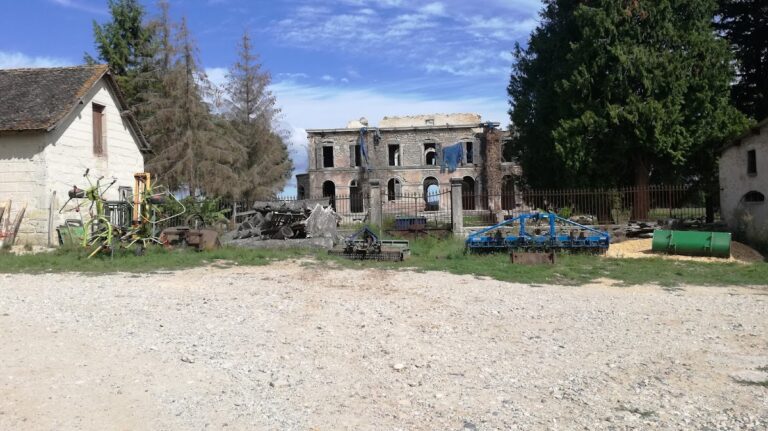
The law on religious associations of July 1901 refused authorization to the Carthusian order. The monks left Portes between September and November that year and took refuge at Saxon-les-Bains in the Valais, Switzerland. The property again passed into lay hands. Farmers used the buildings, which also served briefly as an unsuccessful hotel and holiday estate.
During the Second World War, Portes became a refuge and supply centre for regional resistance fighters based at Les Granges-de-Servieux. The Bourgoin resistance group arrived in August 1944 after the Allied landing in Provence, and fighting with German forces took place in September. Jean-Marcel Servonnat sold the monastery to the Carthusians of Sélignac on 7 August 1952. Emmanuel Cluzet supervised restoration from 1955, although a plan to move the whole Sélignac community to Portes was abandoned because of the severe climate and the limited size of the house.
Part of the Sélignac community, led by Prior Marie-Paul Chapeau, settled at Portes on 29 June 1971, when the novitiate was also restored. In 1985, the community comprised ten monks, including three professed monks and one novice, together with seven lay brothers, including one novice. Foulques-Marie Vidor has been prior since 1 September 2023. Portes has been protected as a historic monument since 20 February 1947, with protection covering its façades and roofs.
The monastery’s religious identity remains Roman Catholic and Carthusian, and its dedication is to the Virgin Mary. Arthaud of Belley, Anthelme of Chignin, Étienne de Châtillon, Airald, Bernard of Portes, and Bernard de La Tour gave rise to the name “Charterhouse of the Saints” through their association with Portes and their later recognition as saints or blessed. Bernard of Ambronay, Hugh the Carthusian, Jean de Montmédy, and Étienne de Chalmet were also regarded as holy or spiritually exemplary, although their cults were not established in the same way. The former community of communes Rhône Chartreuse de Portes took its name from the monastery until its dissolution in 2017, and a public college named Chartreuse de Portes opened at Briord in 2019.
Remains
The monastery stands in a mountainous, forested setting at approximately 1,000 metres above sea level. The principal complex is arranged around a cloister, which encloses the cemetery, while the monks’ cells occupy the surrounding buildings. Natural stone is the principal construction material. The restored community uses a small charterhouse containing approximately twelve cells, reflecting the Carthusian combination of communal worship and strict solitary life in separate cells.
Upper monastery
Church
The church rebuilt in 1660 is approximately 25 metres long, 7.5 metres wide, and 9 metres high. Its form reflects seventeenth-century architectural tastes and the rebuilding undertaken after the earlier church had deteriorated. The church was converted into a hay store during the first lay period, then restored and returned to religious use during the nineteenth-century rehabilitation.
Chapter house and monastic buildings
The complex also included a sacristy, chapter house, refectory, cloister, cells, and agricultural buildings. The chapter house, known as the Chapel of Saint Anthelme, remained in use during the farm period because religious services continued there. A private owner later desacralized both the church and Saint Anthelme’s Chapel. The prior’s cell became the principal family residence, most other cells were demolished except the cell formerly occupied by Michel Vallet, and the refectory was divided into apartments. The chapel and sacristy were converted into a stable.
La Courrerie and the wider estate
Lower monastery
La Courrerie lies below the monks’ monastery and was the lower dependency associated with the lay brothers and practical work. It became a farm after the Carthusians suppressed the correries in the seventeenth century. Foundations of its old church, consecrated in 1128, survive. A calvary associated with Portes stands on the summit of Friolan.
Forests, fields, and water installations
The former estate included extensive forests, cultivated land, meadows, fisheries, mills, granges, and other water-related properties. The mills at Valouse and Bellet were among its installations, and the Bellet mill was supplied by the Tréfond stream. These remains and associated properties reflect the material resources that supported the monastery’s religious community and its agricultural administration.
Devotional and archival remains
Portes’ heraldry is dedicated to the Virgin Mary. Its arms were registered in 1696 as a blue field bearing a silver image of Our Lady turned to the side. A correction made in 1872 interpreted the figure as crowned, while a nineteenth-century sculptural interpretation showed the Virgin and Child, with the Child on her right arm.
Several seals preserve related images. A seal attached to a 1249 charter shows the seated Virgin holding the Child on her left arm. A damaged green wax seal from 1309 depicts the crowned Virgin seated in a Gothic chapel, with a kneeling Carthusian below her and a legend identifying the prior of Portes. An undated pale wax seal shows the Virgin holding the Child on her knees, while a sixteenth-century seal includes the Virgin and Child with a bishop below. A seal from 1777 also represents the Virgin and Child.
An ivory oliphant formerly kept in the charterhouse treasury survived the revolutionary upheavals. Tradition says that shepherds found it around 1400 in the cave of La Balme à Roland at Ordonnaz and placed it at Portes. During the Revolution, the monks entrusted it to the scholar Thomas Riboud. The Duke of Luynes later acquired it and donated it to the Bibliothèque nationale de France in 1862.
Much of the monastery’s former furniture, panelling, sacred and secular objects, and devotional statuary was dispersed after the Revolution. Ancient parchments were deposited in the Archives of Ain, while many books were taken to the departmental capital and later disappeared.
Nearby sites