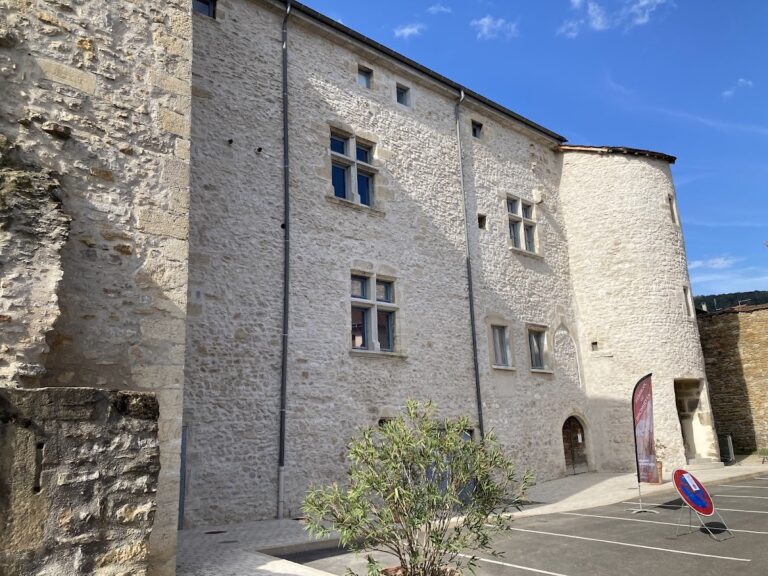
Château du Vernay: A Nineteenth-Century Residence in Charette, France


Site at a Glance
- Rating
- 4.4
- Popularity
- Very Low
- Country
- France
- Primary era
- Modern
- Eras represented
- Modern
- Civilizations
- French
- Site type
- Domestic
- Remains
- Elite Residence
On this page10 sections
History
Château du Vernay is a nineteenth-century residence in Charette, France, built in the late Neoclassical period and completed during the Second Empire, the rule of Napoleon III from 1852 to 1870. It became the seat of a cadet branch of the Ruolz family, whose lineage was traced to the twelfth century. The original owners were Baron Ferdinand de Ruolz and Anna Badin.
The Ruolz family and construction
Ferdinand de Ruolz combined scientific, military, and educational careers. A graduate of the École polytechnique, he served as a captain of engineers, took part in expeditions in Africa, and worked on the fortifications of Lyon and Paris. He later directed the Lycée La Martinière Diderot in Lyon. Under his ownership, the residence was completed during the Second Empire, when it also received an additional upper story set into a steeply sloping roof.
The Chardonnet connection
In 1865, the Count of Chambord, a French Legitimist claimant to the throne, sent Hilaire de Chardonnet to inspect the estate’s mulberry cultivation after disease affected its silkworms. At Vernay, Chardonnet met Camille de Ruolz, Ferdinand’s daughter. They married in 1866, linking the Chardonnet family to the estate.
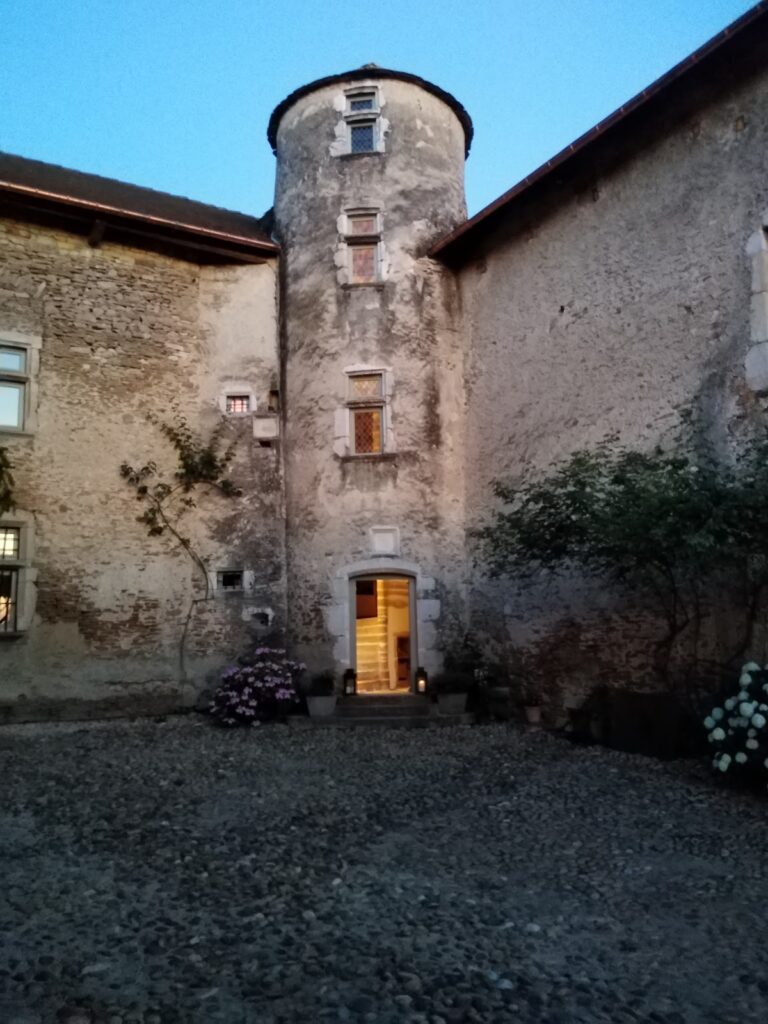
Chardonnet established a workshop in the château’s outbuildings, where he developed artificial silk, described as viscose. The workshop exploded in 1888. The enterprise nevertheless became an important part of the family’s history, although its commercial difficulties later contributed to the reduction of their fortune.
Carlist associations and aristocratic society
Between 1867 and 1872, Chardonnet was actively involved in the Second Carlist War in Spain, a conflict in which supporters of the Bourbon claimant opposed the ruling line. During this period, Château du Vernay regularly received Charles de Bourbon, the Carlist claimant to the Spanish crown, his family in exile, and several of his generals. These visits were accompanied by large nighttime celebrations in an illuminated park.
The Chardonnet family also welcomed senior religious figures, noble families from the surrounding region, and members of the European aristocracy. Among the guests were Prince Roland Bonaparte and Jacques de Bourbon, a Legitimist claimant to the French crown. The estate’s political and social associations connected it with both Spanish Carlist circles and French monarchist succession claims.
Financial decline and changing ownership
Carlist involvement and the financial problems of the artificial-silk enterprise placed heavy pressure on the Chardonnet family’s wealth. Several properties were sold, while Vernay was repeatedly mortgaged. After the First World War, Félix de Pardieu, who had married Anne de Chardonnet in 1917, helped settle part of the château’s debts.
Hilaire de Chardonnet and Camille subsequently spent less time at Vernay and lived more modestly in Paris on a pension paid by Lyon silk manufacturers. After the deaths of Hilaire in 1924, Anne in 1926, and Camille in 1927, the property passed to a younger nephew, Hilaire de Boisgrollier. He paid the remaining inheritance debts through his work at Banque Adam.
Banque Adam was liquidated in 1930 after the financial speculations of Albert Oustric. Boisgrollier then established a wool-producing sheep operation at Vernay, but eventually sold the château to private individuals in 1952 to repay his loans. A commemorative plaque was placed on the wall of Charette town hall in 1929.
Abandonment and conservation
The château was emptied of most of its furnishings in 1952. Its outbuildings continued to provide housing and agricultural premises, while the main residence was abandoned. Woodwork, large mirrors, the library, and other interior elements were damaged or taken during looting and exposure to the weather.
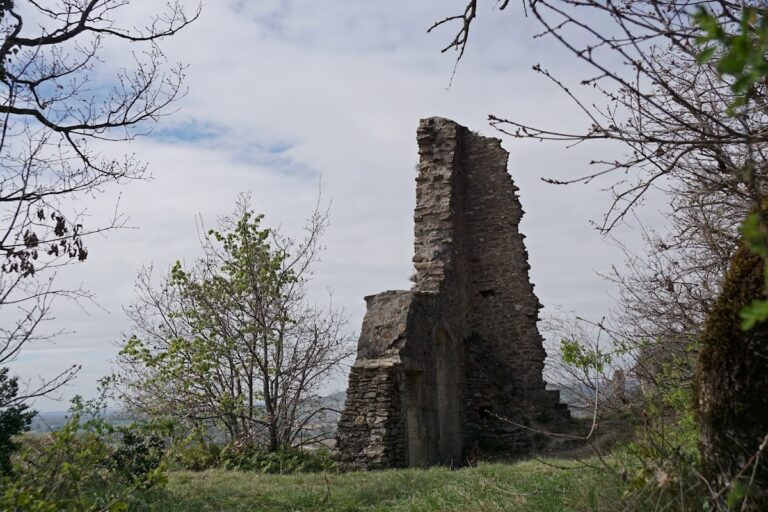
Consolidation work began in spring 2019, along with measures intended to make the building watertight and weatherproof. Plans were announced to rehabilitate the château as rental housing. The property remains privately owned and has been described as being in ruins.
Remains
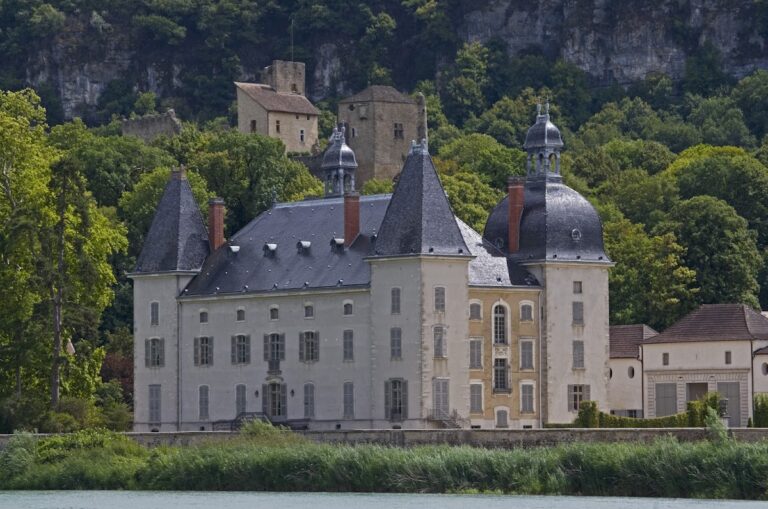
Château du Vernay is a late Neoclassical building with restrained ornament and clear, orderly lines. Its monumental garden façade is organized around a central projecting pavilion crowned by a pediment, the triangular feature above the pavilion. The design follows the pattern of several Lyonnais country houses, including Maison La Rivette and Château de Chavagneux, and recalls the former Château d’Issy of the Princes of Conti, while using less elaborate decoration.
Exterior and roof
During the Second Empire, the residence was raised by an additional mansard story, an upper floor built within a steeply sloping roof, and covered with slate. This alteration gave the château a visual resemblance to Château du Haut-Buisson at Cherré in Sarthe. The change remains part of the building’s architectural character and reflects the transformation of the residence during the period of its completion.
Patio and interiors
A glass roof formerly covered the château’s patio, an enclosed interior courtyard arranged in an Orientalist style. The glass roof was later destroyed. The interior also included an entrance hall, salons, woodwork, large mirrors, and a library. These spaces were affected by abandonment, looting, and exposure to the weather, while photographs from 1949 and from 2014 to 2018 preserve evidence of the building and its interiors.
Political and artistic spaces
An honor bedroom was reserved for exiled claimants to the Spanish crown. Red tapestries decorated with fleurs-de-lis formed part of the room’s furnishings and connected the space with the monarchist circles welcomed at Vernay.
Anne de Chardonnet, the daughter of Hilaire de Chardonnet and Camille de Ruolz, established her sculpture studio at the château. She had trained under Mathurin Moreau and Jules Franceschi. Objects from the château workshop are preserved at the Musée des Beaux-Arts et d’Archéologie in Besançon and the Musée de la Viscose in Échirolles.
Nearby sites