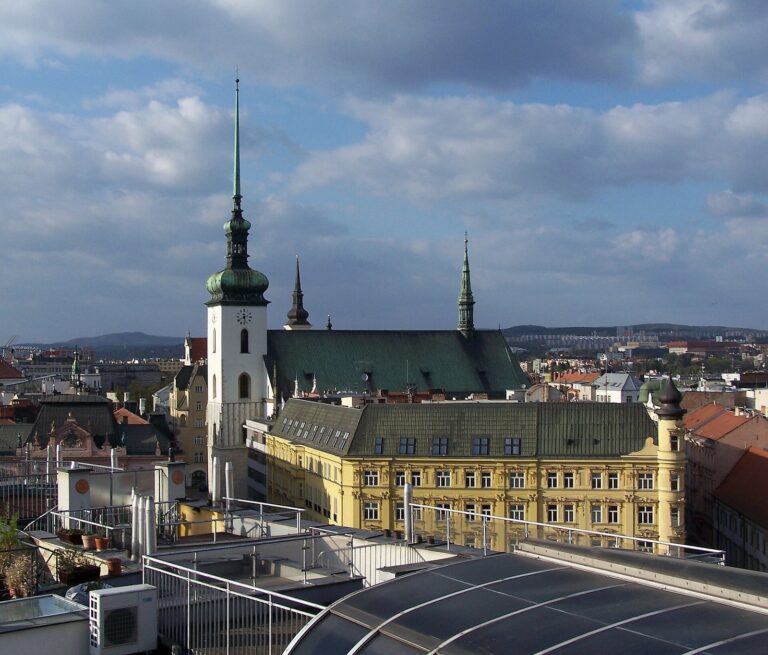
Charterhouse of Brno: A Medieval Carthusian Monastery
Site at a Glance
- Popularity
- Medium
- Country
- Czechia
- Primary era
- Early Modern
- Eras represented
- Medieval, Early Modern, Modern
- Civilizations
- Habsburg, Habsburg Austria, Holy Roman Empire, Margraviate of Moravia
- Site type
- Religious
- Remains
- Monastery
On this page19 sections
History
The Charterhouse of Brno is a former Carthusian monastery in Brno, Czechia, founded by Moravian margrave John Henry of Luxembourg in 1375 and dedicated to the Holy Trinity. A margrave was a ruler of a frontier territory. The Carthusian Order is a Catholic monastic order whose members combine periods of solitude with communal worship. The house was the first Carthusian monastery in Moravia and the second in the Czech lands.
Foundation and early community
Planning and building probably began in 1369, when John Henry summoned a monk from the Charterhouse of Gaming. The foundations were laid after the foundation charter was issued on 13 August 1375, and the church and monastery may have been completed the following year. John Henry established the house with the support of his sons Jobst, Procopius, and John Sobieslaus. He granted it land and other property at Královo Pole, villages at Strzielcz and Černovice, a vineyard at Obřany, exemptions, and his direct protection. Bishop John of Olomouc confirmed the charter three days after its issue. Following John Henry’s death in November 1375, Jobst confirmed the endowment and entered the monastery’s property in the Moravian land records in January 1376.
Monks came from Gaming, which served as the new community’s mother house and provided its first prior, or head. The community was planned for twelve brothers, in addition to the necessary servants. At first, the monks lived in an existing residence incorporated into the monastery grounds. The Brno house maintained connections with Gaming and with the Carthusian monastery at Dolany, formalized by agreements in 1384 and 1415. In 1387, a chaplain from Brno’s Church of St James gave his library to the monks in exchange for accommodation and customary support for the rest of his life.
Conflict, destruction, and rebuilding
The monastery suffered during conflicts between Jobst and Procopius, although Procopius was buried in its church in 1405. Johannes Rode, a monk from the Prague Charterhouse, served as prior from 1406 to 1408. During the Hussite conflicts, the monks sought refuge within Brno’s walls. The deserted monastery was plundered and burned, and its estates passed into secular hands amid the wartime disorder. The monastery and village were burned in 1423; rebuilding began after 1431. In 1448, the monks acquired a house or palace in Brno from the Benedictines of Třebíč.
The house began to recover with support under King George of Poděbrady, but fighting around Brno and Špilberk fortress brought further damage. After Brno allied with Hungarian king Matthias Corvinus against George, Hungarian troops supporting Matthias sacked and burned the monastery around 1468 or 1469. George’s son Viktorin had been defending Špilberk but could no longer hold the fortress by January 1469. The monastery was rebuilt, and its prospects improved under prior Bernhard Lang and, from 1490, his brother Anton. Members of the Brno Lang family supported the Carthusians through bequests over several generations.
Reform and renewed instability
A period of stagnation followed, and discipline loosened during the second half of the sixteenth century. In 1590, a Carthusian visitor, an official who inspected monasteries, sought the removal of Prior Petr. Bishop Stanislav Pavlovský opposed the move, blaming some disorder on frequent changes of prior. He also defended the scholarly standing of Petr Carbonarius, whose work on Hebrew had recently been printed with imperial support.
Seizure and rebuilding
Protestant estates confiscated the charterhouse on 17 August 1619 and detained its monks. The monastery’s villages were devastated and divided into plots for sale. After imperial forces prevailed, the community recovered its property and received compensation from land taken from Protestants. By 1626 it could lend the indebted city of Brno 5,000 gulden, a contemporary currency, to support its troops. Bishop Franz Seraph von Dietrichstein also pressed for the house to be restored and compensated.
Swedish forces plundered the monastery repeatedly during the Thirty Years’ War. General Lennart Torstensson used it as his headquarters in 1645. When the monks returned after the Swedish departure, about half of the complex remained standing. Rebuilding and expansion proceeded in stages from the 1650s through the 1690s, with priors Bernardus, Adam Pozius, and Benatus Hensaeus involved in the recovery and consolidation.
Baroque renewal and dissolution
Around the turn of the seventeenth and eighteenth centuries, the monastery enjoyed renewed economic, intellectual, and cultural prosperity, interrupted by the War of the Austrian Succession. Regional artists working for the house included architect Mořic Grimm and stucco artist Giacomo Antonio Corbellini. In the 1760s, Prior Athanasius Gottfried led a major Baroque renewal and enlargement of the monastery and church.
Emperor Joseph II’s reforms targeted contemplative religious orders and transferred their property to the Religious Fund for the benefit of Catholic institutions. The charterhouse was dissolved on 18 January 1782. A commission led by Count Johann Mitrowsky announced the decree; the monks could accept pensions or join another religious house. Gottfried, prior from 1750 and the last to hold the office, died in Brno in 1814. The former monastery buildings became barracks, and the adjoining land was divided into plots. The library was dispersed and auctioned, while Gottfried gradually sold his art collections. The church became a filial church in 1782 and an independent parish church in 1853. It replaced the former village church, which was suppressed in 1783 and demolished in 1785.
Later use
The former monastery served as barracks and, from 1877, as a cadet school. After Czechoslovakia was formed in 1918, the army used the complex. Brno University of Technology took over the surviving monastery buildings in 1964. A university computer department later occupied the site, and the Faculty of Information Technology, established in 2002, is based there. The complex, apart from the parish church, is protected as a Czech cultural monument.
Remains
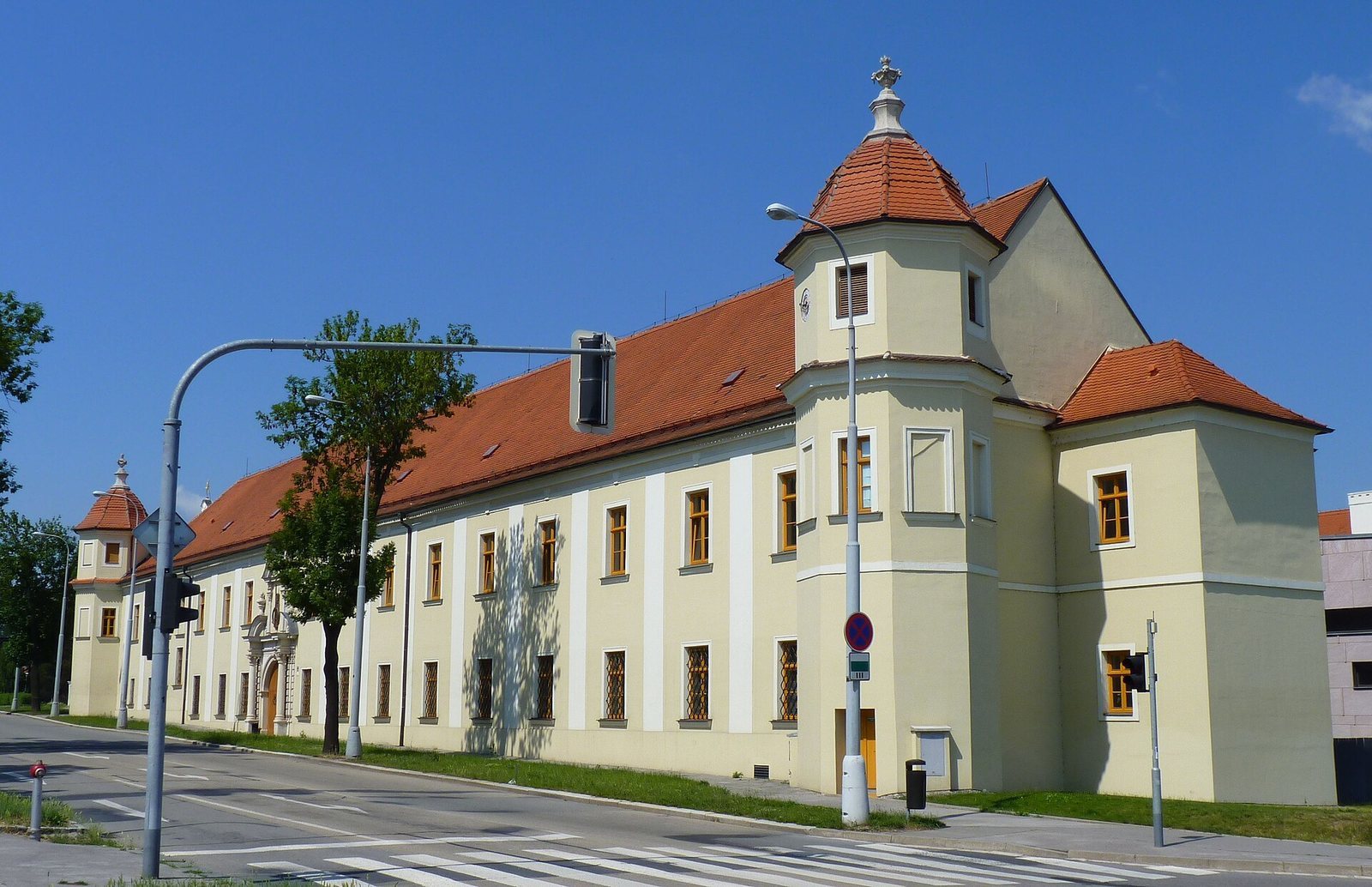
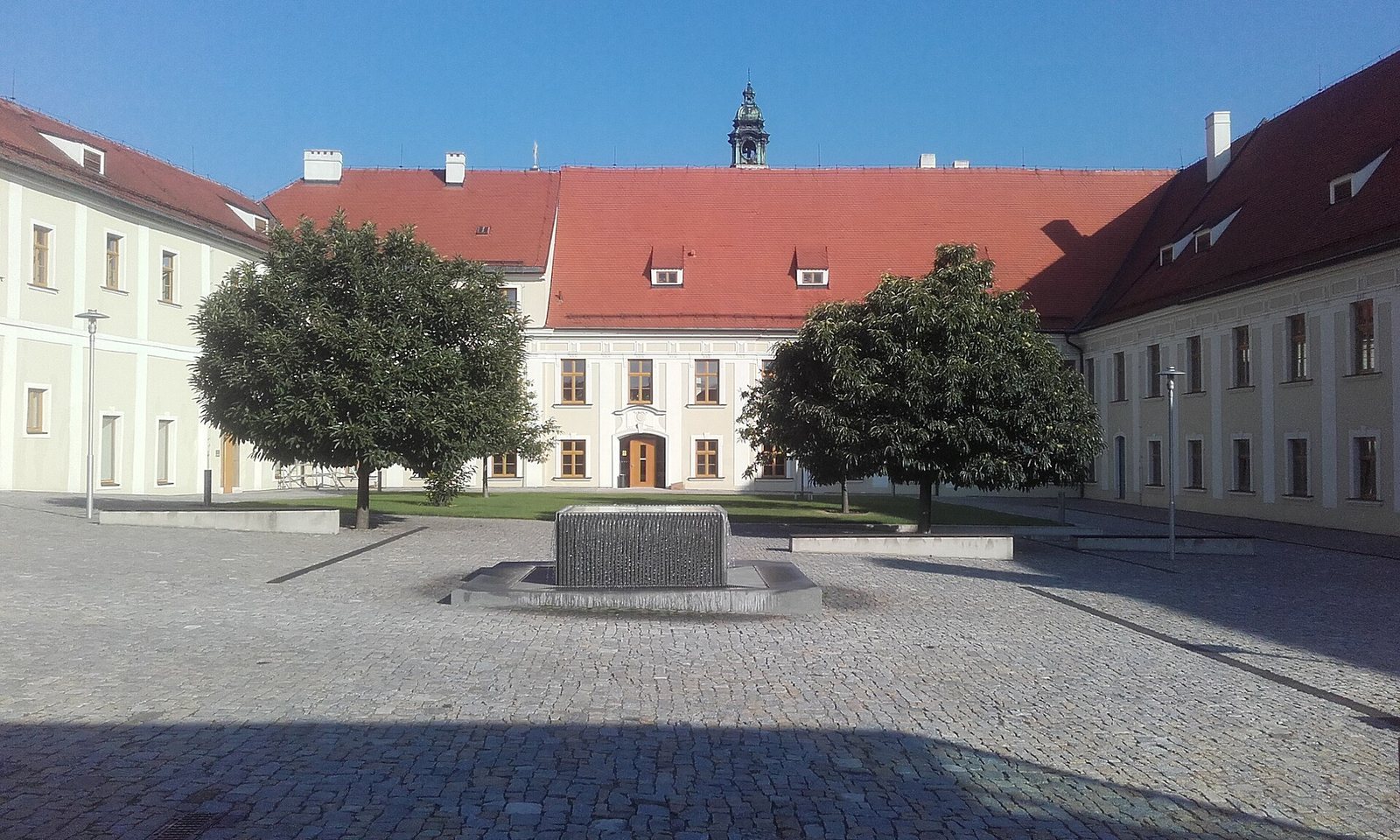
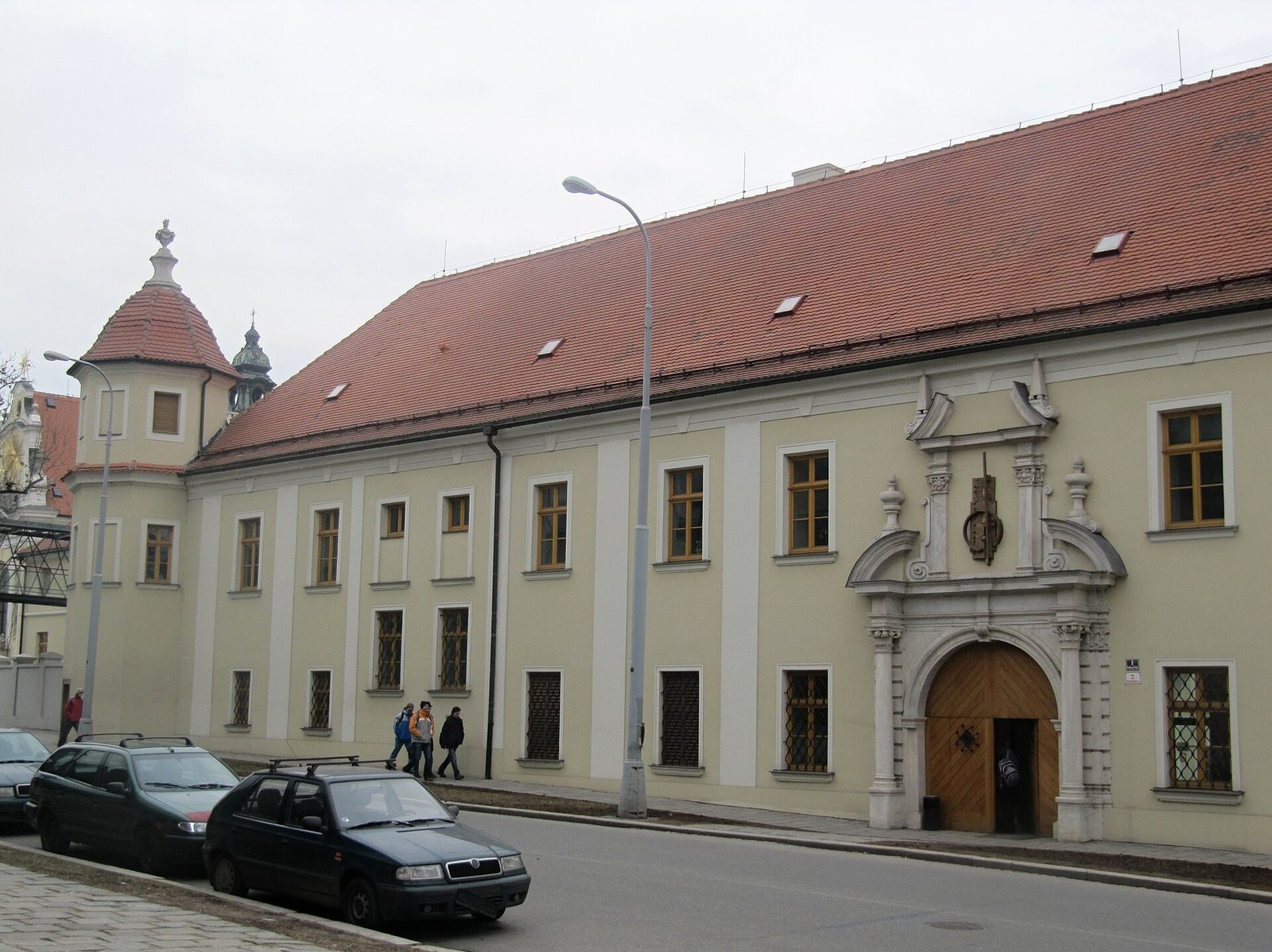
The surviving complex retains the general arrangement of a medieval Carthusian house, with individual monks’ dwellings grouped around two cloisters and economic buildings adjoining the monastic precinct. Its church occupies the western part of the grounds. Brick construction and plaster painted to imitate carefully cut stone blocks characterize the medieval core, while later rebuilding added and altered buildings across the complex.
Medieval plan and boundaries
The monks’ individual houses were arranged around a small cloister and a larger cloister. A residence that existed before the monastery was incorporated into its grounds. By 1387, seven monks’ cells stood within the complex. A ditch marked its northern and western sides, while a wall bounded the southern side. The buildings were made of brick, with painted plaster giving the appearance of stone blocks, a decorative treatment associated with the Luxembourg period.
The church
Medieval plan
The church began as a restrained Carthusian oratory, a place for prayer. Its single-nave hall ended in a many-sided eastern termination. A screen with two altars separated the fathers’ choir, or area for choir monks, from the brothers’ choir, used by lay brothers. Pointed windows lit the fathers’ choir; round windows and a window in the western wall brought light into the brothers’ choir.
Baroque decoration
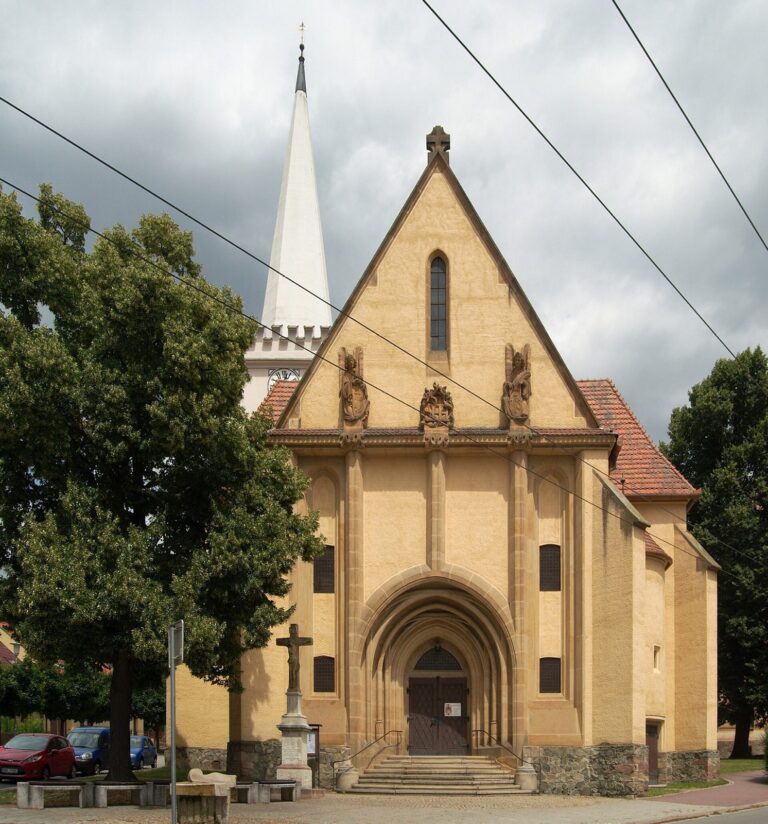
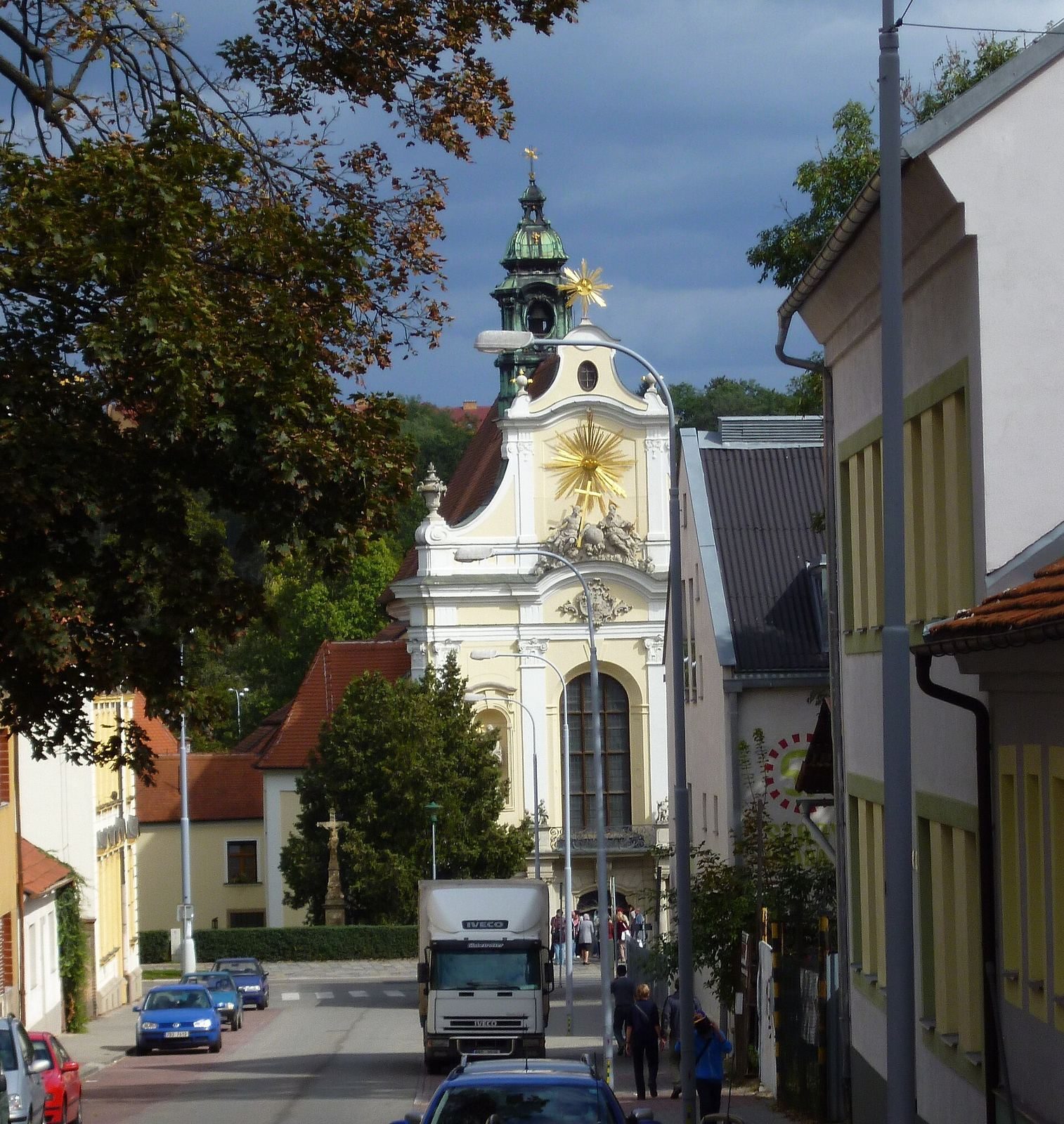
During Gottfried’s eighteenth-century renewal, the church received a new Baroque façade. Sculptor Ondřej Schweigl made a group representing the Holy Trinity and statues of St John the Baptist and St Bruno for the façade, and also worked on the main altar. Felix Lerder painted canvases for two side altars. Twelve apostles painted by Josef Stern were placed in stucco frames on the church walls.
Choir stalls and devotional image
Emerich Thurn carved walnut choir stalls in 1604, decorating them with architectural and figurative designs. The two large stalls from the fathers’ choir remain in the church; smaller stalls from the brothers’ choir are held by the Brno City Museum and the Museum of Decorative Arts in Prague. A Marian painting, probably made in the sixteenth century, was damaged by Swedish troops and came to be venerated as a miraculous image.
Chapter house and adjoining rooms
The sacristy and chapter house, a meeting room for the monastic community, adjoined the church on its eastern side. Traces of original wall paintings survive on their walls. Franz Anton Maulbertsch painted frescoes in the chapter house, including allegories of the Church and Silence, St Bruno, and figures and scenes associated with the monastery’s history. These included its founder, John Henry, his relative Queen Sophia, and her confessor, St John of Nepomuk.
Baroque additions
Rebuilding after the Thirty Years’ War brought a priory building and a long entrance-front wing, with guest rooms on its upper floor. A relief of St Bruno was placed above the gate. Around 1688, a Baroque prefecture with many-sided corner turrets was built south of the charterhouse, on the site of earlier economic buildings. A new refectory, or communal dining hall, and a library above it were built in the early eighteenth century. Around 1709 and 1710, Corbellini decorated the refectory’s barrel-vaulted ceiling with bands of stucco ornament and also worked in the relic chapel. The monks’ houses gained a first floor in 1775.
Library and surviving books
Library and art collection
The library above the refectory held 271 manuscripts, 162 incunables (books printed before 1501), and about 3,000 printed books. The prior’s residence also contained a print collection and a small, carefully selected picture gallery. Its works included paintings attributed to Dürer and Leyden, sketches by Maulbertsch, and a Madonna by Sassoferrato.
Manuscripts and service books
A richly decorated antiphonary, a book of chants for daily worship, dates from the third quarter of the fifteenth century. It contains about twenty figurative initials and additional paintings in its margins. A German explanation of the Ten Commandments by theologian Nicholas of Dinkelsbühl belonged to the Carthusian Matthew of Judenburg. Some of its decoration was completed, while the rest remained in underdrawing; two related codices are now in the Austrian National Library in Vienna. The charterhouse also produced a gradual, a book of chants for Mass, in 1505.
Modern fabric
Restoration of the former monastery complex in the early twenty-first century was accompanied by the addition of modern buildings. The parish church and a separate nearby parish building remain distinct from the former monastery complex.