Saint-Ghislain Abbey: A Monastic Foundation in Belgium
Site at a Glance
- Popularity
- Medium
- Country
- Belgium
- Primary era
- Early Modern
- Eras represented
- Medieval, Early Modern
- Civilizations
- Carolingian, Habsburg, Habsburg Austria, Holy Roman Empire
- Site type
- Religious
- Remains
- Monastery
On this page10 sections
History
Saint-Ghislain Abbey was a Frankish monastery founded around 650 at Saint-Ghislain, Belgium, near the Haine River and about 11 kilometres west of Mons. Its founder, Saint Ghislain, gathered followers in a forest in Hainaut, and the surrounding town later took its name from the abbey. Ghislain’s tomb became a destination for pilgrims.
Foundation and early abbey
A grant of the site for a monastery is dated to around 633, before the abbey’s foundation. The grant is associated with Dagobert I, though Sigebert III is considered the more likely king of Austrasia. A local tradition tells that Dagobert, hunting a bear, saw it take refuge with Ghislain. The story explains the name Ursidongus, meaning “Bear’s Den.” The early community may have followed teachings associated with Basil of Caesarea, whose writings influenced monastic life.
Ghislain led the community for about thirty years and died around 680. He was buried at the monastery. He was close to Saint Amandus, a missionary and bishop, and advised the religious founders Waldetrudis and Aldegonda, associated with foundations at Mons and Maubeuge. In 808, while Eléphas was abbot, work began on a church above Ghislain’s tomb. It was completed in 822 and consecrated by Aubert, bishop of Cambrai. The monastery probably began to be called an abbey around this time, and it adopted the Benedictine Rule, a set of monastic precepts, around 940.
At the end of the ninth century, after Regnier I, count of Hainaut, was defeated, invading Normans plundered the abbey and church. A monk rescued Ghislain’s remains and sacred objects. Neglect and disorder followed, and the monastery’s religious life and finances deteriorated. Around 931, Count Gislebert restored the community with the bishop of Cambrai and arranged for Gérard of Brogne, a Benedictine reformer, to introduce the Rule of Saint Benedict. Gérard served briefly as abbot. A fire badly damaged the monastery in 938. In 965, Otto I confirmed a gift to the abbey from Godfrey of Lower Lotharingia, consisting of 18 landholdings at Villers-Saint-Ghislain.
Medieval growth and local disputes
During the eleventh century, Godfrey of Verdun had an enclosure built around Saint-Ghislain, improving security for both the monastery and town. Baldwin I, count of Hainaut, made further land gifts in 1055. In 1095, Gaulcher, bishop of Cambrai, gave the abbey an altar dedicated to the Virgin Mary. Around 1113, a fire destroyed the abbey. The rebuilding lasted many years and was completed with the church in 1183; Ghislain’s relics, sacred objects associated with a saint, were placed in a new shrine. The knight Gilles de Chin also gave the abbey lands, including Marcasse, a gift confirmed by Pope Lucius III in 1183.
During the Second Crusade, a twelfth-century military expedition to the eastern Mediterranean, the monks supported the counts of Hainaut with fasting and prayer as they took part in expeditions to the Holy Land. The thirteenth and fourteenth centuries brought prosperity, new land acquisitions, and major building projects. In 1289, the abbot received the rank of count of the Holy Roman Empire, a medieval European political realm. At the same time, townspeople increasingly pressed for independence from the abbey, leading to repeated disputes with civil authorities. An agreement in 1400 set out local customs and the use of public property, making the distinction between the town and abbey clearer.
War, reform, and renewed damage
A severe famine in 1437 and near-continuous warfare during the fifteenth century weakened the regional economy and the abbey. Armies regularly crossed Hainaut, and fighting between French and Austrian forces near Cambrai around 1491 brought pillage and disorder. The abbey was in decline by then, and the Bursfeld reform, a movement to restore stricter Benedictine observance, was introduced from 1491.
The monastery revived during the sixteenth century. Around 1513, Abbot Quentin Benoît established a refuge house in Mons, an urban property where members of the community could shelter during danger. It proved useful during the Wars of Religion. In 1581, Huguenots, French Protestants of the Reformed tradition, captured Saint-Ghislain. Religious images and artworks were destroyed, and the town was besieged three times. In 1627, Ghislain’s reliquary, a container for sacred relics, was hidden in Mons. An attack on the abbey’s dovecote in 1656 caused extensive damage, leaving the church and monastery almost entirely destroyed and the monks in poverty.
Rebuilding and suppression
Abbot Joseph Havinne, in office from 1700 to 1726, undertook a major rebuilding campaign. Work on the fifth abbey church began in 1714, and the church was rebuilt by 1718; work on the monastic buildings continued until 1722. Another fire damaged the complex in 1727. Abbot Ghislain Levesques arranged repairs and the addition of a library. In 1729, the abbey also completed the Sainte-Élisabeth hospital and convent in Mons, including a chapel, and entrusted the complex to Augustinian sisters.
In 1752, Abbot Dom Durot established a municipal library in the former town hall. French revolutionary forces entered the Austrian Netherlands in 1794, and the monks went into voluntary exile in Germany, taking their manuscripts with them. The abbey was formally closed on 1 September 1796. Its buildings were sold as public property and dismantled; some stone was reused for the Mons–Condé Canal. In 1797, 1,600 volumes from the abbey library were transferred to the library of the Jemappes department in Mons.
The abbey’s monks had built Saint Martin parish church around 1565 on the town square. The church was destroyed during a bombardment in 1940, while its tower was later renovated and converted into the Espace Ockeghem cultural centre.
Remains
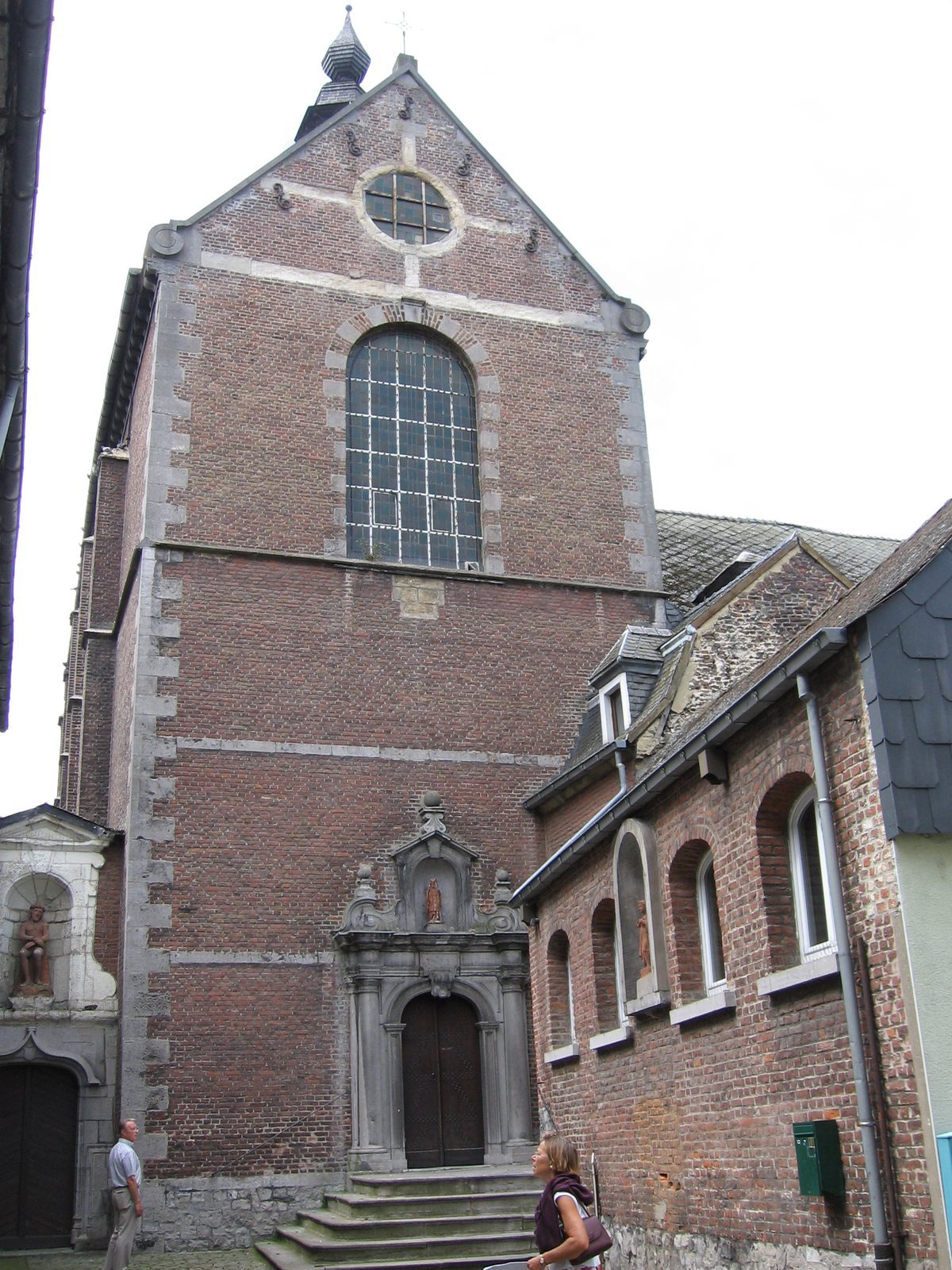
The abbey’s surviving features are dispersed between the former monastery site, Saint-Ghislain, and Mons. A small section of the former enclosure remains, while the abbey church is now a parish church.
Church, enclosure, and relics
The church’s choir stalls, the seats once used by clergy in the choir, are now in Tournai Cathedral. A neo-Gothic abbey chapel contains Ghislain’s reliquary. It was damaged in an earlier war and restored during the French Revolution.
Associated buildings in Mons
The abbey’s refuge house, built around 1513, stood apart from the monastery as a separate building in Mons. The Sainte-Élisabeth hospital and convent complex, completed in 1729, included a chapel; its orangery is the surviving part of the complex. The former town hall where Dom Durot established the municipal library still bears the arms of Abbot Nicolas Brouwez, who held office from 1739 to 1763.
Saint Martin church tower
The tower of the former Saint Martin parish church was renovated after the church’s destruction and now forms part of the Espace Ockeghem cultural centre.
Manuscripts and chronicles
Works by the abbey’s writers are preserved in Mons and at the Royal Library. Its monastic chronicles, known as the Annales, were begun by prior Pierre Baudry and continued by Augustin Durot through 1756.