Centre de musique romantique française: A French Romantic Music Centre in Venice


Site at a Glance
- Rating
- 4.7
- Popularity
- Low
- Country
- Italy
- Primary era
- Early Modern
- External website
- Open
- Eras represented
- Early Modern
- Civilizations
- Venetian
- Site type
- Domestic
- Remains
- Elite Residence
On this page13 sections
History
The Centre de musique romantique française is a French-administered cultural institution, research centre, and concert hall in Venice, Italy. Established in 2009 and opened in October of that year, it is devoted to French Romantic music, the broad repertory associated with French musical life from about 1780 to 1920. The centre places particular emphasis on composers and works that have received limited attention, while also revisiting better-known figures whose reputations often rest on only a few popular compositions.
A centre for French Romantic music
The institution is funded by the Fondation Bru, which is associated with the French physician and patron Nicole Bru. Its work combines editorial research, the recovery of unpublished scores, musicological conferences, study days, educational projects, competitions, concerts, opera and symphonic programmes, and support for new recordings. The centre works with descendants of nineteenth-century composers to locate previously unpublished music and collaborates with opera houses, concert halls, performers, ensembles, competition organisers, publishers, and more than 40 record labels.
Its programmes have been presented in Venice, elsewhere in Europe, and in Canada. The foundation publishes scholarly and paperback books, musical scores, performance materials, and recordings, including numerous first recordings of French operatic and instrumental music. Its publications include the Actes Sud / Palazzetto Bru Zane collection of letters and contemporary writings, the Collection Opéra français, which had reached 42 volumes by January 2025, the five-volume Collection Prix de Rome, and the six-volume Collection Portraits.
Beginning in early 2015, the Bru Zane Mediabase offered free online access to articles about figures, works, genres, institutions, and instrument making connected with French musical life during the long nineteenth century. The resource also contains conference material, digitised archival documents from the Baillot and Marsick family archives and the Villa Medici, together with contemporary images, press reports, libretti, and composers’ own testimonies. Bru Zane Classical Radio followed in May 2016 as a free worldwide internet station broadcasting French Romantic music continuously for 24 hours a day.
Among the composers brought back into public attention through the centre’s work are Étienne-Nicolas Méhul, George Onslow, Ferdinand Hérold, Félicien David, Charles-Valentin Alkan, Louis Théodore Gouvy, Théodore Dubois, Benjamin Godard, Florent Schmitt, Reynaldo Hahn, Louise Farrenc, Pauline Viardot-García, Marie Jaëll, Augusta Holmès, and Cécile Chaminade. The centre also presents music by Charles Gounod, Camille Saint-Saëns, Jules Massenet, Claude Debussy, and Paul Dukas.
The Zane family complex
The centre occupies the building now known as the Palazzetto Bru Zane, formerly the Casino Zane. In the seventeenth-century Italian architectural sense, a casino was a small house or pavilion rather than necessarily a gambling establishment. Between 1695 and 1697, Marino Zane commissioned this smaller building and a library beside the Zane family palace. The library no longer survives, while the casino was intended to house Marino Zane’s extensive collections of books and paintings and to provide a setting for art, music, and entertainment.
The wider complex had undergone major work earlier in the seventeenth century. In 1682, the main palace was extensively renovated under Baldassarre Longhena, a leading Venetian Baroque architect best known for the Basilica of Santa Maria della Salute, for Domenico Zane. Domenico died before the work was complete, and his property and collections later passed to his nephew Marino. The complex subsequently passed to the Venier family and was sold to the Collalto family around 1784.
Restoration and continuing use
The Fondation Bru acquired the former Casino Zane in 2006 and began a comprehensive restoration. A study by the Venetian heritage authority that year preceded restoration work carried out in 2007. The project aimed to revive the building’s period character while adapting it for contemporary musical use. It also recovered the garden linking the smaller building with the principal residence, although parts of the garden had been occupied by later buildings.
The restoration helped establish the Palazzetto Bru Zane as the working home of the Centre de musique romantique française. The salon frescoes and those on the grand staircase were restored during the renovation. The Palazzetto is protected by Italy’s Ministry for Cultural Heritage and Activities.
Remains
Palazzetto and garden
Former Casino Zane
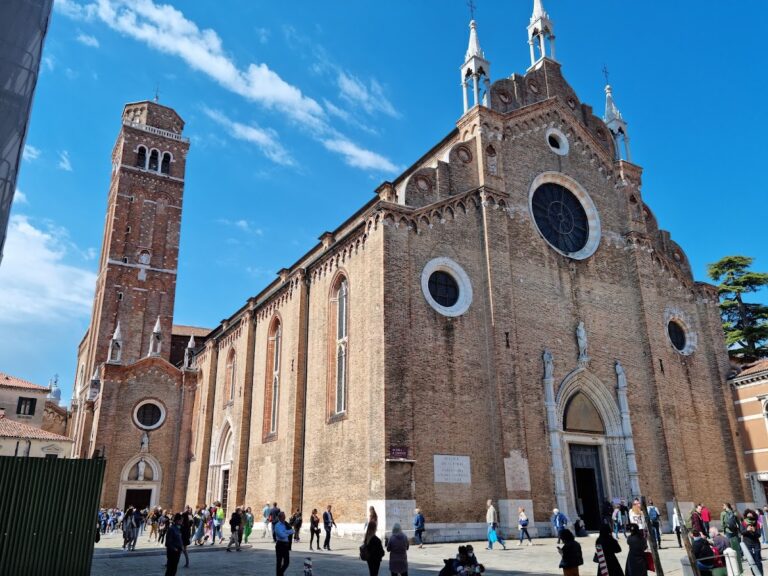
The Palazzetto Bru Zane is a small palace in Venice’s San Polo district, beside the Palazzo Zane Collalto on the Rio Marin and near the Basilica dei Frari. It forms an annex to the principal Zane residence. Built between 1695 and 1697, it belongs to the architectural tradition associated with Baldassarre Longhena’s studio. Antonio Gaspari was initially responsible for the work, and Domenico Rossi continued it after Gaspari’s death.
Connecting garden
A French-style seventeenth-century garden was laid out between the casino and the main palace. Later construction occupied parts of this space, but the garden was recovered during the Fondation Bru’s restoration. Its position preserves the intended relationship between the smaller pavilion and the principal Zane residence.
Interiors and decoration
Ballroom and carved balustrade
The ground-floor ballroom is overlooked by a wooden balustrade on the floor above. The carved structure follows the entire perimeter of the room, and Andrea Brustolon is credited with making the section facing the ballroom. The balustrade forms one of the building’s principal surviving interior features.
Frescoes and stucco work
Elaborate stucco and sculptural decoration enrich the interiors. The stucco work is attributed to Abbondio Stazio, a Swiss artist, while the sculptural work is attributed to Andrea Brustolon. The frescoes in the salon and on the grand staircase have subsequently been attributed to Sebastiano Ricci, a prominent Venetian painter of the late Baroque period. Both groups of frescoes were restored during the comprehensive renovation.
Musical facilities
Rooms and concert hall
The building contains sixteen rooms, including offices, studios, a library, a concert hall with seating for up to 100 people, and a soundproof rehearsal room. The original concert hall contains an Erard piano dating from 1902. Made by the historic French instrument manufacturer Erard, the piano belongs to the musical furnishings of the restored building and connects its present performance function with the French musical tradition studied by the centre.
Nearby sites