Cathedral of La Laguna: Cathedral Church of the Diocese of San Cristóbal de La Laguna
Site at a Glance
- Rating
- 4.3
- Popularity
- Medium
- Country
- Spain
- Primary era
- Modern
- External website
- Open
- Eras represented
- Early Modern, Modern
- Civilizations
- Spanish
- Site type
- Religious
- Remains
- Cathedral
On this page21 sections
History
The Cathedral of La Laguna is the cathedral church of the Diocese of San Cristóbal de La Laguna in San Cristóbal de La Laguna, Spain. Its present Neo-Gothic main body was constructed between 1904 and 1915, while the surviving façade belongs chiefly to the early nineteenth century. The building developed from a hermitage founded in 1511 and serves as a parish church and Marian shrine dedicated to Our Lady of Los Remedios.
From hermitage to parish church
In 1511, Alonso Fernández de Lugo ordered a hermitage on the present site, then part of the Aguere valley and now associated with Fray Albino Square. It was dedicated to the Virgin Mary in her Expectation. The area may have included a Guanche necropolis, and the former lake of Aguere was a sacred place for Tenerife’s indigenous population.
A larger church in the Mudéjar tradition replaced the hermitage in 1515. On 21 April that year, it became the parish of Santa Maria de los Remedios, with its principal feast assigned to 8 September, the Nativity of the Virgin Mary. The church was completed in 1522. In the same period, the Portuguese mason Miguel Alonso was contracted to build the main chapel, triumphal arch, altar, steps, tabernacle, sacristy door, and the beginnings of the arches in stone.
The church was enlarged repeatedly. Its first tower was begun in the early seventeenth century and completed in 1618, but the structure was replaced by a lower tower in 1691 because of the danger of collapse. In 1752, a new transept was built, the main chapel was enlarged, and large sacristies and dressing rooms were added for the image of Our Lady of Los Remedios. Domingo de la Guerra directed this work partly in the hope that the church would eventually become Tenerife’s cathedral.
Religious and diocesan importance
The church acquired an important connection with José de Anchieta, who was baptized there on 7 April 1534. Born in La Laguna, Anchieta later helped found São Paulo and Rio de Janeiro in Brazil. The cathedral is the diocesan shrine associated with him.
From 1515 onward, repeated efforts sought to make Los Remedios a cathedral, a collegiate church, or an auxiliary cathedral of Santa Ana in Las Palmas de Gran Canaria. A further request for a diocese based at Los Remedios was made in 1783 but met opposition from ecclesiastical authorities. A papal bull of 1 February 1819 approved the division of the Diocese of the Canary Islands. By a bull issued by Pope Pius VII on 21 December 1819, the parish church of Los Remedios became the cathedral of the new Diocese of San Cristóbal de La Laguna, serving the western islands of Tenerife, La Palma, La Gomera, and El Hierro.
Cristóbal Bencomo y Rodríguez helped secure the cathedral and the foundation of the diocese. A La Laguna-born cleric, royal confessor to Ferdinand VII, and titular Archbishop of Heraclea, he held an archiepiscopal title without governing a corresponding residential archdiocese. His tomb is in the presbytery. The diocese was suppressed between 1851 and 1875, during which time the church lost its cathedral status and became a collegiate church. It regained the cathedral title when the diocese was restored in 1875.
Nineteenth-century reconstruction
The early-nineteenth-century tower and entrance façade became unsafe. The Bencomo brothers promoted their reconstruction, using designs based on Pamplona Cathedral. Work on the façade began in 1813, and the first tower was completed on 15 December 1824.
By the end of the nineteenth century, successive additions had produced structural cracks and displaced supports. The building was declared a ruin in 1897. When restoration proposals proved impracticable, demolition began on 26 April 1905. The early-nineteenth-century façade and its two towers were retained, while José Rodrigo de Vallabriga y Peraza de Ayala designed and supervised a new cathedral. Bishop Nicolás Rey Redondo consecrated it on 6 September 1913, and construction continued until 1915, including the chapel of Our Lady of Los Remedios.
The rebuilding was supported by the sale of altars to other churches, the sale of some devotional jewellery, donations from Spain and abroad, and practical assistance such as free transport of building materials by the Tenerife electric tram company. Bishop Nicolás Rey Redondo provided approximately one third of the construction cost from his personal funds.
Music, worship, and later conservation
A cathedral music chapel was established after the diocese was created. Miguel Jurado Bustamante served as its master and composed approximately 140 religious works. Among the musicians trained by him was Domingo Crisanto Delgado Gómez, who became the first organist of the Cathedral of San Juan Bautista in Puerto Rico in 1836. The attached chapter house is the seat of the Chapter of Canons, the body of priests responsible for the cathedral’s worship and religious and cultural activities.
The cathedral closed for worship in 2002 after deterioration of its concrete structure caused repeated falls of small ceiling fragments. During the closure, the episcopal seat was temporarily transferred to the Church of the Immaculate Conception. Investigations found severe damage to the vaults and dome, partly because salt-bearing beach sand had contributed to corrosion of the reinforcement.
Between 2009 and 2014, the upper portions of the cathedral were dismantled and rebuilt, including parts of the walls and supports, the vaults, and the dome. The restoration used concrete strengthened with glass and polypropylene fibres and covered the roof with soldered copper sheets. The cathedral reopened on 25 January 2014 and resumed worship on 31 January. A jubilee year marking its centenary and reopening ran from 27 April 2014 to 12 April 2015 under a special mandate from Pope Francis.
Remodeling in Cathedral Square in 2014 revealed rubble that may belong to the former church or to structures from La Laguna’s first European settlement. Human remains found in 2018 date to the sixteenth century and are thought to belong to the former parish cemetery. The cathedral was declared a Spanish National Historic-Artistic Monument, with the status of a monument of cultural interest, on 5 October 1983. It also lies within the historic centre of La Laguna, which UNESCO declared a World Heritage Site in 1999.
The cathedral remains associated with Holy Week processions, the September feast of Our Lady of Los Remedios, the February procession of Our Lady of Candelaria, Corpus Christi, the feast of Saint Christopher, and the feast of José de Anchieta. In the former church, Isabel de la Cruz, her niece María de las Vírgenes, and later María Emerenciana followed the ascetic practice of voluntary immurement, living in a small chamber connected to the church so that Mass and Communion could be followed through an opening. This is described as the only recorded case of the practice in the Canary Islands.
Remains
Plan and exterior structure
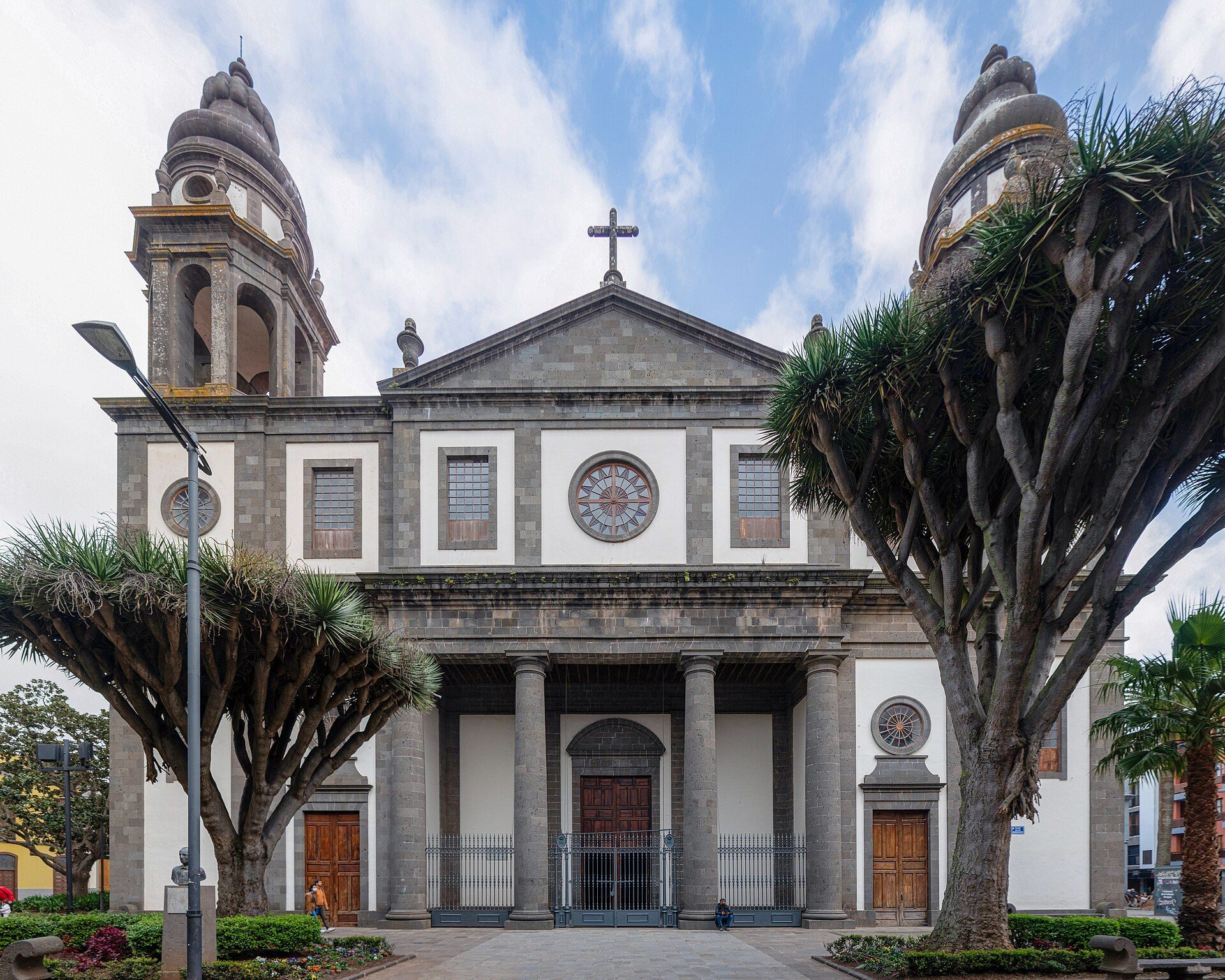
The cathedral combines a neoclassical façade from the early nineteenth century with a predominantly Neo-Gothic main body built between 1904 and 1915. Its plan has three broad aisles, a transept, a chancel, and an ambulatory, a passage encircling the sanctuary. The ambulatory is an unusual feature among churches in the Canary Islands. The present structure therefore brings together nineteenth-, twentieth-, and twenty-first-century building phases.
Façade and towers
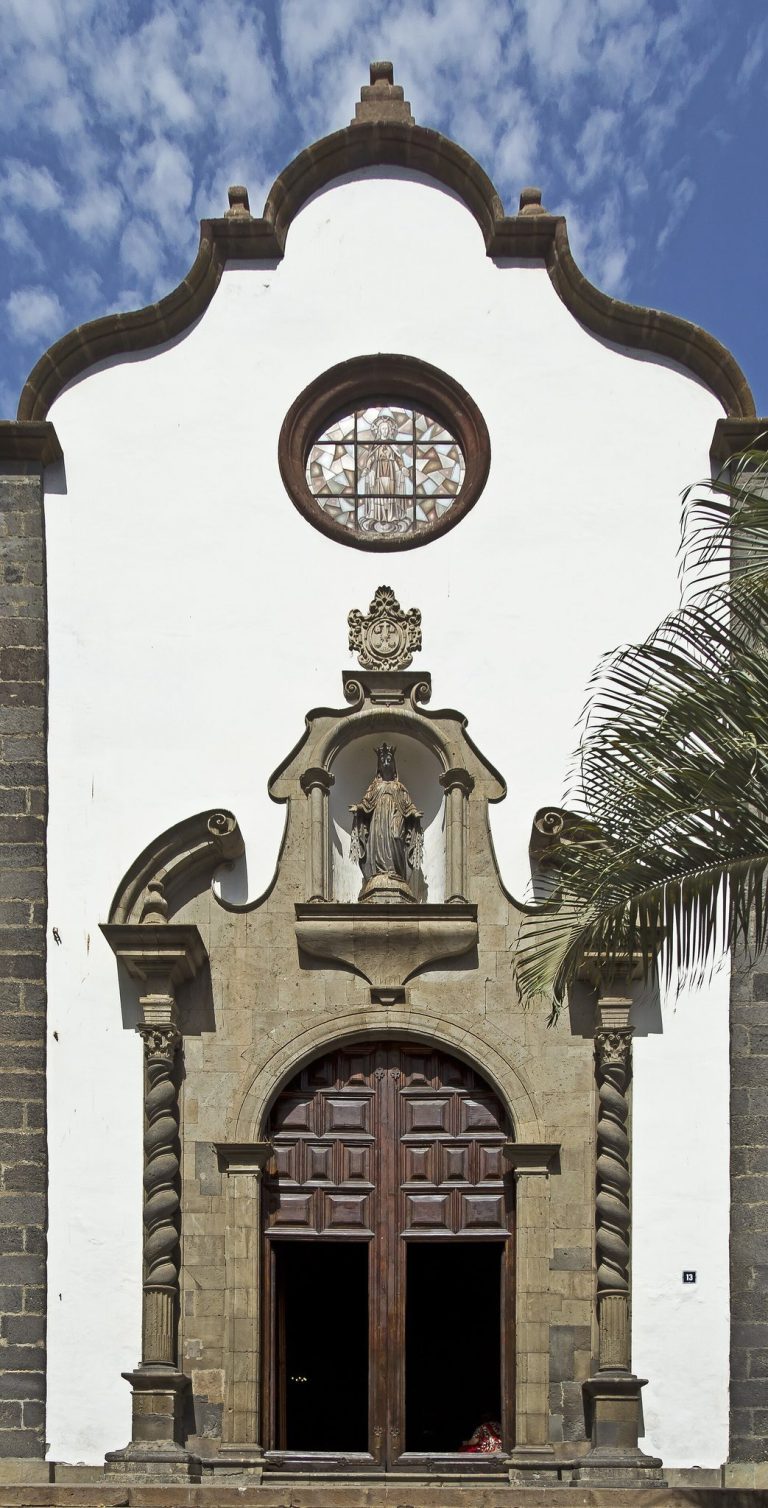
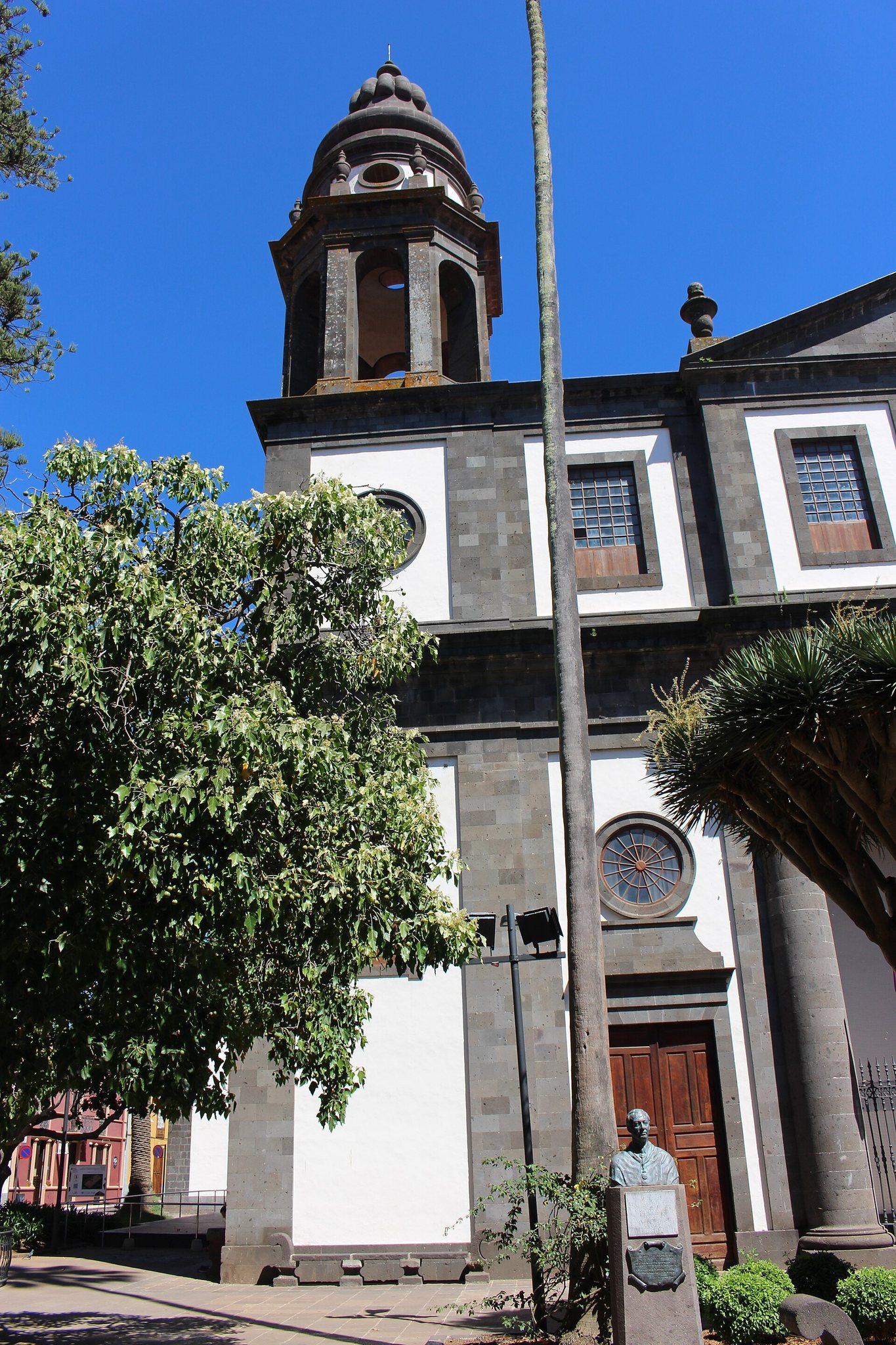
The retained entrance front and its two towers reflect the early-nineteenth-century reconstruction inspired by Pamplona Cathedral. They form the surviving exterior element of the earlier cathedral that was incorporated into the twentieth-century rebuilding.
Dome and vaults
The rebuilt roof contains 53 vaults. Its Neo-Gothic interior vaults and dome use concrete reinforced with polypropylene fibres rather than conventional metal reinforcement. The dome rises approximately 41 to 41.5 metres, is topped by a concrete cross and a lantern, and is covered with copper sheeting. Its treatment imitates the copper-clad domes of cathedrals in central and northern Europe. Small lanterns above the vaults admit natural light, while sixteen windows in the drum of the dome contain monochrome glass.
The interior has large vertical stained-glass windows and a spatial character associated with medieval European churches, contrasting with the more colonial appearance of the exterior. The floor, laid from 1912 onward, combines reused and new black-and-white marble slabs. Rectangular patterns occur in the crossing, while diagonal patterns predominate elsewhere.
Sanctuary and principal furnishings
Ambulatory windows and memorials
The ambulatory contains seven figurative pointed-arch windows and four circular windows near the crossing. Its imagery includes Our Lady of Los Remedios, Saint Ferdinand, Saint Elizabeth of Portugal, Saint Christopher, Saint Michael, Saint James, Saints Peter and Paul, Saint Joachim and Saint Anne, Saint Joseph, Saint Anthony of Padua, Saint Eustace, and Saint Roch. The area also contains paintings of historical significance and a memorial to Alonso Fernández de Lugo.
Chapel of Our Lady of Los Remedios
The chapel of Our Lady of Los Remedios occupies the right side of the transept and contains the largest altarpiece in the Canary Islands. The Baroque altarpiece dates from the first half of the eighteenth century and incorporates seven panels attributed to Hendrick van Balen. Antonio Francisco de Orta created the present principal altarpiece between 1709 and 1715, incorporating paintings from an earlier Flemish work commissioned by Pedro Afonso Mazuelos and installed as the church’s main altar in 1614.
The image of the patroness stands in a central niche on a silver canopied throne. A silver sunburst frames it, while a gilded crescent moon accompanies the image. The chapel was added as a quasi-right transept after the rebuilding and continues to function as a parish chapel. On its west wall hangs Juan de Miranda’s Last Supper, measuring 306 by 190 centimetres. A memorial plaque to Bishop Domingo Pérez Cáceres is placed on the east wall.
Main altar and pulpit
The main altar includes a wooden tabernacle by José Miguel Luján Pérez, painted by Manuel Acosta Villavicencio to imitate jasper and bronze. It was consecrated in December 1795, and its silver-clad antependium, the decorated front covering of an altar, dates from 1877. The sixteenth-century Christ of Los Remedios surmounts the tabernacle, with sculptures of Saints Peter and Paul on either side.
The Carrara-marble pulpit was completed in Genoa in 1767 by Pasquale Bocciardo for Andrés José Jayme. Its hexagonal body is supported by an angel on a cloud, and three sides carry the four Evangelists with their symbols. An inscription on the base identifies the commission.
Choir and organ
Juan Miguel Inclán Valdés designed the choir stalls, which the La Laguna carpenter Domingo Estévez made in 1832 and 1833. After the twentieth-century rebuilding, their number was reduced and the stalls were enclosed by wood panelling. An English organ made by Henry Bebington and Sons was installed in 1858. It originally stood near the middle of the nave for acoustic reasons, and its gallery was later moved above the main entrance.
Side chapels and devotional sculpture
Chapel of the Immaculate Conception
The chapel of the Immaculate Conception lies on the Epistle side beside the chapel of Our Lady of Los Remedios. Its altarpiece was made in 1915, damaged during the cathedral’s closure between 2002 and 2014, and later restored. The chapel contains Our Lady of Light, a polychrome and gilded wooden sculpture probably made in Seville in the mid-sixteenth century and attributed to the circle of Roque Balduque. The tomb of Nicolás Rey Redondo is set into the floor.
Chapel of Saint Teresa and chapel of Christ Tied to the Column
The chapel of Saint Teresa of Avila contains a Neo-Gothic altarpiece and a dressed sculpture of the saint. Its Ecce Homo altar, popularly called the Lord with the Little Cane, was installed in March 2014 after the cathedral reopened.
The chapel of Christ Tied to the Column contains a sculpture made by Pietro Galleano in Genoa and blessed on 6 June 1756. Its altarpiece was carved between 1763 and 1765 and later gilded. Other works include Our Lady of Sorrows, attributed to Gabriel Astorga y Miranda, and Saint Mary Magdalene by Fernando Estévez. The tomb of Bishop Luis Franco Cascón is also in the chapel.
Chapel of Our Lady of Candelaria
The central chapel of Our Lady of Candelaria, also called the Chapel of the Canary Saints, stands beside the side door facing Bencomo Street. Its altarpiece was originally dedicated to Our Lady of Mercy. The chapel contains a replica of the patronal image of the Canary Islands by Faustino Álvarez Hernández, restored by Ezequiel de León Domínguez, as well as images of José de Anchieta and Peter of Saint Joseph Betancur.
Its other contents include a Christ Nazarene from Valencia that reached La Laguna in 1901, an eighteenth-century Our Lady of Solitude by José Rodríguez de la Oliva, and the tomb of Bishop Bernardo Álvarez Afonso.
Other chapels
The chapel of Saint Joseph contains a dressed sculpture of Saint Joseph of Nazareth, probably made by Lázaro González de Ocampo in the late seventeenth century, with a later figure of the Christ Child. It also houses eighteenth-century Canarian-school sculptures of Saint Anne and Saint Joachim and a small wooden Saint Jerome.
The Neo-Gothic chapel of Saint Barbara has an altarpiece designed by Francisco Bonnín Guerín and made by members of the Santa Cruz de Tenerife artillery corps. It formerly stood in the Church of Saint Francis of Assisi in Santa Cruz de Tenerife. The chapel also contains the altarpiece of Our Lady of La Salette, donated by Estanislada González in 1915.
The chapel of Our Lady of Mount Carmel contains a Neo-Gothic altarpiece and an image of the Virgin that has been in the church since 1619. Its side niches hold Saints Andrew and Teresa of Lisieux. The chapel also houses the present copy of the Christ of Burgos, whose original was destroyed in the 1964 fire at the Church of Saint Augustine.
The baptistery contains a baptismal font made in 1969 and a Saint Thomas Aquinas altarpiece. Other images include Our Lady of Mercy by José Rodríguez de la Oliva and a dressed Saint Lawrence probably dating from the second half of the seventeenth century.
Paintings, relics, and treasure
The cathedral contains a Carrara-marble tabernacle bearing the sixteenth-century Christ of Los Remedios, a sculpture of uncertain authorship traditionally regarded as the twin of the Christ of La Laguna. Opposite the chapel of Our Lady of Los Remedios is The Souls in Purgatory by Cristóbal Hernández de Quintana, painted in 1717 and measuring approximately 5 by 3.95 metres.
Other major works include a Last Supper by Juan de Miranda, paintings of Saint Ferdinand and Saint Elizabeth of Portugal, and the Christ of the Chapter House by Fernando Estévez. Works by Cristóbal Hernández de Quintana, José Miguel Luján Pérez, and Fernando Estévez are also preserved. The stained glass includes figurative windows in the ambulatory and side chapels, geometric windows in the clerestory and transepts, and images of saints and religious figures including Diego of Alcalá, Ignatius of Azevedo, Our Lady of Guadalupe, John the Baptist, Teresa of Avila, Pope Sylvester I, Our Lady of Mount Carmel, Bernard of Clairvaux, Our Lady of the Pillar, the Archangel Raphael, Saint Sebastian, and Saint Francis of Assisi.
Relics preserved in the cathedral include those of Saints Aurelius of Córdoba, Faustino, Venustus, and Amadus of Nusco, a piece of Saint Ferdinand’s mantle, and a bone of James the Less. The collection also includes relics of the Canary saints Peter of Saint Joseph Betancur and José de Anchieta.
The cathedral treasure ranges from the sixteenth century to the present, with most pieces dating from the seventeenth and eighteenth centuries. It includes religious carvings, vestments, mantles, ornaments, paintings, a sixteenth-century alabaster Virgin of Trapani, and two silver candlesticks described as the largest in Spain.
Chapter house and archaeological setting
The attached chapter house is a mid-eighteenth-century Canarian vernacular house. It contains an icon museum with 160 original Byzantine icons, most approximately three centuries old, originating mainly from Russia, Romania, the former Yugoslavia, Italy, and Greece.
The cathedral’s archaeological setting is connected with the former lake and sacred landscape of the Aguere valley. Subsurface discoveries in Cathedral Square include rubble potentially belonging to the earlier church or to structures from La Laguna’s first European settlement. Sixteenth-century human remains found in the square are probably associated with the former parish cemetery.