Fuerte de Almeyda: A Nineteenth-Century Fortress in Tenerife
Site at a Glance
- Rating
- 4.9
- Popularity
- Very Low
- Country
- Spain
- Primary era
- Modern
- External website
- Open
- Eras represented
- Modern
- Civilizations
- Spanish
- Site type
- Military
- Remains
- Fort
On this page9 sections
History
Fuerte de Almeyda is a nineteenth-century fortress in Santa Cruz de Tenerife, Spain, built according to the Vauban system, a form of artillery-resistant fortification associated with the French military engineer Sébastien Le Prestre de Vauban. Its construction was planned in 1854 as part of the island’s defensive infrastructure.
Construction and changing military value
Colonel Clavijo y Plo, a military engineer, presented the fortress project on 21 April 1854. It received approval on 22 September, and construction began on 6 November of the same year. The work was completed in 1884.
By the time the fortress was finished, advances in artillery technology and the growth of Santa Cruz de Tenerife’s population had reduced its military value. The site now houses the Museo Histórico Militar de Canarias and the Biblioteca Histórico Militar de Canarias.
Military collections and library
The Biblioteca Histórico Militar de Canarias holds more than 35,700 items, including approximately 28,700 monographs and more than 7,000 periodicals. Its more than 3,000-volume Fondo Antiguo consists mainly of works published before 1901 on history, fortification, legislation, and scientific subjects.
The library also contains official military gazettes from 1887 onward, official state bulletins from 1937 onward, and a legislative collection dating from 1846. Other holdings include military memorials, institutional bulletins, yearbooks, journals, collections of military legislation, armament publications, personnel lists, uniform regulations, ordinances, instructions, and manuals.
Remains
Fortification layout
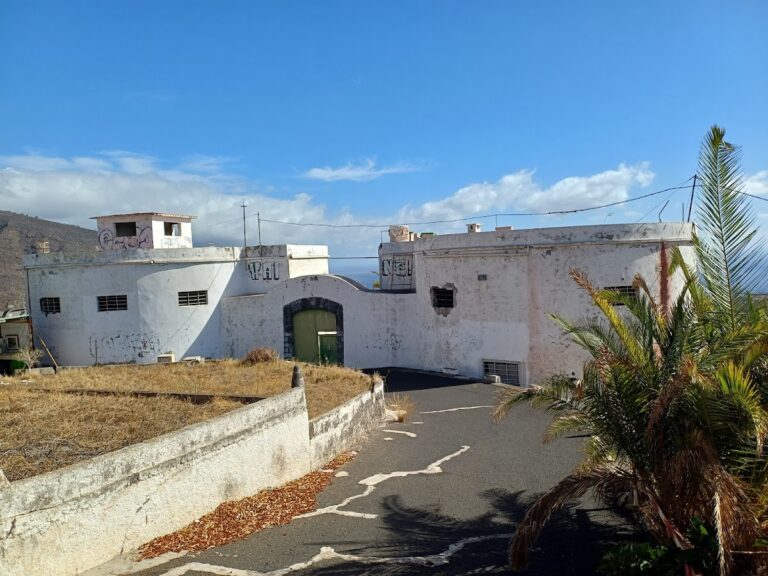
Fuerte de Almeyda stands beside the Toscal district, between the castles of San Miguel and San Pedro, on the eminence known as Cuesta de los Melones at San Antonio beach. Its plan is semicircular, with the diameter closed by the main facade, and the fortress is arranged on two levels. A small fortification on the western side commands a valley formed by the surrounding mountains.
Eastern casemated front
The eastern side contains a single-level casemated front, with a battery, or prepared artillery position, built on its upper terreplein. The casemates are fortified chambers protected by thick masonry for artillery, troops, or storage.
Northern front and casemates
The northern side has another front pierced by loopholes, narrow openings in a defensive wall for firing weapons. Three casemates rise on two levels along this side.
Western casemates and defensive barracks
The western side contains three single-level casemates. At the gorge, the rear section that closes the fortification, stands the defensive barracks, a troop accommodation building incorporated into the fort’s protected perimeter.
Surviving collections and condition
The fortress is in good condition. Its central building has a facade, and the Museo Histórico Militar de Canarias has displayed the Tigre cannon. A gallery also identifies a Henschel HS 33 D1 truck manufactured in 1936 or 1937.