Santa Maria del Sagittario Abbey: A Medieval Cistercian Monastery in Italy
Site at a Glance
- Rating
- 4.8
- Popularity
- Very Low
- Country
- Italy
- Primary era
- Medieval
- Eras represented
- Medieval
- Civilizations
- Kingdom of Sicily
- Site type
- Religious
- Remains
- Fortified Monastery
On this page10 sections
History
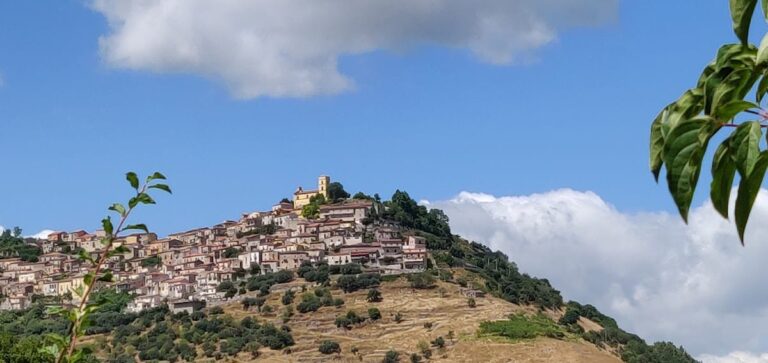
Santa Maria del Sagittario abbey is a medieval Catholic monastery in Italy, in the territory of Chiaromonte, Basilicata. Dedicated to the Virgin Mary, it began as a Benedictine foundation in the twelfth century, traditionally dated to 1152, when an older church built by Tancredi Murrino in 1061 was enlarged. The abbey later became a Cistercian house connected through Casamari with Clairvaux, and developed into a religious, agricultural, and economic centre in the region.
Benedictine origins and Cistercian affiliation
The monastery’s earliest foundation is also placed more broadly in the middle of the eleventh century. Its land was donated by Ugo I Chiaromonte and his daughter Alibreda during the pontificate of Pope Eugene III. A local foundation legend links the name Sagittario to a wooden image of the Virgin and Child. Hunters are said to have discovered the image inside a chestnut tree after repeatedly failing to hit a deer with their arrows.
An earthquake damaged the monastery in 1184. Around 1200, a Cistercian community from Casamari entered the abbey under its first abbot, Palumbo, followed by Guglielmo. Cistercians were a reform movement within Western Benedictine monasticism that stressed stricter communal discipline and the cultivation of monastic lands. Through Casamari, Sagittario belonged to the affiliation of Clairvaux, one of the principal early Cistercian houses.
The new community served religious, agricultural, and economic purposes in an area where Greek monasticism remained strong. Its monks cleared woodland and brought uncultivated land into cultivation, helping to strengthen the Latin monastic presence while reducing tensions between Latin and Greek religious communities. Under Palumbo and Guglielmo, the abbey expanded its territory and its economic base.
Territory, jurisdiction, and economic power
In 1203, Rinaldo del Guasto, count of San Marco, his wife Agnese, and his brother Riccardo founded the church of Santa Maria di Buonavalle for the benefit of Sagittario. They also assigned it movable and immovable property. The abbey’s possessions extended along the Ionian side of the region, especially between Policoro and Scanzano Jonico.
On 24 April 1221, Emperor Frederick II confirmed these holdings to Abbot Palumbo and added uncultivated and wooded demesne lands near the monastery. A demesne was land held directly by a ruler. Frederick’s grant gave inhabitants of the monastic lands fiscal freedoms and privileges, while Palumbo received civil jurisdiction, including the power to punish, correct, and condemn. The abbot could charge outsiders whose flocks grazed on monastic pastures, whereas the abbey’s own flocks could use royal demesne lands, water, and sheepfolds without tolls. These rights gave Sagittario a seigneurial structure, with the abbot exercising powers similar to those of a lay feudal lord.
The abbey appears to have enjoyed direct papal protection rather than ordinary dependence on a diocese. Its abbot was granted the use of a mitre, ring, and other episcopal insignia. Between 1269 and 1274, Leonardo, a former monk of Sagittario, became bishop of Anglona.
Mills added to the monastery’s income and supplied grain for the community. One stood at Ventrile and used horizontal wheels powered by the Frida. Another was located on the eastern boundary of the Grancia del Ventrile, a monastic agricultural estate, and was powered by the Sinni.
Religious life and later decline
The early fourteenth century brought a notable religious association. Blessed John of Caramola of Toulouse lived as a hermit near Sagittario. In old age, he asked Abbot Ruggero of Senise for the monastic habit, was received as a lay brother, and died at Sagittario on 26 August 1339. His remains were later transferred to the mother church of San Giovanni Battista at Chiaromonte.
Margherita of Chiaromonte, wife of Giacomo Sanseverino, returned lands and goods that had been taken from the abbey. She also exempted Abbot Guglielmo II from a payment to the Apostolic See because of the monastery’s poverty. Under Sanseverino patronage, Sagittario possessed a strong economic structure by the early fifteenth century and resumed payment of the apostolic common-service tax between 1399 and 1444.
By 1633, the abbey had fallen into commendam, meaning that it was administered by a commendatory abbot who might not live with the community. In that year it joined the Calabrian-Lukan Cistercian congregation, a regional grouping within the order. The abbey was suppressed during the Napoleonic period in 1807, beginning its architectural decline. In 1808, the wooden sarcophagus of Blessed John was moved to San Giovanni Battista in Chiaromonte, while the Baroque altar associated with Sagittario was transferred to the church of San Tommaso. A chapel was later built beside the surviving medieval ruins.
Remains
Monastic layout
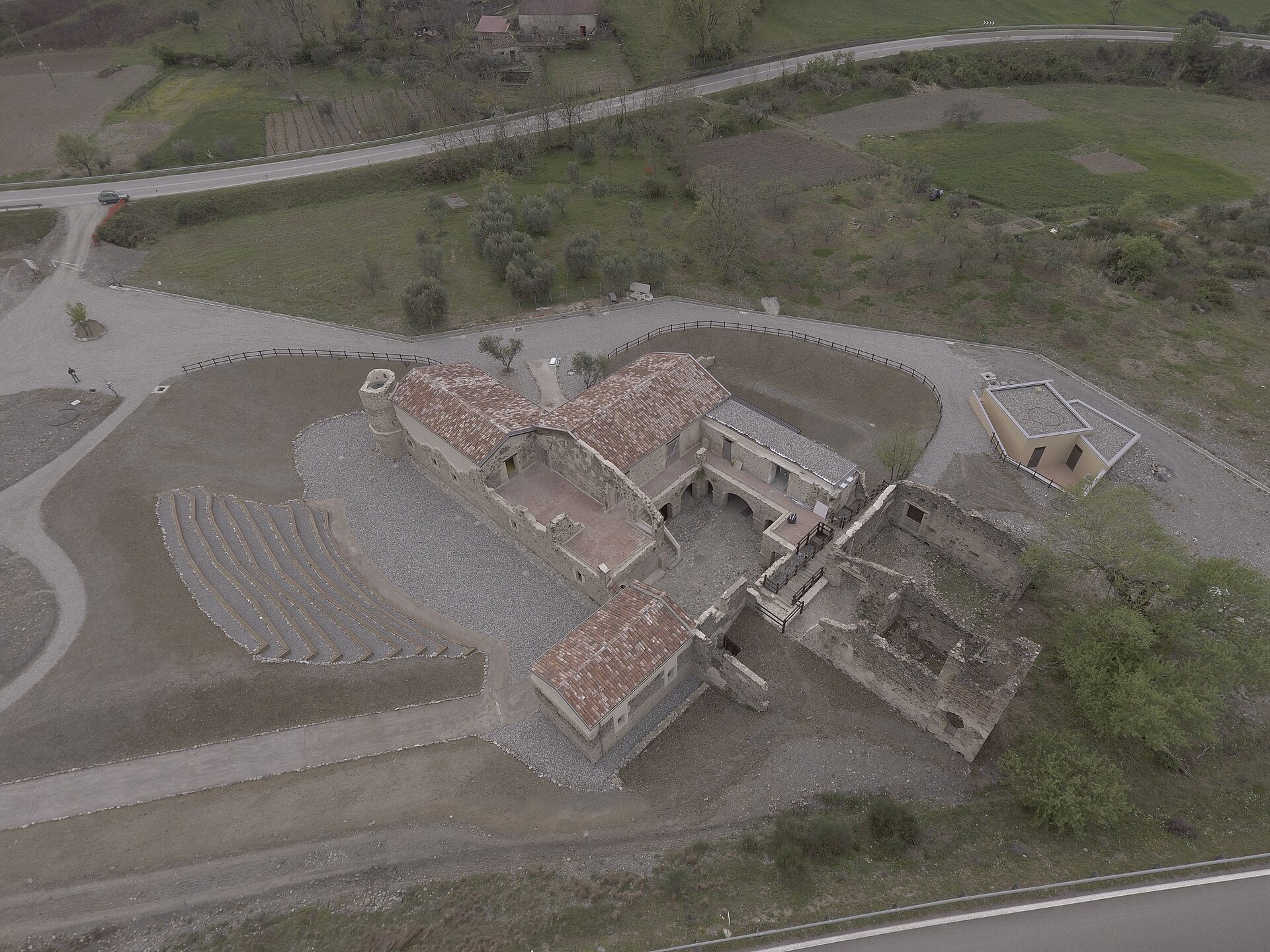
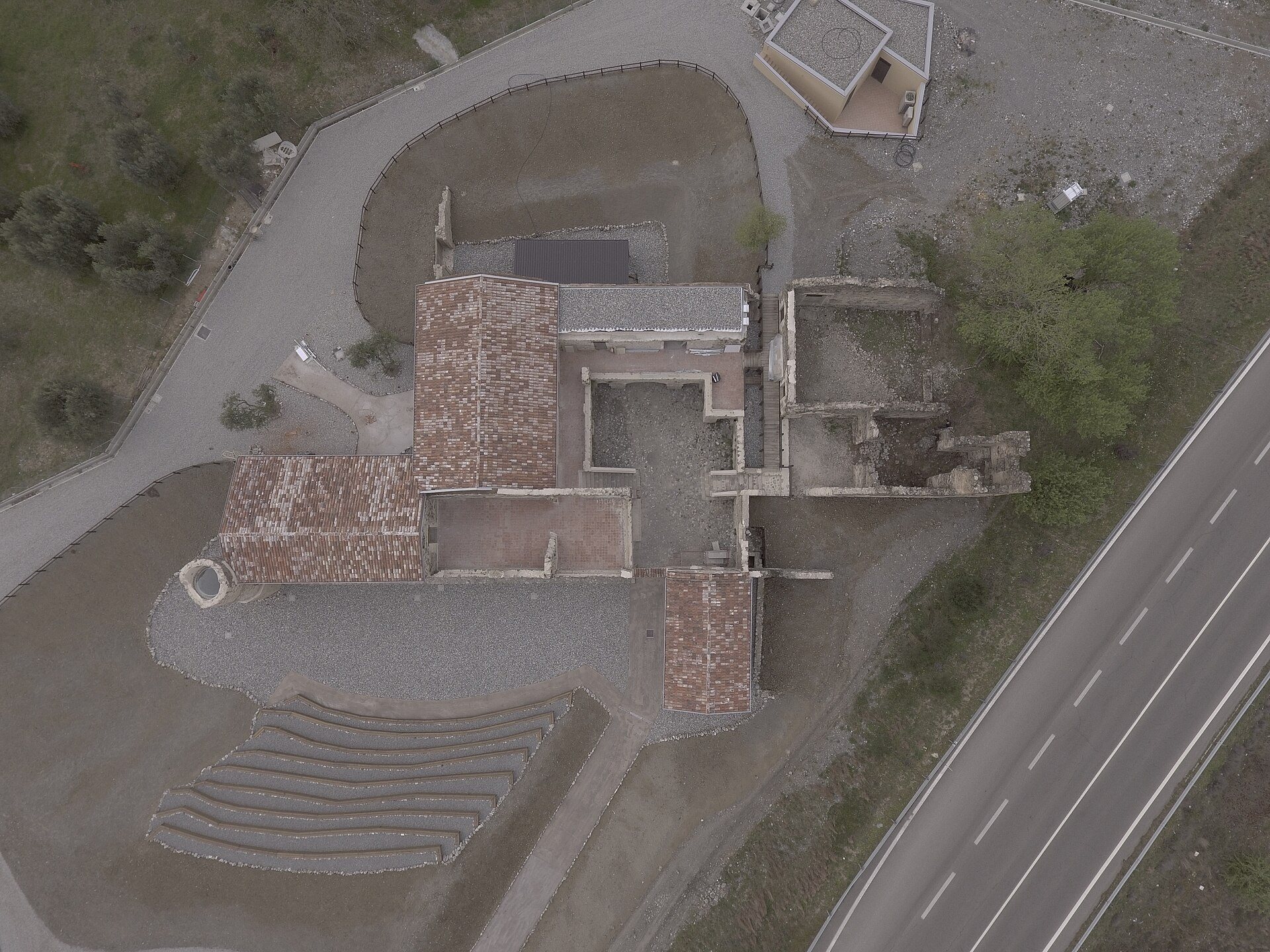
The abbey was arranged around a single square cloister, with the principal rooms placed around it. The church occupied the northern side of the complex and had one nave with a side chapel dedicated to Blessed John of Caramola. At cloister level, the chapter house, where the community met for administrative business and readings from its rule, stood beside the right arm of the transept. A staircase led from this area to the upper floor, which was occupied entirely by the monks’ common dormitory.
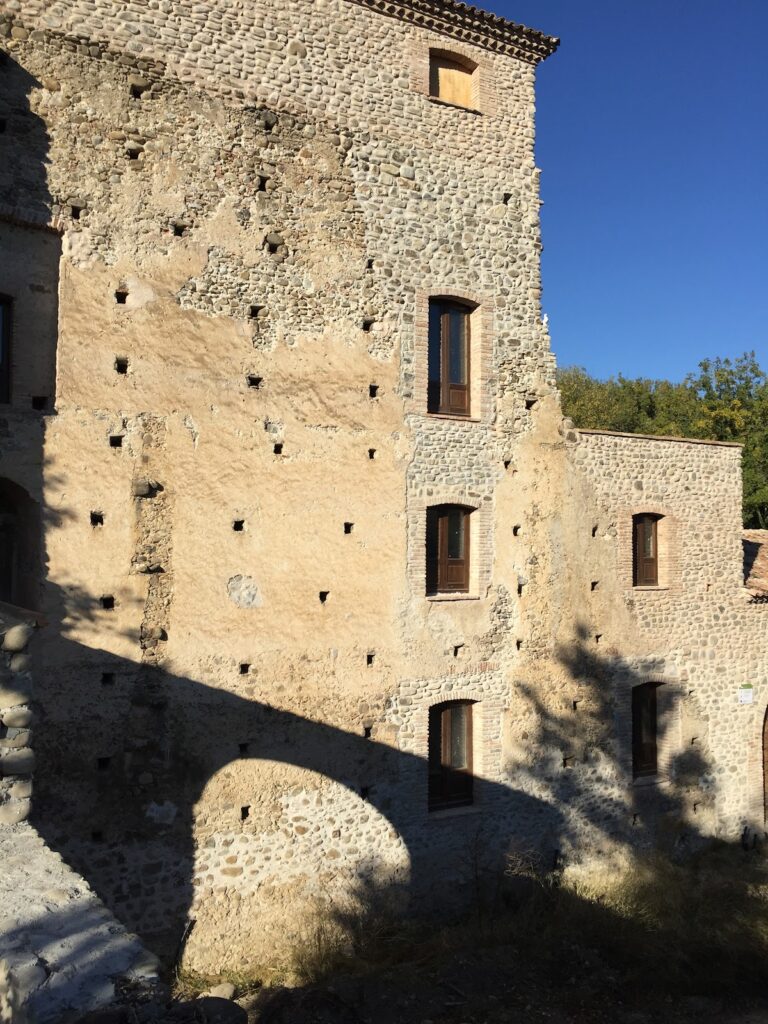
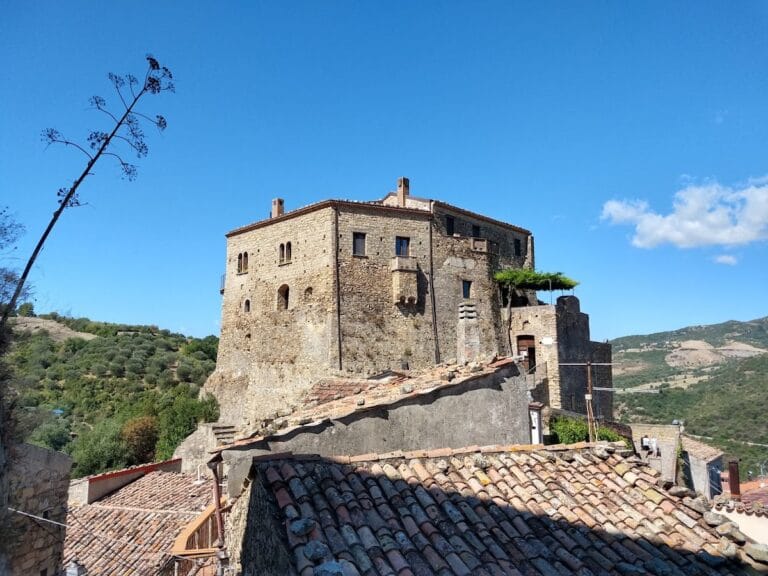
A plan made in 1707 shows a loggia running parallel and adjacent to the chapter house. From this loggia, Chiaromonte could be seen. The surviving complex includes limited portions of the medieval fabric, including the bell tower, an octagonal fortification tower, part of the masonry entrance, sections of the refectory, and part of the eastern fortified enclosure.
Surviving towers and masonry
Bell tower
The bell tower stands at the northwestern corner of the church and remains relatively well preserved. Its walls combine split blocks, fired bricks, and brick packing. Two stringcourses, horizontal bands of masonry, are formed from shaped stone, while the surviving opening arches use worked and moulded sandstone blocks. The walls are approximately 1 metre thick, and the tower’s total height is estimated at about 13 metres. Beam sockets and numerous putlog holes, which held temporary scaffolding beams, remain visible on all three exposed sides.
Octagonal tower
An octagonal fortification tower occupies the southeastern corner of the abbey and survives in moderately good condition. Its roof remains in place as a shallow vault made entirely from sandstone slabs. The tower uses construction methods and materials comparable to those of the bell tower, including similar wall thicknesses.
Religious objects and botanical knowledge
The abbey’s wooden statue of the Virgin and Child dates from the fourteenth century and is now preserved in the Provincial Picture Gallery of Bari. The wooden sarcophagus of Blessed John of Caramola is kept in San Giovanni Battista at Chiaromonte, and the Baroque altar formerly associated with Sagittario is in San Tommaso.
The monastic territory also included fruit-bearing plants and medicinal herbs. A Sagittario herbarium lists 40 plants, among them broom, dragon arum, milk thistle, Cretan dittany, masterwort, rhubarb, crown anemone, herb Paris, wood avens, valerian, peony, southernwood, sage, maidenhair fern, angelica, and frog orchid. It also includes plants identified, or possibly identified, as Anacyclus pyrethrum and Peucedanum oreoselinum, along with species such as St John’s wort, Celtic valerian, common polypody, hart’s-tongue fern, and bloody cranesbill.