Castro Laboreiro Megaliths and Rock Art: A Prehistoric Burial Complex in Portugal
Site at a Glance
- Popularity
- Low
- Country
- Portugal
- Primary era
- Stone Age
- Eras represented
- Stone Age, Bronze Age
- Civilizations
- Unclassified
- Site type
- Burial
- Remains
- Necropolis
On this page13 sections
History
The Castro Laboreiro Megaliths and Rock Art is a prehistoric burial complex in the parishes of Castro Laboreiro and Lamas de Mouro, Portugal. Most of its monuments were built in the fifth and fourth millennia BCE. It is considered the Iberian Peninsula’s largest megalithic necropolis of its period and the northernmost in Portugal. It is also the peninsula’s largest concentration of megalithic monuments and one of Europe’s largest.
Prehistoric construction and rock art
At least one burial mound at Alto da Portela do Pau was built later, in the third millennium BCE. Paintings and rock engravings inside some funerary monuments belong to the early Bronze Age, a prehistoric period associated with the use of bronze.
Archaeological study and protection
The first archaeological survey took place in 1978, led by the University of Minho’s Archaeology Unit. Further investigations followed in the 1990s, involving Peneda-Gerês National Park and the Portuguese Society of Anthropology and Ethnology. Teams worked at Alto da Portela do Pau in 1992 and 1994. It is the only group within the necropolis to have been studied in depth by multiple archaeological teams.
In 2013, the complex was classified as a Portuguese Site of Public Interest, a national heritage-protection designation. The Menhir do Alto da Portela do Pau is listed as a monument in Galicia.
Remains
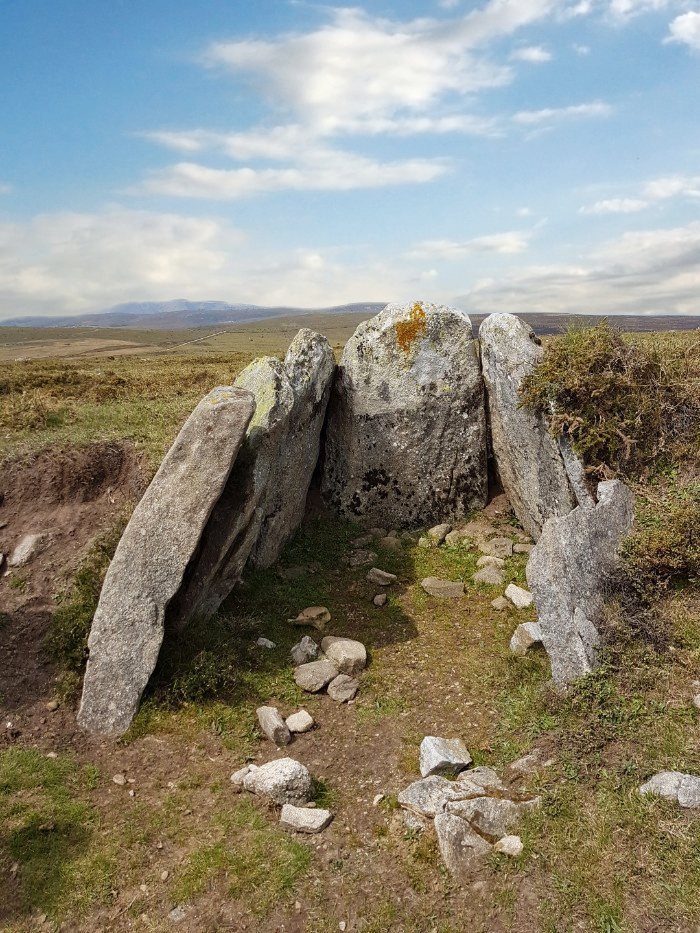
The complex covers more than 50 km² at elevations above 1,100 m, near Peneda-Gerês National Park. Its monuments include burial mounds, dolmens (stone-built burial structures), and stone alignments (arrangements of standing stones), most made from granite. The site extends into Galicia, where 36 of its approximately 90 monuments are located. About a quarter stand separately on the plateau amid uncultivated land; the others are grouped near streams or tributaries of the Laboreiro River.
Monument groups
Alto da Mansão do Guerreiro
This group contains nine burial mounds, all in good condition. Their size makes them clearly visible in the landscape.
Alto do Buscal
Numerous small monuments are scattered across this area, with some partly concealed. Many tombs have been damaged by natural erosion and earlier human activity, from a time when the monuments’ importance was less widely appreciated.
Lamas do Rego
This group consists of six well-preserved burial mounds near a forest track. Mounds 1 and 2 each measure about 18 m in diameter.
Alto da Portela do Pau
Mota Grande
Mota Grande is the largest burial mound on the plateau.
Menhir do Alto da Portela do Pau
The menhir, a large upright standing stone, is a separate monument within the Alto da Portela do Pau group.
Mound 2
Mound 2 has no capstone over its burial chamber. Its upright supporting stones carry dense decoration, with motifs covering almost all of the usable interior surfaces.
Mound 5
Archaeological teams exposed Mound 5, which contains rock engravings, mainly geometric designs, and a simple, open burial chamber with a many-sided plan. The chamber measures about 2.35 by 2.40 m.