Castles in Stadtlengsfeld: A Medieval Fortification and Palace Complex


Site at a Glance
- Rating
- 4.9
- Popularity
- Very Low
- Country
- Germany
- Primary era
- Medieval
- Eras represented
- Medieval, Early Modern, Modern
- Civilizations
- Holy Roman Empire
- Site type
- Domestic
- Remains
- Castle
On this page16 sections
History
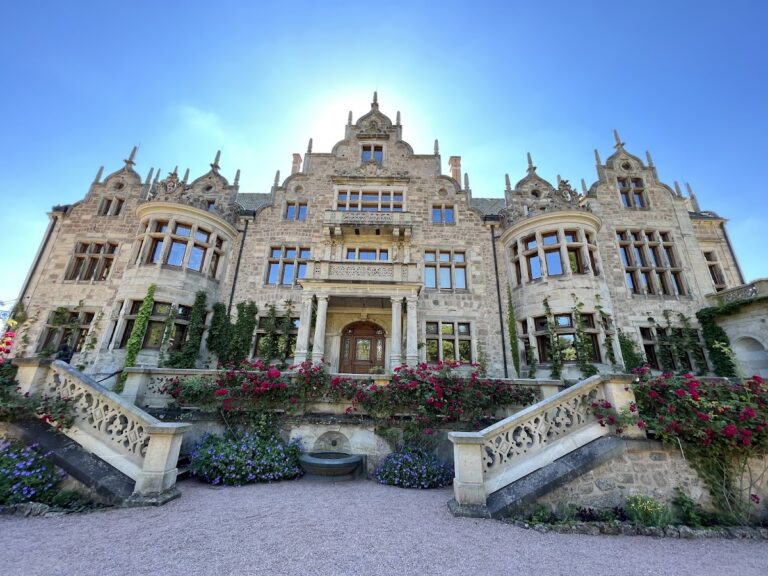
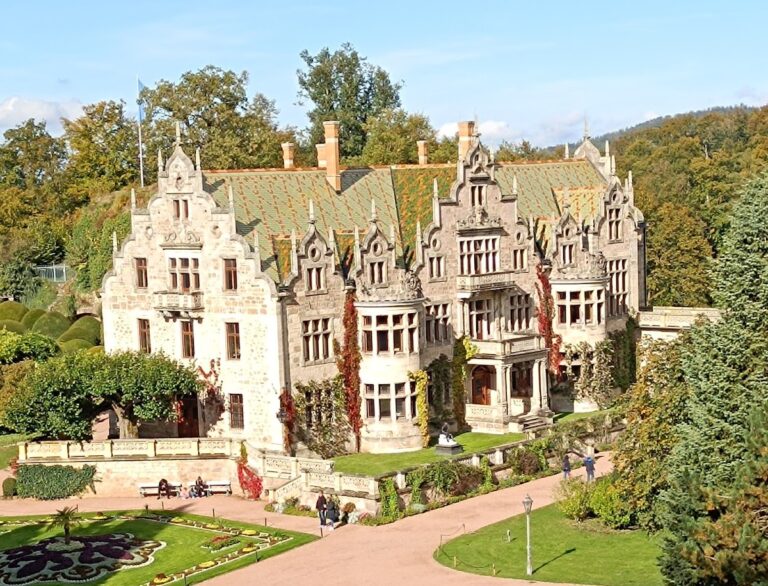
Castles in Stadtlengsfeld is a medieval fortification and later palace complex in Germany, built under Hersfeld Abbey around 1125 on the western edge of Stadtlengsfeld in the Felda valley. Hersfeld Abbey commissioned the original castle to protect its extensive possessions in the valley. The site also became part of the holdings of the dynasts of Frankenstein, whose members acted as the abbey’s advocates in the Rhön and Werra regions.
Hersfeld and Frankenstein rule
The Lords of Lengsfeld occupied the castle as its castlemen. A castleman was responsible for the military and administrative service of a castle, while the Lords of Lengsfeld belonged to the Frankenstein family’s ministerial service nobility. A ministerial was a member of the medieval service nobility who held office or property in return for serving a higher lord or institution.
During the thirteenth century, the Frankensteins declined as the Abbey of Fulda extended its territory into the Felda valley. In 1235, the Abbot and convent of Fulda transferred Seelheim and its administrative office to the Teutonic Order in exchange for the return of Lengsfeld Castle. The castle had previously been held as a fief by Sibodo of Frankenstein. The Teutonic Order was a religious-military institution that controlled estates and administrative territories across central and eastern Europe.
Fulda’s pressure on the Frankenstein holdings continued. Abbot Bertho II besieged and partly destroyed Frankenstein Castle in 1265, and King Adolf of Nassau damaged it again in 1295. Ludwig of Frankenstein later exchanged Lengsfeld Castle and its settlement with Abbot Heinrich of Fulda for Neuhof Castle near Fulda. He nevertheless retained a share in Lengsfeld as Fulda’s hereditary castleman.
A jointly held castle
Fulda pledged its possessions in the Felda valley for ten years in 1308. In 1317 and 1318, Ludwig of Frankenstein sold the villages of Haynau and Waldsassen in Lengsfeld’s castle district, together with Untersuhl, Ottershausen, and revenues from the Dermbach court. These transactions formed part of the wider division and transfer of rights around the castle.
During the fourteenth century, the Fulda abbots greatly enlarged the site and divided it into four separately assigned castle districts. They distributed shares among several castlemen families to prevent any one family from becoming dominant. Recorded co-heirs included Apel of Reckrodt and his heirs, Dizel Schade of Leipolds, Paul of Herbilstadt from 1339, and Ditzel of Pferdsdorf from the same year. This arrangement made Lengsfeld a jointly held castle, in which districts, residences, and associated rights could be inherited, exchanged, or pledged by different families.
Disputes over the sale and exchange of shares were frequent. During the fifteenth century, Fulda’s rivals, the Counts of Henneberg and the Thuringian landgraves, acquired rights in the castle through alliances with individual families. Most of the co-heirs eventually moved away from Fulda’s influence and closer to the Counts of Henneberg.
The Boineburgs and early modern conflict
Phillip von Herda, marshal of the Fulda prince-abbot, bought his first castle estate at Lengsfeld in 1444. Through further purchases, he became the settlement’s largest landowner. After his granddaughter married, most of the Lengsfeld possessions passed to Ludwig I of Boyneburg zu Gerstungen, an influential Hessian landgrave’s court judge and imperial diplomat. His son, Georg von Boineburg, obtained town rights for Lengsfeld from Emperor Charles V in 1548.
Lengsfeld Castle surrendered without fighting during the German Peasants’ War in 1525. The rebel Werra force passed through the Felda valley toward Salzungen, Vacha, and Kaltennordheim, while the commanders and garrisons of the castles in its path generally gave way without resistance.
From about 1600, extensive renovations and alterations changed parts of the castle. Inheritance divisions assigned the castle districts, surrounding economic estates, and castles at Weilar, Gehaus, and other places to branches of the Boineburg family. This created a Boineburg co-ownership within Lengsfeld Castle.
The site was taken several times during the Thirty Years’ War, the major European conflict of 1618 to 1648. Its two southern residential and economic buildings burned completely, and the Boineburg courtyards in the town were looted. After the Reformation, the sixteenth-century religious movement that divided Western Christianity and reshaped territorial control, the Fulda abbots attempted to recover their possessions in the Felda valley and remove the Boineburgs. The Boineburgs resisted with support from the Counts of Henneberg and the Hessian landgraves. In the nineteenth century, Fulda’s rule by prince-abbots ended, while the Boineburgs, by then imperial barons, retained their possessions.
From fortified castle to palace
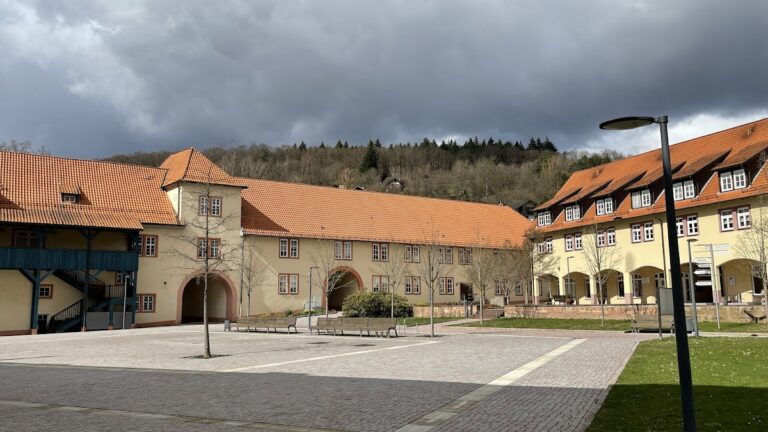
At the beginning of the nineteenth century, the town and castle were stripped of their fortifications. The moats were filled, parkland was created, and the complex was converted into a residential palace. A major fire destroyed most of Stadtlengsfeld in 1878. It also damaged the economic buildings adjoining the town and parts of the palace.
After the Second World War, the Boineburgs were expropriated in Thuringia as large landowners, and their castles and estates became state property. Lengsfeld Palace was converted into a sanatorium and retained that function until the political change of 1989 to 1990. The complex is now privately owned, protected as an architectural and archaeological monument, and houses a clinic for psychotherapeutic and psychosomatic rehabilitation. Its buildings were gradually renovated during the 1990s.
Remains
Layout and defensive enclosure
The surviving remains lie in the western part of Stadtlengsfeld’s historic settlement, in a sheltered position within the Felda floodplain. The original installation is understood as a motte, or defended tower mound, surrounded by a water-filled moat. The Lords of Lengsfeld are thought to have built and occupied it on behalf of the Frankenstein family.
Under the Fulda abbots, the site became a larger castle-like complex with four separate districts enclosed by a common perimeter wall and water moat. Each district had its own defensive tower and multistory residential buildings. A nineteenth-century description presents the whole as an irregular quadrilateral, with sides of approximately 150 to 160 feet. Two large, three-story round towers flanked the western ends of the former castles, while a square tower stood at the northeast.
Entrance and outer works
Eastern entrance
The eastern entrance was defended by a drawbridge and a rondel, a rounded defensive artillery structure associated with a gate. A castle chapel stood above the entrance gate. Its ornamental gable, crowned with pinnacles, separated the castle residences on either side. The chapel and entrance rondel had disappeared by the mid-nineteenth century.
Outer bailey
An extensive outer bailey, or forecourt, lay in front of the entrance. It contained large economic and service spaces, linking the fortified core with the working areas of the complex.
Moat and gardens
The moat formerly surrounded the castle and measured approximately 60 feet across. A masonry embankment protected it on the eastern side. After the moat was filled in the nineteenth century, its area became extensive landscaped gardens.
Towers and residential buildings
Square tower and surviving walls
The high square tower was regarded as a remnant of the oldest castle. By the middle of the nineteenth century, it and sections of the eastern and southern side walls had already fallen into ruin. An underground vaulted space continued to serve as a criminal prison at that time.
Southwestern round tower
The southwestern round tower formed the center of a separate castle residence. By the mid-nineteenth century, it had been almost entirely demolished. Its destruction reduced the surviving evidence for one of the four formerly distinct residential districts.
Eastern residences
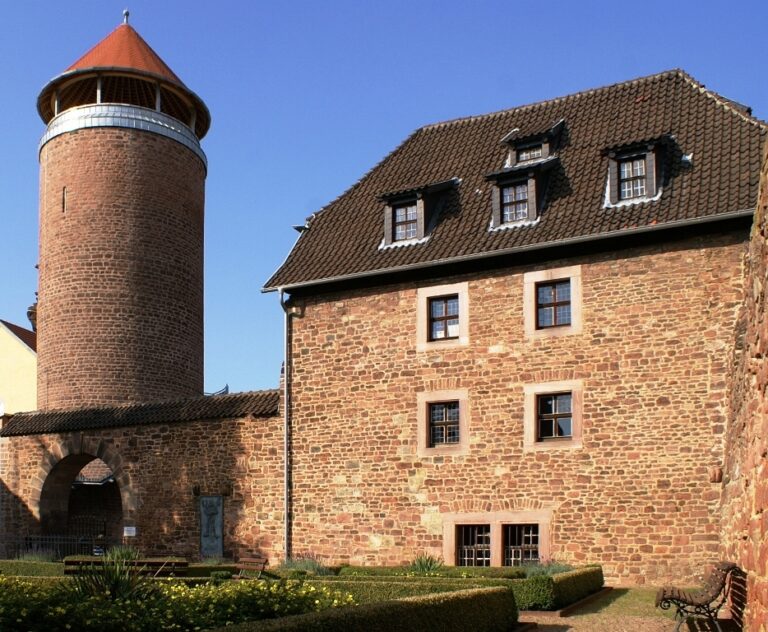
The two formerly separate eastern castle residences had been joined by the nineteenth century. They belonged to the oldest building phase but were then known as the New Castle. Wall remains and the principal building survive among the altered fabric of the palace complex.
Southern buildings
The southern residential and economic buildings were destroyed by fire during the Thirty Years’ War. Other parts of the complex were affected by the Stadtlengsfeld fire of 1878 and by later alterations. The surviving walls and principal building therefore combine elements of the medieval castle, early modern changes, nineteenth-century conversion, and subsequent renovation.
Nearby sites