Burg Wendelstein: A Medieval Town Castle in Germany


Site at a Glance
- Rating
- 4.4
- Popularity
- Very Low
- Country
- Germany
- Primary era
- Medieval
- External website
- Open
- Eras represented
- Medieval, Early Modern, Modern
- Civilizations
- Holy Roman Empire
- Site type
- Military
- Remains
- Castle
On this page12 sections
History
Burg Wendelstein is a medieval castle in Vacha, Germany, built under Heinrich IV, the abbot who governed the ecclesiastical foundation of Fulda, around 1260. First mentioned in 1294, it formed part of Vacha’s town fortifications and protected access to the Werra crossing from the northeastern side of the settlement.
Foundation and Fulda administration
Vacha stood on the Hessian-Thuringian long-distance road network and became an important stopping place because of its crossing over the Werra. Wooden bridges probably improved the crossing from around 1186, followed by one or two stone bridges from 1346. The growing market and town settlement required stronger defenses on the town-side bank, and Burg Wendelstein was founded and militarily equipped for this purpose.
The castle’s retainers served both military and administrative functions. Heinrich von Bienbach is mentioned in 1321, followed by Albert von Gunthausen in 1335 and Ludwig von Leimbach in 1342. Heinrich von Rasdorf held the office of bailiff in 1347, while Friedrich von Völkershausen appears as a castle retainer in 1348. Berthold and Apel von Buttlar were named in 1360, and Kraft von Rasdorf and Johann von Bienbach in 1363. Wolfram von Ostheim was described in 1388 as a retainer of the ecclesiastical foundation.
The castle’s personnel also had obligations within the town. Retainers were required to build residences there, linking the stronghold to Vacha’s urban defenses and administration. Eberhard and Gottschalk von Buchenau served as pledge officials in 1390 with the under-bailiff Hans Schade von Leiboldes. Fritz von Herda was named as a castle retainer in 1396, and Johannes von Bibra in 1399.
Hessian rule and administrative use
In 1406, Burg Wendelstein and two-thirds of Vacha were permanently pledged to Hermann II, Landgrave of Hesse. A landgraviate was a territorial principality ruled by a landgrave, a rank comparable to that of a major regional prince. The castle consequently became a Hessian administrative seat, a place from which territorial government and fiscal or judicial affairs were conducted. Gottschalk von Buchenau held the remaining third of the pledge, and the rights of the castle retainers passed to the von Buchenau knights.
Later officials and holders included Simon von der Thann, bailiff in 1413, and Hans von Baumbach, who received the castle fief at Vacha and Pferdsdorf in 1415. Hans von Bibra was a retainer in 1429 and later also held Biberstein. Burkhard von Kolmatsch served as an administrative official in 1446 and 1452. In 1529, Ludolf von Weiblingen was chamberlain and administrator of the fiscal office, while Alexander von der Thann held an administrative office in 1549.
The castle survived the major fire that damaged Vacha in 1467. Its military importance had declined by the Thirty Years’ War, the European conflict fought mainly between 1618 and 1648, when Vacha was captured several times. From 1648 to 1816, the town and castle belonged permanently to the Landgraviate of Hesse-Kassel. They then passed to the Grand Duchy of Saxe-Weimar-Eisenach.
Later changes and museum history
During the nineteenth century, parts of the castle were temporarily used as a spinning manufactory. Additional buildings were erected, and a simple new wall with a courtyard gate was constructed toward the town. Medieval gates, barriers, and defensive works along the approach to the Werra bridge and castle were demolished because they obstructed traffic, and several town houses were later built in their place.
The city of Vacha purchased Burg Wendelstein in 1936. A local-history museum was established there in connection with the city’s 800th anniversary, and a city museum was set up in the castle in 1986. Renovation preceded the opening of the Vacha border tower as a memorial and exhibition space in 2015. The tower now forms part of the city museum.
The name Wendelstein has no recorded explanation. It may refer to a Wendelstein, a stair tower attached to a castle or church, or to the personal name Wendelin, shortened to Wendel. The alternative name Winterstein is also associated with the castle. A memorial plaque on the castle wall commemorates Hans Sippel, a Vacha citizen and leader of the Werrahaufen, an insurgent peasant force during the Peasants’ War. He was captured in Eisenach and executed in 1525.
Remains
Burg Wendelstein is a lowland town castle at the northern edge of Vacha’s old town, about 100 metres from the present bank of the Werra. Its rectangular complex measures approximately 60 by 80 metres. The castle controlled access to the Werra bridge, while the principal approach passed the lower gate of the town fortifications immediately west of the site and could be monitored from the castle.
Walls, moats, and entrances
Defensive enclosure
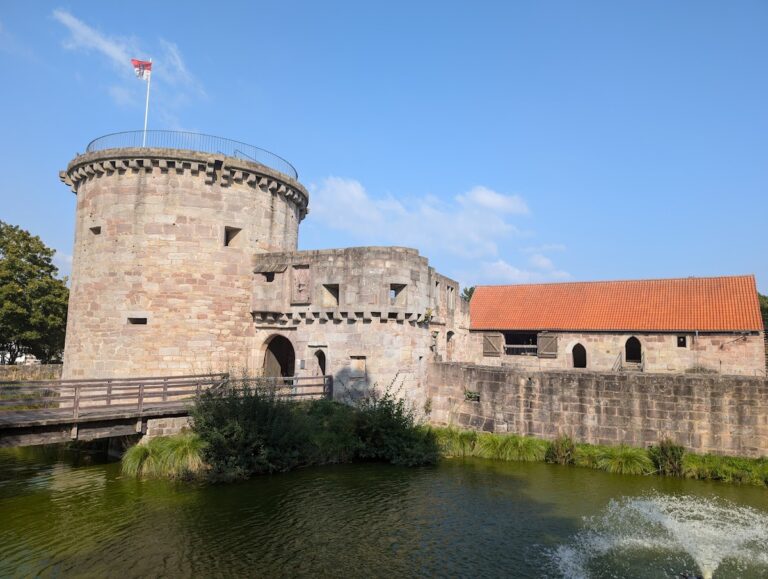
The outer walls survive in sections and once enclosed the rectangular castle area. An outer water moat and an inner moat separating the castle from the town were later filled in. The town-side walls were demolished or relocated during the nineteenth century; an overview plan from 1911 labels their replacement the “New Wall.” Service and ancillary buildings stood against the inside of the curtain wall and were gradually renewed or removed.
Entrances and bridge approach
The castle had an entrance on the south toward the town and a separate entrance on the east. The lower gate of Vacha’s town defenses stood directly west of the complex, beside the route leading toward the bridge. Defensive installations along this approach were removed in the nineteenth century, when traffic requirements led to the demolition of the medieval gates and barriers.
Towers and principal buildings
Southwestern round tower
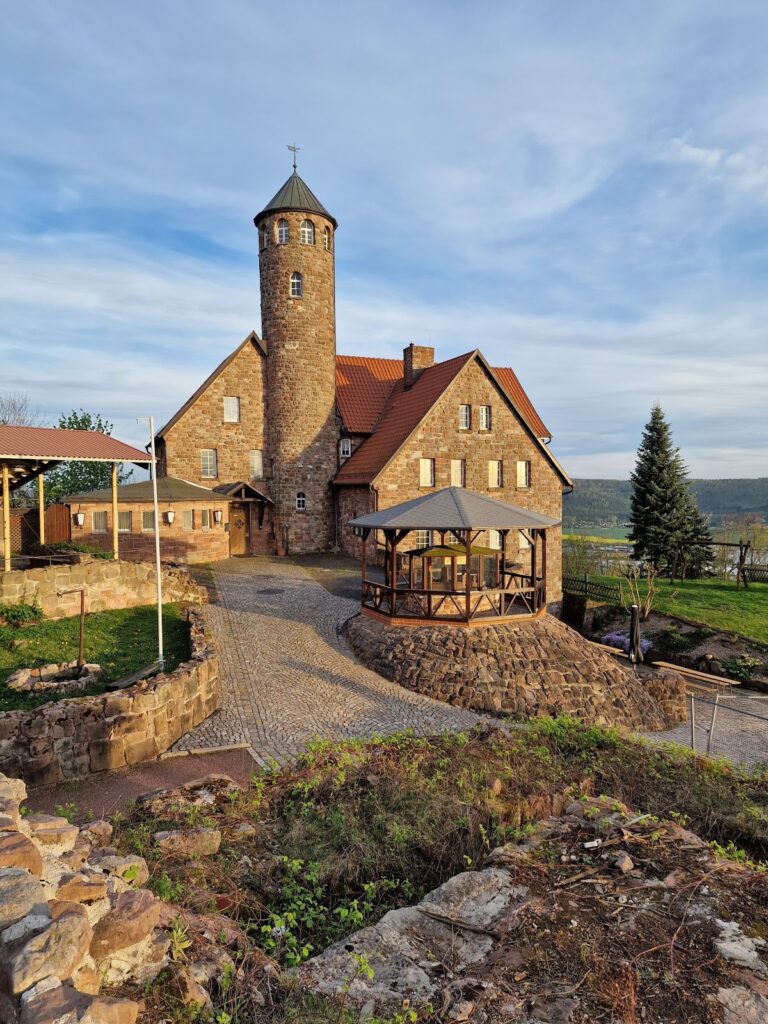
A round tower remains at the southwestern corner of the castle. It is approximately 20 metres high, with walls about 2 metres thick. Entry was through a small doorway roughly 10 metres above ground level, and the tower has a roof constructed in masonry. The former keep is now used as an observation tower.
Kemenate
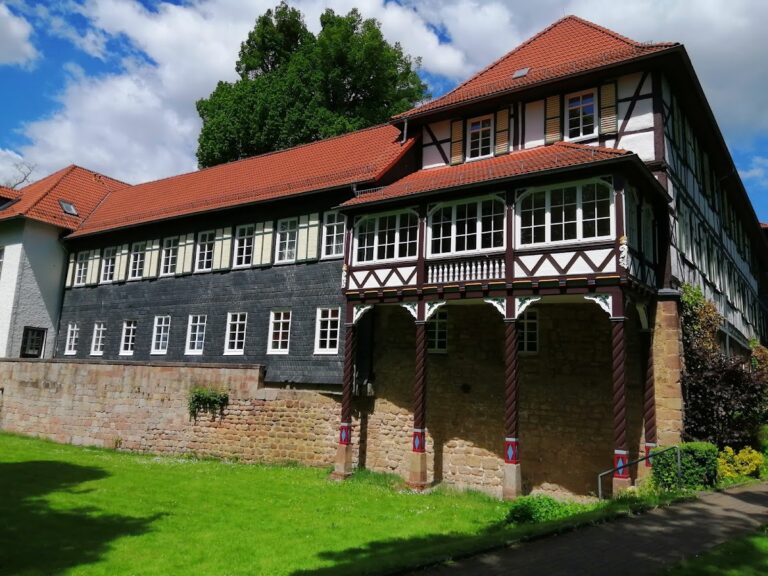
The principal building is the Kemenate, a largely preserved structure dating from around 1600. The term describes a main residential building traditionally associated with a heated living space within a medieval or early-modern castle complex. Its survival provides the clearest substantial example of the castle’s later residential architecture.
Museum buildings and collections
The castle now contains Vacha’s city museum. Its upper floor houses approximately 2,000 dolls from the private collection of Elenor Fischer, a Vacha resident who has died. The collection extends the museum’s importance beyond the immediate region. The Vacha border tower, incorporated into the museum complex after renovation, contains a memorial and exhibition space.
Nearby sites