Castillo de Santiago de la Torre: A Medieval Fortress near El Provencio, Spain

Site at a Glance
- Rating
- 4.3
- Popularity
- Very Low
- Country
- Spain
- Primary era
- Medieval
- External website
- Open
- Eras represented
- Medieval, Early Modern, Modern
- Civilizations
- Crown of Castile
- Site type
- Military
- Remains
- Castle
On this page12 sections
History
Castillo de Santiago de la Torre is a medieval fortress in Spain, near El Provencio in Cuenca, at a crossroads connecting San Clemente, Las Pedroñeras, El Provencio, and La Alberca del Záncara. The principal tower and settlement were established in the fifteenth century by Pedro González del Castillo Portocarrero, although older accounts had incorrectly placed the castle in the thirteenth century and associated it with the military Order of Santiago.
From El Quebrado to Santiago de la Torre
The settlement was known as El Quebrado or Santiago El Quebrado until 1434. The name Santiago de la Torre first appears in 1436, indicating that the place-name connected with a tower belongs to a later phase than the thirteenth-century settlement. Around 1271, during the reign of Alfonso X, known as Alfonso the Wise, El Quebrado was granted to the Order of Saint Mary of Spain. This military-religious order, founded for the naval defence of the Crown of Castile, included clerics and knights and followed the model of the Order of Calatrava.
The Order of Saint Mary of Spain was suppressed in 1280, and its surviving members entered the Order of Santiago. El Quebrado was then incorporated into the territory of Alarcón. These events explain the settlement’s association with Santiago in later historical writing, but the construction phases of its walls and towers place the existing fortress later than the traditional thirteenth-century date.
The Castillo Portocarrero foundation
On 13 November 1404, the council and territory of Alarcón granted Santiago El Quebrado, including its dues, rights, tributes, and jurisdiction, to Rodrigo Rodríguez de Avilés. The grant also included the depopulated settlement of Martín Ovieco. Rodríguez de Avilés was captured in 1407 while assisting the castle of Huércal near Lorca, on the frontier with the Kingdom of Granada. He later sold the settlement and lordship to Pedro González del Castillo in 1428 to help pay his ransom.
The Castillo Portocarrero lineage, which originated at Castillo de Garcimuñoz and claimed descent from the founder of San Clemente, subsequently acquired Santiago El Quebrado. In 1443, Pedro González del Castillo Portocarrero created a mayorazgo, an inheritable estate designed to keep noble properties together through a prescribed succession. It incorporated Santiago de la Torre and Santa María del Campo Rus, along with estates at Las Pedroñeras and Robledillo, a house at Castillo de Garcimuñoz, and other possessions in Salamanca.
The physical and documentary evidence identifies Pedro González del Castillo Portocarrero as the builder of the principal tower and the founder of the settlement and its associated hermitage. He became the first lord of Santa María del Campo Rus and Santiago de la Torre. Although he requested burial in the church of Santiago de la Torre, his family later moved his remains to the Augustinian convent at Castillo de Garcimuñoz.
Lordship and administration
Pedro’s son Juan del Castillo succeeded him, followed by Bernardo del Castillo Portocarrero and Antonio del Castillo Portocarrero. This succession continued from the middle of the fifteenth century into the middle of the sixteenth. The two settlements held their own jurisdictions after Pedro González del Castillo received them, while the estate was administered through several offices. Santa María del Campo had a governor, and Santiago de la Torre had a senior mayor who also served as castellan, the official responsible for the castle. A senior bailiff and a notary completed the local administration.
In the sixteenth century, Santa María del Campo Rus became known for resistance to seigneurial authority. Around 1566, Antonio del Castillo Portocarrero became involved in a violent conflict with Miguel García, who was imprisoned in the castle. The detailed account of García’s escape refers to the fortress’s dungeons, weapons room, and military courtyard, and shows that the outer defensive perimeter was complete at that time.
After García escaped and his father was arrested, opposition to Antonio’s authority grew stronger. Antonio abandoned Santa María del Campo Rus and Santiago de la Torre in 1579. Santa María del Campo Rus was exchanged with the Crown for Fermoselle, and its inhabitants paid 16,000 ducats. On 17 March 1579, they received the rights of a free town and their own jurisdiction.
Later ownership and decline
Alonso Pacheco y Guzmán purchased the town of Santiago de la Torre in May 1590. The transaction returned it to the Pacheco lineage and created a new mayorazgo. The property later became part of the holdings of the Pachecos of San Clemente. Members of that family also held offices in the corregimiento of San Clemente, a territorial district governed by a royal official called a corregidor, during the sixteenth and seventeenth centuries. This history helps explain the complex’s later administrative connection with San Clemente.
By 1649, Santiago de la Torre had absentee lords and was being worked by tenant farmers. Its population numbered no more than about six inhabitants, while tenants from El Provencio cultivated much of its land. The settlement’s decline began the long deterioration of the castle. From the late eighteenth century into the early nineteenth, the former fortress was remodelled as a seigneurial manor because its defensive functions were no longer adequate for estate management.
After the nineteenth-century abolition of the seigneurial system and successive disentailments, the castle and hamlet were divided among multiple owners. The buildings were adapted into separate houses and agricultural structures. During the twentieth century, the hamlet was abandoned and disappeared, while the castle became a farm building. Neglect, looting, and vandalism caused extensive deterioration. In January 2002, vandalism dismantled the associated hermitage, and the remains of people buried there were transferred to the cemetery at Hellín in Albacete.
Protection and restoration
A section of the exterior wall collapsed in December 2011. The castle was placed on the Red List of Heritage on 12 March 2012 because of its vulnerable condition. On 24 February 2018, San Clemente and El Provencio agreed to undertake a historical and archaeological study, including an assessment of structural problems and restoration requirements.
In August 2018, agreements with many owners enabled El Provencio to acquire approximately 75 percent of the castle, with the intention of restoring it for cultural use. The municipality acquired the keep on 14 August 2022, bringing its ownership to approximately 90 percent. Restoration of the palatial section was completed in August 2023.
Remains
Plan and defensive enclosure
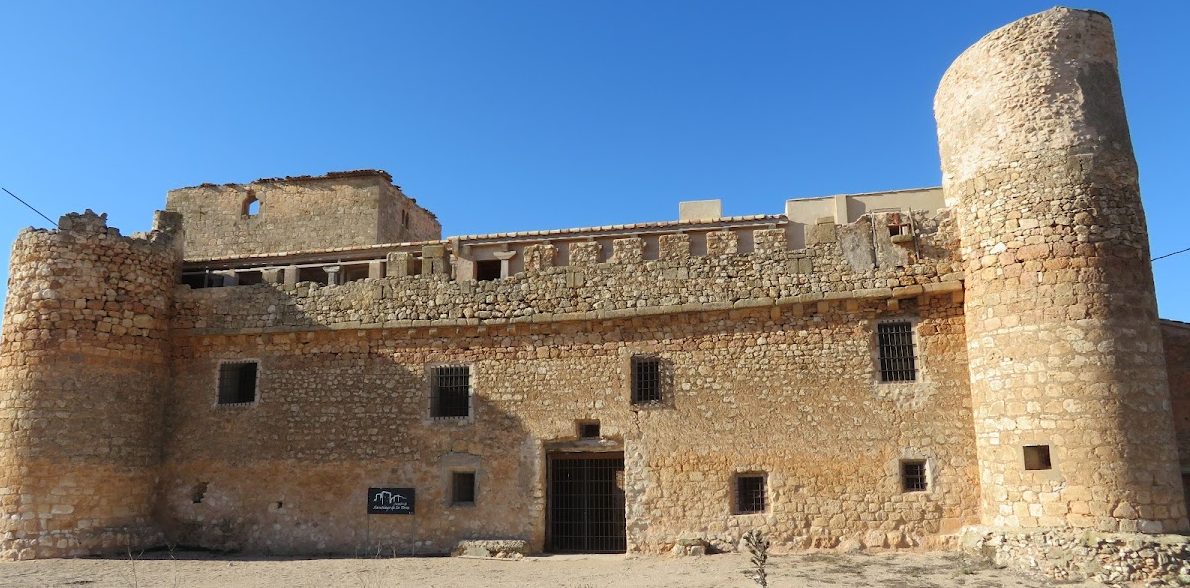
The castle stands on a plain beside a small bridge over the Záncara River and close to the routes linking the surrounding settlements. Its enclosure has an L-shaped plan bounded by a crenellated wall. A round tower terminates each of the five corners, giving the outer perimeter a regular defensive character. The fortress’s arrangement combines an enclosed military compound with a central residential and administrative focus.
A square courtyard occupies the centre of the enclosure, with the large rectangular keep standing at its centre. The fortress is listed as approximately 20 metres high. Sixteenth-century evidence describes a complete outer defensive perimeter, including a military courtyard and a weapons room. The later conversion into a manor house altered this arrangement by creating openings through the walls, roofing over and removing the wall-walks, and forming rooms on two floors with an additional attic.
Keep and internal structures
The central keep
The keep is the principal fortified tower of the castle and was probably built for Pedro González del Castillo Portocarrero. Its window seats and paired windows match those of the old tower at San Clemente, suggesting that both towers were constructed by the same builders and stonemasons. The lower part of the keep contained the dungeons described in the sixteenth-century account of Miguel García’s imprisonment and escape. Prisoners reportedly moved between the cells and the upper levels by rope, while a small window provided light.
The keep later became a dovecote, a structure for keeping pigeons. Its interior was completely ruined before recent restoration work, while the surrounding fortress retained much of its exterior fabric. The keep’s surviving form therefore combines evidence of its original defensive and administrative purpose with the physical effects of later agricultural reuse.
The manor conversion
The transformation from fortress to manor introduced plasterwork chimneys, simple wooden coffered ceilings, and brick floors in the attic. Subsequent subdivision created partition walls across the palace and military courtyard, turning the complex into separate houses and agricultural dependencies. Later owners repaired the dwellings with industrial materials and added tilework and modern brick. The buildings increasingly served to store agricultural machinery rather than as residences.
Walls, towers, and hermitage
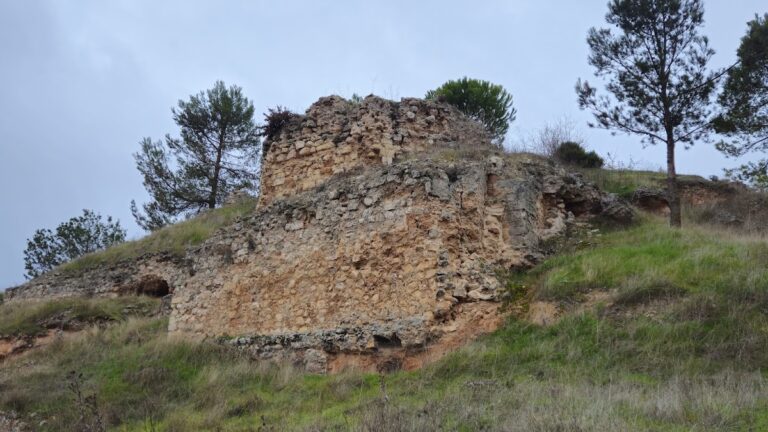
The outer wall contains numerous later windows and doors opened during the domestic conversion. Much of the wall-walk and its defensive elements disappeared when the wall sections were roofed over and incorporated into rooms. Some of the round towers, like the keep, were converted into dovecotes. A section of the exterior wall collapsed in 2011, adding to the damage caused by long neglect and later alterations.
The hermitage associated with the castle stood around the complex. Vandalism dismantled it completely in January 2002, leaving its walls as the surviving elements of the building. Its connection with the castle belongs to the foundation established under Pedro González del Castillo Portocarrero, who also established the settlement surrounding the fortress.