Castle of Numão: A Medieval Mountain Fortress in Portugal


Site at a Glance
- Rating
- 4.5
- Popularity
- Low
- Country
- Portugal
- Primary era
- Medieval
- External website
- Open
- Eras represented
- Medieval
- Civilizations
- Portuguese
- Site type
- Military
- Remains
- Castle
On this page10 sections
History
Castle of Numão is a mountain fortress in Portugal, rebuilt and expanded during the medieval period with Romanesque and Gothic elements. Occupation of the rocky hill reaches back to the Neolithic period, followed by a Lusitanian hillfort that was later Romanized. A further fortification may have been established during the Muslim invasion of the Iberian Peninsula.
From early occupation to Christian reconquest
During the Christian Reconquista, the medieval expansion of Christian kingdoms into Muslim-ruled territories in the Iberian Peninsula, Numão and other fortresses in the eastern Beira region belonged to D. Chamoa Rodrigues. In 960, she donated them through her aunt, Countess Mumadona Dias, to the Monastery of Guimarães. Muslim forces retook Numão around 1000. The brothers Tedom and Rausendo Ramires destroyed the castle in 1030, and Fernando Magno, a king of León and Castile, reconquered it in 1055 or 1056. The castle was listed among the possessions of the Monastery of Guimarães in 1059.
Rebuilding during the emergence of Portugal
As Portugal emerged as a kingdom, Afonso Henriques, its first king, granted his domains to his brother-in-law, Fernão Mendes de Bragança. On 8 July 1130, Mendes de Bragança issued a charter to the settlement, then called Civitate Noman, and encouraged the castle’s reconstruction. During the reign of Sancho I, the walls were restored and the keep was completed. An inscription formerly placed at the western gate dated the beginning of the tower’s construction to 1189.
Under Sancho II, Numão and its castle were temporarily granted to Abril Peres de Lumiares. In 1247, D. Afonso Lopes de Baião represented the king as the territory’s military and administrative official. Afonso III confirmed the settlement’s charter in October 1265. A further phase of defensive construction probably began after King Dinis reconfirmed the charter on 27 October 1285.
Late medieval administration and decline
In 1373, during the reign of Fernando I, Vasco Fernandes Coutinho, Count of Marialva, served as the castle’s senior governor. The office remained with the Coutinho family until D. Francisco Coutinho, the fourth Count of Marialva, during the reign of João III. During the Portuguese succession crisis of 1383–1385, a conflict over the crown that led to a new ruling dynasty, Numão supported Beatriz, alongside the neighboring settlements and castles of Penedono, Pinhel, Sabugal, Castelo Rodrigo, and Trancoso.
In 1436, during the reign of Duarte, Numão became a couto de homiziados, a protected settlement offering legal refuge to certain fugitives in an effort to attract inhabitants. Manuel I granted the village a new charter on 25 August 1512. At that time, Numão was a commandery of the Order of Christ, the Portuguese military-religious order that succeeded the Templars in Portugal.
The 1527 population register counted 15 households in Numão and another 41 in the surrounding area. After the Coutinho family became extinct for lack of heirs in 1534, the decline of the settlement and castle intensified. About two centuries later, the village moved to a new location at the foot of the hill. In 1798–1799, the castle was described as almost ruined, and the inscription once located at the western gate was transcribed as “Incepit Tvrrem in Era MCCXXVII,” corresponding to 1189.
Protection and conservation
Castle of Numão was classified as a National Monument by decree on 23 June 1910 and is included in the Côa Valley Archaeological Park. Public conservation work in the second half of the 1940s consolidated and cleared the site, reconstructed sections of the walls, cleared debris from the cistern, and recovered the keep. Further campaigns followed in 1973–1974 after the collapse of a northern section of the walls, and again in 1984.
Remains
Hilltop enclosure and defensive walls
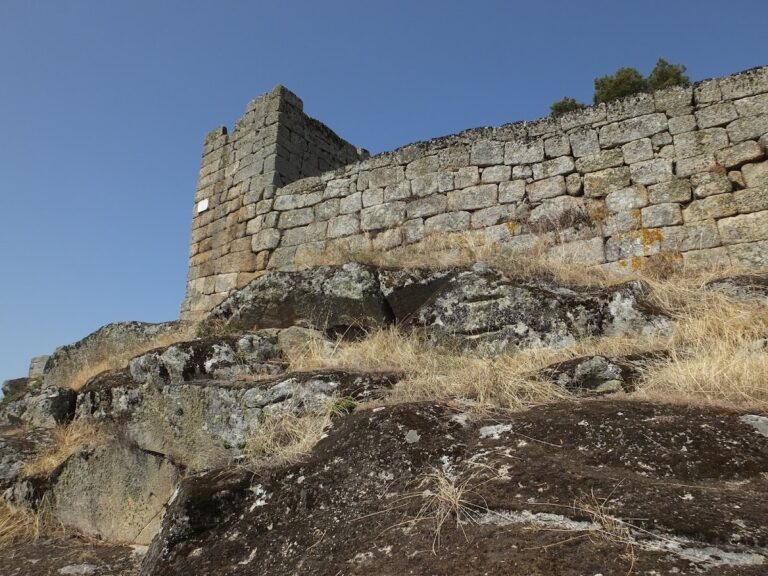
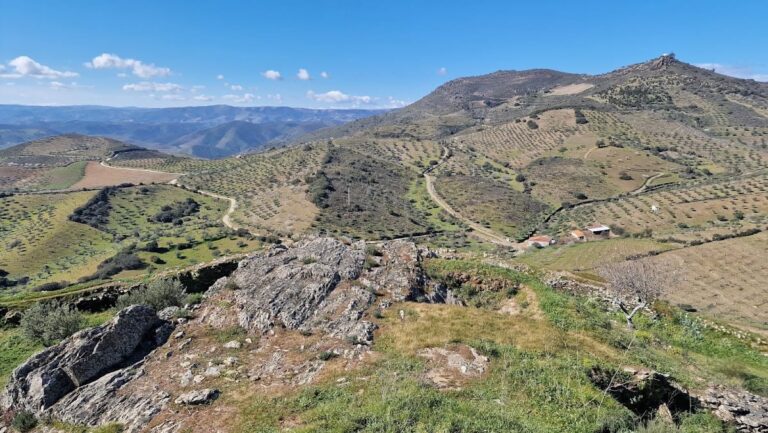
The castle occupies a rocky hill at 677 metres above sea level on the eastern slope of the Lapa mountain range. Its irregular, organic oval enclosure covers approximately 2 hectares. The walls combine Romanesque and Gothic features, with crenellation surviving along a short section. They were originally reinforced by 15 towers, of which six are now represented; some towers are attached externally to the curtain walls. The elevated position gives views toward the castles of Ansiães, Castelo Melhor, Castelo Rodrigo, Ranhados, and Penedono. The castle is in good condition overall.
Gateways
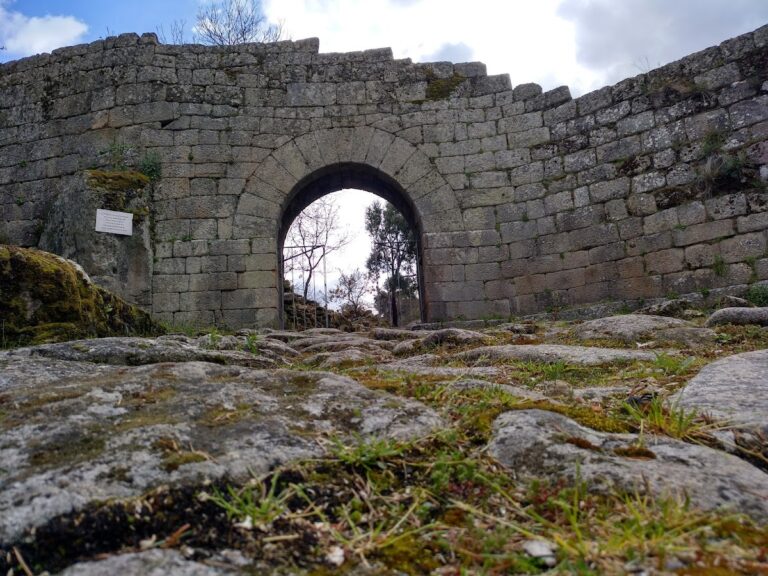
Four gateways pierce the enclosure. The São Pedro Gate stands on the east, the western gate on the opposite side, the False Gate or postern, a small secondary entrance, lies to the southeast, and the Main Gate opens on the south. The São Pedro Gate is protected by a tower and has a pointed arch beneath a slightly pointed barrel vault. The western gate has a similar form, while the postern has a broken arch. The Main Gate survives only to the springing points, where its arch begins to curve.
Keep and central ground
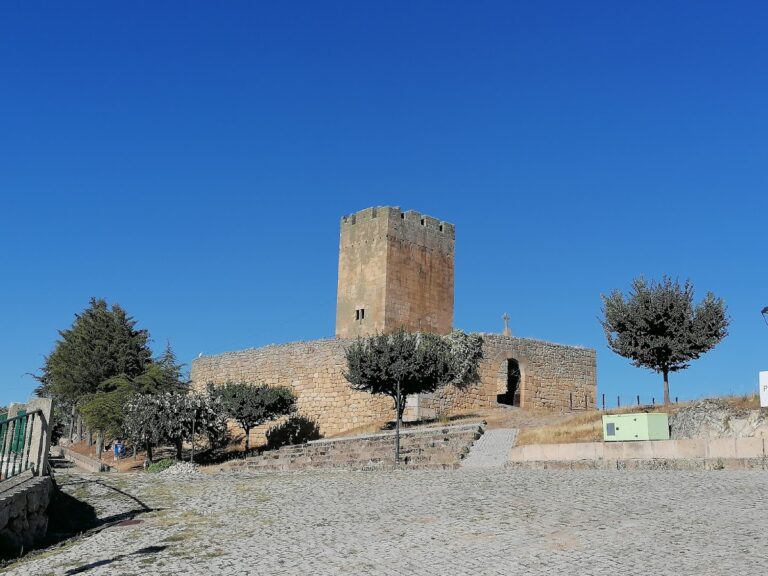
The keep, the principal fortified tower, occupies the northeastern part of the enclosure. It has a square plan, two tall slit openings, and a crowning row of corbels, which are projecting supports, decorated with geometric designs. At the centre of the parade ground, the open area used for assembly and military activity, stands a circular roofless cistern approximately 7 metres in diameter.
Church and cemetery
Beside the Main Gate are the ruins of the Romanesque Church of Santa Maria do Castelo and an associated cemetery. On the eastern slope, beside the São Pedro Gate and the site of a former chapel dedicated to Saint Peter, lies a necropolis of approximately 10 anthropomorphic graves cut into the rock. These human-shaped graves are popularly known as the Cemetery of the Moors. The church stands in ruins, while the former chapel site remains identified beside the gate.