Castle of Montalbán: A Reconquista Fortress in Spain


Site at a Glance
- Rating
- 4.9
- Popularity
- Very Low
- Country
- Spain
- Primary era
- Medieval
- Eras represented
- Medieval
- Civilizations
- Crown of Castile, Crusader, Knights Templar
- Site type
- Military
- Remains
- Castle
On this page17 sections
History
Castle of Montalbán is a medieval fortress in Spain, developed during the Reconquista, the centuries-long Christian expansion into territories ruled by Muslim powers in the Iberian Peninsula. Built as a defensive position on the left bank of the Tagus, it substantially enlarged an earlier and smaller Muslim castle, which may have been abandoned after the Christian conquest of Toledo. The fortress occupies a naturally strong site and became an important military and administrative center in Castile.
From Muslim stronghold to Templar commandery
The earlier Muslim fortification formed the starting point for the later castle. During the Christian reconquest, the site was expanded to control and defend the surrounding area. Montalbán appears in written records in 1209, when it was granted to the knight Alfonso Téllez.
The present fortress is traditionally connected with the Knights Templar, a medieval military-religious order that maintained fortified estates and administrative commanderies. Alfonso VII granted Montalbán to the order, and the surrounding lands became its most important commandery in Castile. In this role, the castle served not simply as a defensive position but also as the center of a substantial territorial jurisdiction.
Changes of lordship and military rebuilding
In 1275, Montalbán became the principal commandery of the Order of Santiago in Aragon. This was another Iberian military-religious order, established to defend Christian territories and administer commanderies, or estates governed by the order. In 1308, the castle returned to the Crown, and Alfonso XI granted it to the knight Alfonso Fernández Coronel.
A dispute between Fernández Coronel and Pedro I led to further changes. The castle was remodeled and received additional defenses, reinforcing a stronghold that already occupied a difficult position to attack. After Fernández Coronel was executed, Pedro I granted Montalbán to Beatriz, his illegitimate daughter.
The siege of 1420
Castle of Montalbán played a prominent part in the Castilian political struggles of the fifteenth century. In December 1420, King John II was besieged there by troops commanded by the infante Enrique, who later became king. The siege lasted for two months and ended in part because the community of Villa Real sent approximately 1,500 armed militiamen to aid John II.
John II rewarded Villa Real for this intervention by granting it the title “Very Noble and Very Loyal City.” The community subsequently adopted the name Ciudad Real. The episode connected the castle with one of the region’s notable political and military events, while also preserving the memory of the local community’s role in lifting the siege.
Later ownership and decline
The lordship of Montalbán later passed to Álvaro de Luna, a powerful Castilian nobleman and royal favorite. After his death, his widow inherited the lordship and occasionally lived in the castle. During the reign of Henry IV, the fortress was acquired by Juan Pacheco, another major noble and royal favorite. Ownership then passed through his successors to the present-day Dukes of Osuna.
The castle’s strength and great extent led to the historical assessment that it was the most robust and formidable castle in Toledo Province, perhaps surpassing the Castle of Escalona. Its reputed defensive power may help explain why no attacks are recorded during the battles associated with its later history. The castle was declared a historic monument in 1931 and is included on Hispania Nostra’s Red List of endangered heritage. It belongs to the Duchy of Osuna and is undergoing progressive ruin, although the initial sections of the stairway behind the curtain wall have been restored.
Traditions of hidden treasure
A tradition links the surroundings of Montalbán with the possible presence of Solomon’s Table, a legendary treasure associated with theories of hidden Visigothic and Templar wealth. The hypothesis places concealed treasure along escape routes running from Toledo toward the Montes de Toledo and along ancient Roman roads, in the same general direction as the discovery of the Guarrazar Treasure.
The castle’s underground spaces have also been compared with the subterranean structure at Dormelle, which is associated with a Templar commandery. This association remains an unverified tradition rather than an established historical conclusion.
Remains
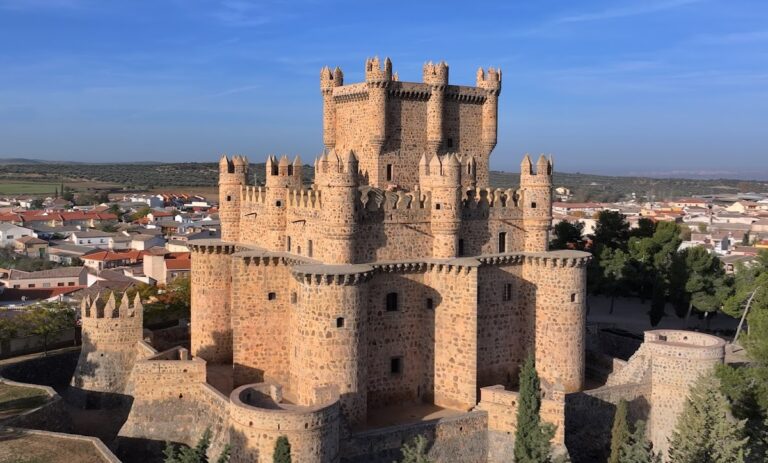
Castle of Montalbán covers more than 15,000 square metres on a naturally defended site. The Torcón River cuts an escarpment approximately 100 metres deep along the north and northwest sides, where it served as a moat on three sides. Ravines to the east and west added further natural protection. The southern side faced level ground, so the principal artificial defenses were concentrated along that approach.
Earlier fortress and enclosing walls
Muslim fortress
Remains of the earlier Muslim castle survive within the later complex. It had a quadrangular plan and was considerably smaller than the fortress that replaced and incorporated it. Its surviving fabric provides the earliest physical phase of the site’s fortified history.
Perimeter walls
The later fortress is enclosed by crenellated walls and square towers. Some tower angles contain projecting sentry structures. The side above the precipice is less heavily built because it relied on the natural escarpment for protection. Parts of this side were constructed in rammed earth, a technique in which earth was compacted inside temporary formwork, and the upper crowning of these stretches has been lost.
Southern approach and outer defenses
Ditch and coracha
On the southern approach, a broad ditch linked the two ravines and strengthened the side most exposed to level ground. Beyond the ditch stood a low, semicircular, crenellated tower with arrow slits. It functioned as a coracha, a fortified projection or enclosed approach that extended the defensive line toward the outer approach.
Barbican and entrances
The coracha extended the outer barbican, an advanced defensive enclosure protecting an entrance. This outer defense retains crenellations and limestone loopholes. Three gates and a sally port provided entry through the outer works, leading to a spacious wall-walk that surrounds almost half of the main building.
Inner entrance and towers
Albarrana towers
The inner entrance is protected by two enormous pentagonal albarrana towers. An albarrana tower projects from a fortification and is connected to it by a bridge or narrow link. At Montalbán, the towers have slender pointed arches rising more than 10 metres to their keystones, while three carefully concealed wickets provided subsidiary passages.
Both towers were built with rubble masonry and ashlar corners, and they retain numerous lapidary inscriptions, including a five-pointed star. They project over the wall-walk and share a similar design. The left tower is solid, whereas the better-preserved right tower contains rooms.
Right-hand tower and stairway
The right-hand tower includes arrow slits and four brick machicolations, openings through which defenders could attack people below. It is connected to the main tower inside the enclosure, which also formerly had machicolations. Both entrance towers are reached by a stairway behind the wall, whose lower sections have been restored.
Interior spaces
The interior remains substantially complete and contains two large underground silos or cisterns. Together with the surviving entrance works, wall-walk, towers, ditches, ravines, and sections of rammed-earth walling, these features show how the fortress combined substantial construction with the defensive advantages of its landscape.
Nearby sites