Burg Lutzmannstein: A High-Medieval Castle and Lordship in Germany


Site at a Glance
- Rating
- 4.6
- Popularity
- Very Low
- Country
- Germany
- Primary era
- Medieval
- Eras represented
- Medieval, Early Modern
- Civilizations
- Duchy of Bavaria, Holy Roman Empire
- Site type
- Military
- Remains
- Castle
On this page14 sections
History
Foundation and ducal administration
Burg Lutzmannstein is a high-medieval castle in Germany, probably founded around the middle of the twelfth century by Adalbert Lutzmann. It became the center of the Lutzmannstein lordship in the Upper Palatinate. Adalbert may have belonged to the Babonen family, a medieval noble lineage associated with Bavaria and the Upper Palatinate, or to a branch of the lords of Prunn, Laber, and Breitenegg.
From 1260, Adalbert used the name Albertus de Luitzmanstein, apparently deriving it from the fortress. The Lutzmannstein family were ministeriales, medieval service nobles who performed administrative, military, or judicial duties for rulers. Adalbert also held the bailiwick of Nittenau from the Bishopric of Bamberg until 1269. After the death of Adalbert V Lutzmann, the castle reverted to Duke Ludwig II of Bavaria in 1268 or 1269 and became the seat of ducal officials.
Stephan of Kemnath was associated with Lutzmannstein, Hohenkemnath, and Rosenberg in 1267. Later, Ulrich Zenger served as administrator and pledge-holder in 1360, and Hans Zenger of Tannstein declared the pledge ended in 1389. Following the Treaty of Pavia, the 1329 agreement that divided Wittelsbach territories between the Bavarian and Palatine branches, Lutzmannstein remained with the Duchy of Upper Bavaria.
Pledges, inheritance, and noble ownership
In 1397, the Bavarian dukes Stephan III, Johann II, Ludwig VII, and Ernst pledged the Lutzmannstein lordship to Altman Kemnather for 4,000 gulden. The agreement granted him redemption rights and permanent access. Kemnather later served as district judge at Amberg in 1402 and at Sulzbach from 1403 to 1412. Friedrich Kemnather acknowledged the fief to Duke Johann in 1420.
Debt forced Friedrich Kemnather’s descendants to sell the castle and its associated properties in 1428 to Count Palatine Johann of Palatinate-Neumarkt for 5,000 Rhenish gulden. Johann transferred Lutzmannstein in 1432 to Heinrich V Notthafft of Wernberg, the king’s chief captain beyond the Forest. In 1433, Heinrich received the fief from Dukes Ernst and Wilhelm III of Bavaria-Munich, whose rights had emerged from the Bavarian partition of 1392.
Heinrich V’s will of 23 January 1440 assigned Lutzmannstein, along with Aholming and Eckmühl, to his middle son Heinrich VI. In 1460, Heinrich VI settled inheritance claims with his sons Kaspar I and Heinrich VII. Heinrich the Younger apparently received Lutzmannstein and an annual payment of 300 gulden, but further disputes followed in 1469. By 1482, Heimeran III held one half of the castle and his half-brother Heinrich VII the other. Heinrich VII later acquired the remaining half and reunited the property. After his death in 1487, his sons Kaspar II and Johann VI divided the inheritance.
In 1490, Kaspar II and his mother Barbara sold their share of Lutzmannstein to the knight Heinrich Notthafft, although they continued to live at the castle. Kaspar II and Heinrich Notthafft belonged to the Löwlerbund, a late-medieval noble league in Bavaria and nearby territories. Kaspar fought for Duke Albrecht IV at the Battle of Wenzenbach on 12 September 1504 and was knighted by Emperor Maximilian I for his bravery.
Palatinate-Neuburg and the Stiebar family
The Cologne arbitration of 30 July 1505 ended the War of the Landshut Succession, a Bavarian dynastic conflict that resulted in the creation of the Duchy of Palatinate-Neuburg. Lutzmannstein became part of the new duchy. After Kaspar Notthafft died in 1520, his son Christoph Joachim inherited his property.
In 1538, Christoph Joachim’s cousin Anna, daughter of Hans VI Notthafft of Wernberg, married Hans Joachim Stiebar of Buttenheim. Stiebar was a privy councillor of the Bishopric of Bamberg and of Palatinate-Neuburg. When Christoph Joachim died in 1547, guardians acting for his sons Heinrich and Kaspar III sought a renewed enfeoffment. The subsequent inheritance settlement transferred half of the Lutzmannstein lordship to Anna and Hans Joachim Stiebar. Hans Joachim bought the remaining half from Kaspar III Notthafft in 1566.
Because Hans Joachim Stiebar also served as burgrave of the Rothenberg fortress near Schnaittach, officials administered Lutzmannstein on his behalf. Jorg Grosmann, Anton Schmauss, Klement Stainhaus in 1575, Ulrich Dollnstainer in 1577, and Sebastian Gulden in 1623 are recorded among these administrators. An administrator managed a lord’s estate or district and could combine administrative, judicial, and military duties.
A jurisdictional dispute arose in 1555 when the Hohenfels administrator claimed Electoral Palatine authority to protect a local church fair. He forcibly removed a Lutzmannstein official, detained a participant, and demanded a fine. The government at Neuburg ruled that protection of the fair belonged to the Electoral Palatinate and required Grosmann to recognize that jurisdiction.
War, destruction, and replacement palace
Wartime pressures affected Lutzmannstein during the early seventeenth century. In 1621, Hans Veit Stiebar ordered night watches at the castle gate, in the market, and in surrounding villages after Bavarian troops entered the Upper Palatinate following the Battle of White Mountain. In 1628, the administrator was instructed to obtain gunpowder and lead because the castle had no reserve.
On 1 March 1633, Lutzmannstein was handed over to the imperial and Bavarian lieutenant-colonel Hans Jakob von Voit. Mercenaries and officers quartered in the market and castle had to be paid and supplied by the estate. At the instigation of Albrecht Schenk of Staufenberg, the Regensburg episcopal administrator at Hohenburg, the castle was completely plundered. Further troops entered during the fighting, and fire destroyed the old fortress and its registry, including its documents. The castle and St. Ottilia Chapel were destroyed during the Thirty Years’ War, the major European conflict of 1618 to 1648.
Joachim Ludwig Stiebar and his cousin Georg Pankraz Stiebar sold the destroyed castle and the Lutzmannstein estate in 1662 to Franz Wilhelm von Gise of Sinningen and Seibersdorf, a privy councillor and president of the Palatinate-Neuburg court council. His descendants left the ruined castle and built a new palace at the foot of the castle hill around 1730.
Heinrich Andreas Freiherr von Gise was named in 1705 as a benefactor of the Neuburg Congregation of Our Lady of Sorrows. Philipp Wilhelm Baron von Gise, a Bavarian chamberlain and former state-directorate councillor, was the last of his family. In 1805, he adopted the privy councillor Friedrich August Freiherr von Koch of Teublitz. Koch’s descendants owned Schloss Lutzmannstein until 1916.
Jurisdiction, evacuation, and military destruction
The local patrimonial jurisdiction, meaning judicial authority exercised by the estate’s lord, ended in 1848. The Lutzmannstein-Allersburg Hofmark, a manorial estate with local administrative and jurisdictional rights, was dissolved in 1849. Maria Anna Hildegard von Gise and Lutzmannstein, Philipp Wilhelm’s sister, became the last abbess of Holzen Abbey and left it after its dissolution in 1802.
In 1916, the Bavarian royal forestry administration acquired the Lutzmannstein estate, which consisted mainly of woodland. During the Second World War, the palace served as an art depot for the Munich City Museum. After the war, five refugee families lived there.
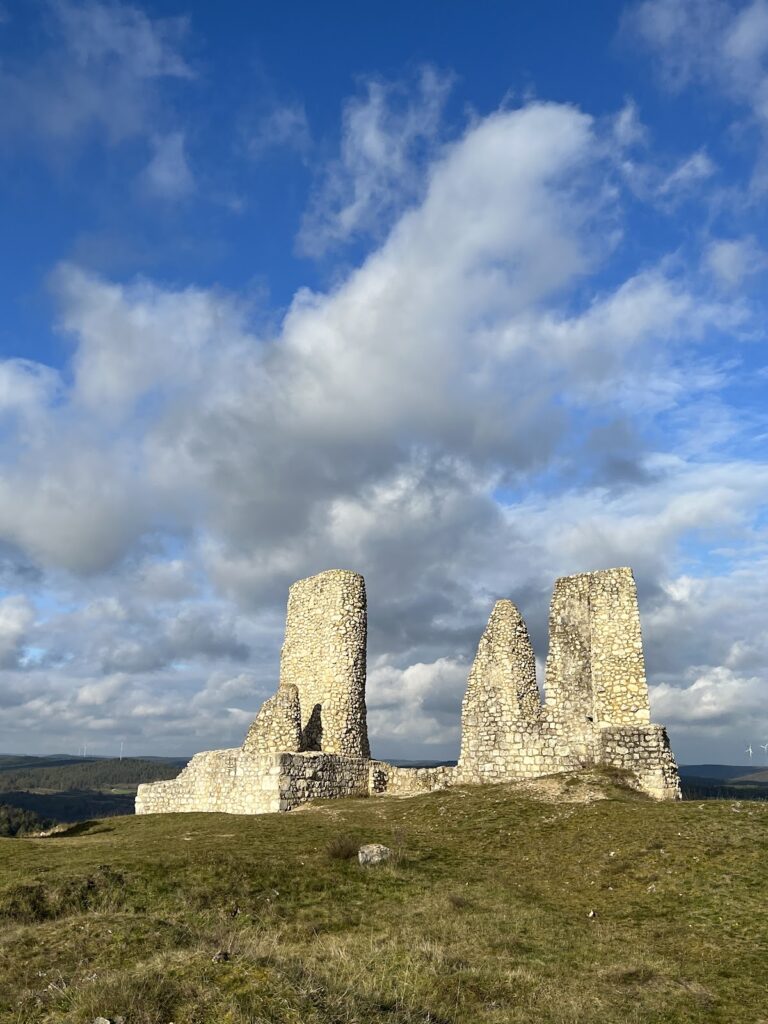
The settlement was evacuated in 1951 when the Hohenfels military training area expanded. From 1953, the area was used for military target exercises. Shelling caused the settlement and palace to burn for four days, leaving the palace largely destroyed. The ruins now lie inside a military restricted zone and are not freely accessible. Lutzmannstein is listed as an archaeological monument in two Bavarian heritage-register entries, one concerning archaeological remains around the early-modern palace ruins and another covering the former castle gatehouse, a probably late-medieval ruin.
Remains
Castle hill and defenses
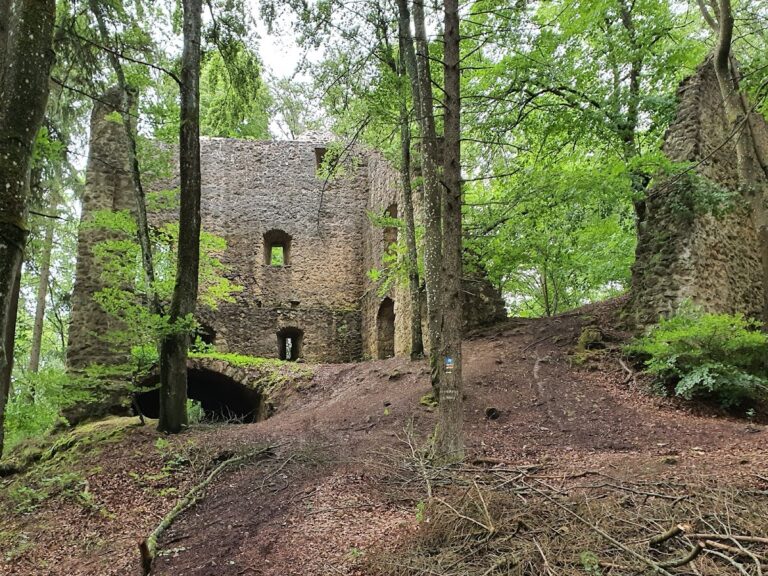
Burg Lutzmannstein occupied a hill beside the former St. Ottilia Chapel. A rocky ditch separated the ridge from the castle plateau. The approach road passed through a gatehouse, later used as the community poorhouse, then followed a loop before reaching the castle entrance.
Gatehouse
The old gatehouse formed part of the approach to the castle. It was rebuilt in 1662, after the destruction of the medieval fortress, and its surviving remains are classified as a probably late-medieval ruin. An approximately 1800 view by Johann Georg Hämmerl shows the gatehouse, the castle hill, St. Ottilia Church, and a small number of wall fragments.
Keep and enclosure
A keep, the principal fortified tower of a castle, was presumed on the eastern side of the hill from masonry made of roughly bossed stone blocks. On the southern side of the castle enclosure, the bounded area within the fortification, stood a cistern and a sixteenth-century rubble-stone wall. A cistern is a tank or underground structure for collecting and storing water.
St. Ottilia Chapel
St. Ottilia Chapel stood on the northern side of the castle enclosure. A member of the Nothaft family founded it around the middle of the fifteenth century. The chapel and the castle were destroyed during the Thirty Years’ War. A few ruin fragments of the former church remain.
Palace and later religious furnishings
Baroque palace
The replacement palace built around 1730 at the foot of the castle hill was a two-storey building with three projecting central sections and two rear side wings. Military shelling and fire in 1953 largely destroyed the building. Its ruins form part of the archaeological remains associated with the deserted settlement of Lutzmannstein.
Transferred church furnishings
The Baroque high altar, Stations of the Cross, and Baroque figures of the apostles Peter and Paul from the parish church of St. Mary and St. Lucia at Lutzmannstein were transferred to the branch church built at Nattershofen in 1955 and 1956. Nattershofen is now part of Lauterhofen.
Nearby sites