Castle of Guadamur: A Late Medieval Fortress and Noble Residence in Spain


Site at a Glance
- Rating
- 4.3
- Popularity
- Medium
- Country
- Spain
- Primary era
- Medieval
- External website
- Open
- Eras represented
- Medieval, Early Modern
- Civilizations
- Crown of Castile, Spanish
- Site type
- Military
- Remains
- Castle
On this page9 sections
History
Castle of Guadamur is a late medieval fortress and noble residence in Guadamur, Spain, built in phases around 1470 and 1520 to protect the settlement and surrounding area. Commissioned by the Count of Fuensalida, it stood in a region repeatedly affected by fires and plundering between 1446 and 1521. Its military role was combined with use as a family retreat, hunting lodge, and secure refuge near Toledo during periods of political crisis.
Foundation and the Counts of Fuensalida
The first building phase began around 1470, when the Ayala family received the County of Fuensalida from King Henry IV of Castile. A second phase followed around 1520, adding further defensive and residential elements. The castle and the county remained associated with the Ayala family before passing in the seventeenth century to the House of Velasco through Bernardino Fernández de Velasco y Pacheco Téllez-Girón, the eighth Count of Fuensalida. In the eighteenth century, the title and property became part of the extensive estate of the House of Escalona.
The fortress was intended to provide a dependable refuge close to Toledo during political uncertainty. It was used or considered for this purpose in 1471, 1473, possibly 1507, and during the Revolt of the Comuneros, a major uprising in Castile against the rule of Charles V in 1520 and 1521. Alongside this protective role, the counts used the castle for rest and hunting. Its strongly military character continued until the eighteenth century, when the counts moved to their Toledo palace beside the Church of Santo Tomé.
Military administration and noble ownership
During the sixteenth century, the castle possessed ancient weapons and an alcaide, or castellan who represented the lord and oversaw the castle’s administration. The alcaide represented the count when municipal offices were formally taken up and participated in the town’s social life, especially in matters linked to the Church. The office did not include judicial or financial administration.
The Counts of Fuensalida maintained close connections with the army. Members of the family served in wars associated with Ferdinand II of Aragon and Isabella I of Castile, known as the Catholic Monarchs, as well as at Saint-Quentin in 1557 during the war between Spain and France and in the armies of Philip IV. Philip IV ordered the sixth Count of Fuensalida to surrender all available weapons for the Crown’s military needs in 1637, 1641, and 1659.
Later ownership became disputed between the sixteenth Duchess of Osuna and the seventeenth Count of Cedillo, who descended through the female line from the second Count of Fuensalida. In 1880, three residents of Guadamur bought the castle from Bernardino Fernández de Velasco y Roca de Togores Pacheco y Téllez-Girón, the eighteenth Count of Haro and a descendant of the Counts of Fuensalida. They housed poor and needy people there, although the building had already deteriorated considerably and its conditions were unhealthy.
Restoration and modern recognition
On 4 May 1887, Jerónimo López de Ayala y del Hierro, fifth Marquess of Villanueva del Castillo and a descendant of the Ayala family, encouraged his father-in-law, Carlos Morenés y Tord, to purchase the castle. Morenés was the fourth Baron of Cuatro Torres and Count of Asalto, while López de Ayala was a specialist in art history and Morenés a medievalist. They acquired the building for restoration and use as a second residence. The nineteenth-century restoration recovered the castle from its ruined condition.
Carlos Morenés y Tord was born at La Nou de Gaya in Tarragona in 1835. He served as an elected senator for Tarragona in the 1876 to 1877, 1884 to 1885, and 1891 to 1893 legislatures. He was married to María Fernanda García-Alessón y Pardo de Rivadeneyra, sixth Countess of Asalto and Baroness of Davalillo.
The castle was damaged during the Spanish Civil War. The Marquess of Aguilar de Campoo later carried out its last restoration. Its changing appearance and restoration were also reflected in cultural works: Benito Pérez Galdós referred to the restoration in Ángel Guerra, and Ricardo Madrazo painted the castle in 1910. The painting is now preserved at the Hispanic Society of America in New York.
Castle of Guadamur was declared a historic-artistic monument on 18 June 1964. It now has the status of a Property of Cultural Interest, with the designation code RI-51-0001611.
Remains
Setting and defensive circuit
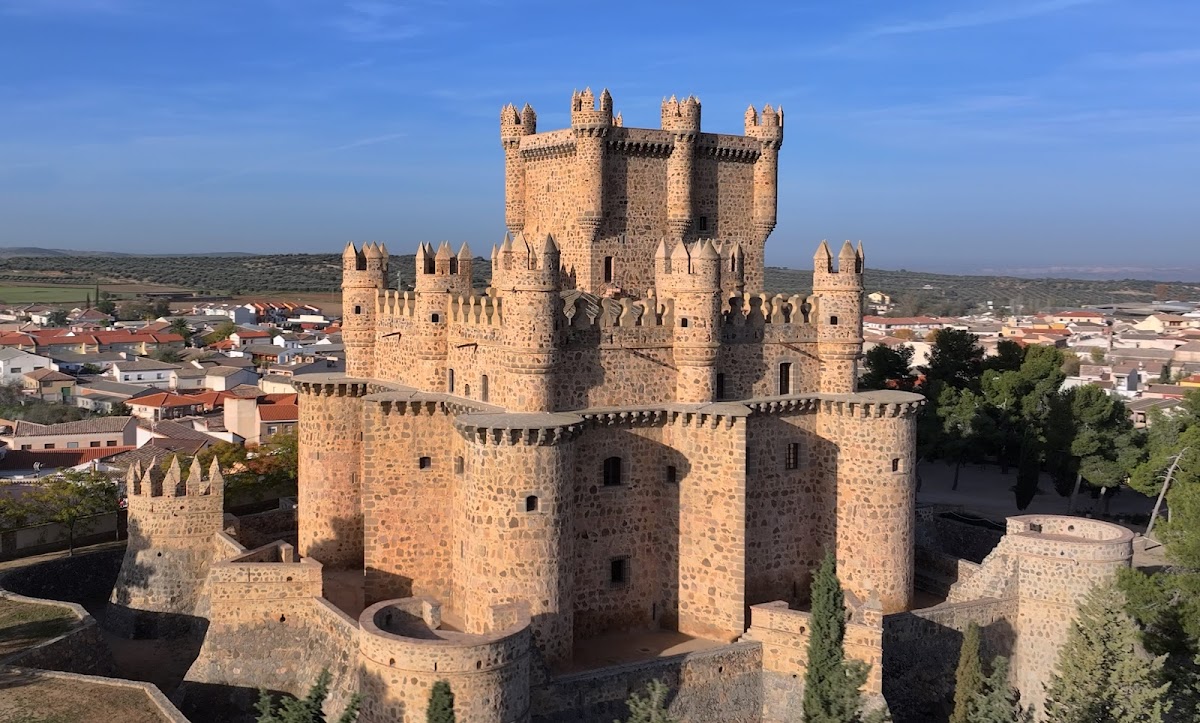
The castle stands east of Guadamur on Cerro de la Ermita, a small promontory beneath which the stream crossing the settlement once passed. Its inner core is enclosed by a nearly square ring wall strengthened by circular corner towers. At the midpoint of each side, a pointed triangular projection extends from the wall. The same defensive arrangement is repeated in the outer wall surrounding the complex. This design is regarded as an early example of a solution later associated with eighteenth- and nineteenth-century military architecture.
The upper part of the inner wall is set slightly behind its base and follows a straight line. Its parapet has crenellations and small turrets. The second construction phase added the outer defensive barrier and a moat, extending the castle’s protected area beyond the original ring wall.
Keep and entrance defenses
The keep is a rectangular tower about 30 metres high, with a base measuring approximately 10 by 15 metres. It is attached to a corner of the inner ring wall, and its front faces the entrance. The approach between the two adjoining wall sections bends around the tower, incorporating the keep into the defensive route.
Small turrets rise at the corners and at the centres of the keep’s walls. Its platform and turrets have machicolations, projecting openings or galleries in a parapet through which defenders could drop objects onto attackers below. By the period when firearms dominated warfare, these features probably had limited practical defensive value, while reinforcing the tower’s fortified appearance.
Courtyard and palace
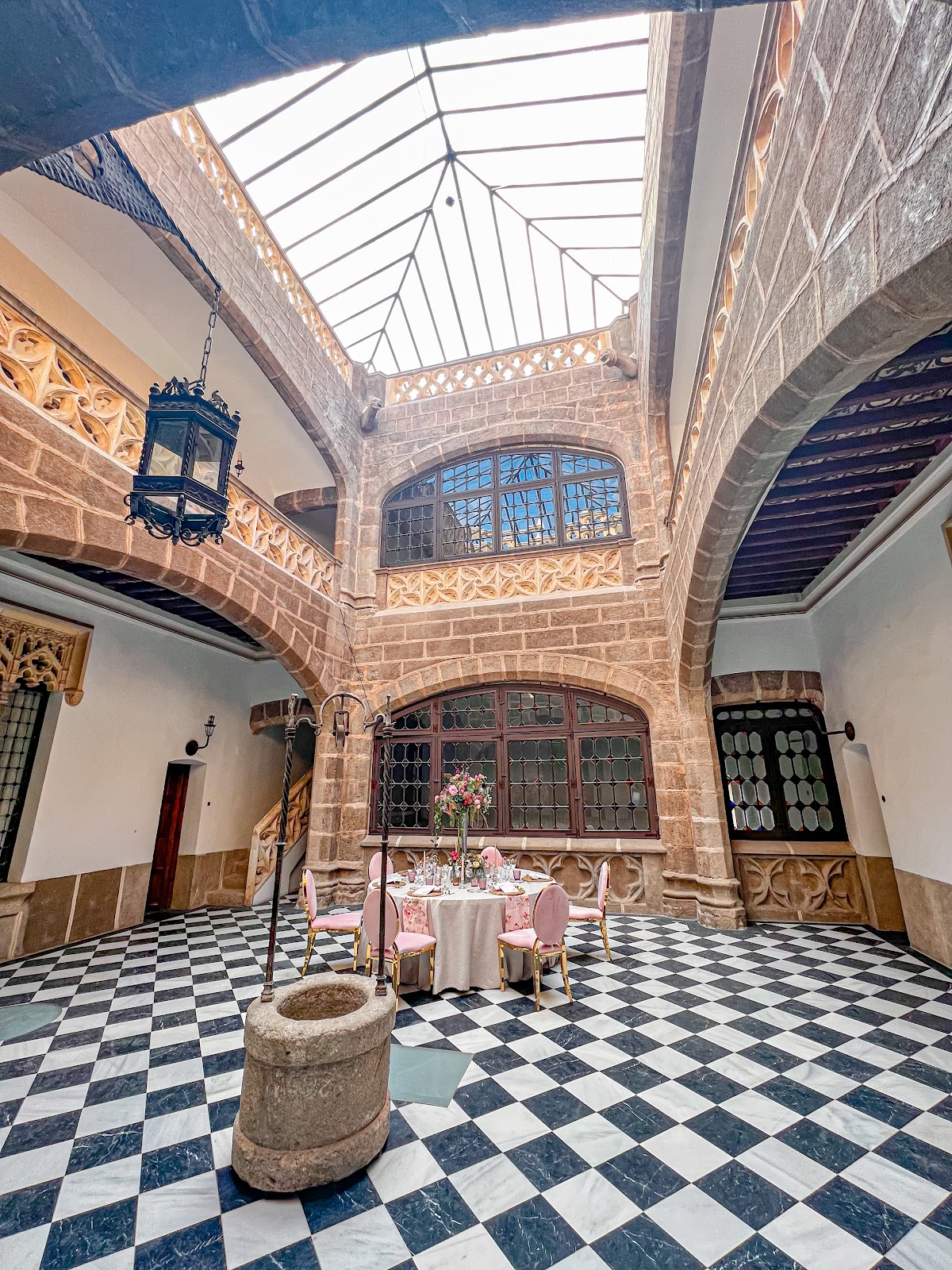
The main body of the castle, formed by the courtyard and palace, has a quadrangular plan measuring approximately 20 by 12 metres. The central courtyard is divided into three smaller courts. Residential rooms and reception halls are linked by two rows of arcades, creating the principal internal arrangement of the noble residence.
The palace’s ground floor contains the chapel, kitchen, and service rooms beneath vaulted roofs. The principal floor, where the living quarters and bedrooms are located, has a lintelled structure with coffered ceilings. A coffered ceiling is formed by a decorative framework of recessed panels, giving the residential rooms a more elaborate finish than the defensive masonry outside.
Inscriptions, reliefs, and painted decoration
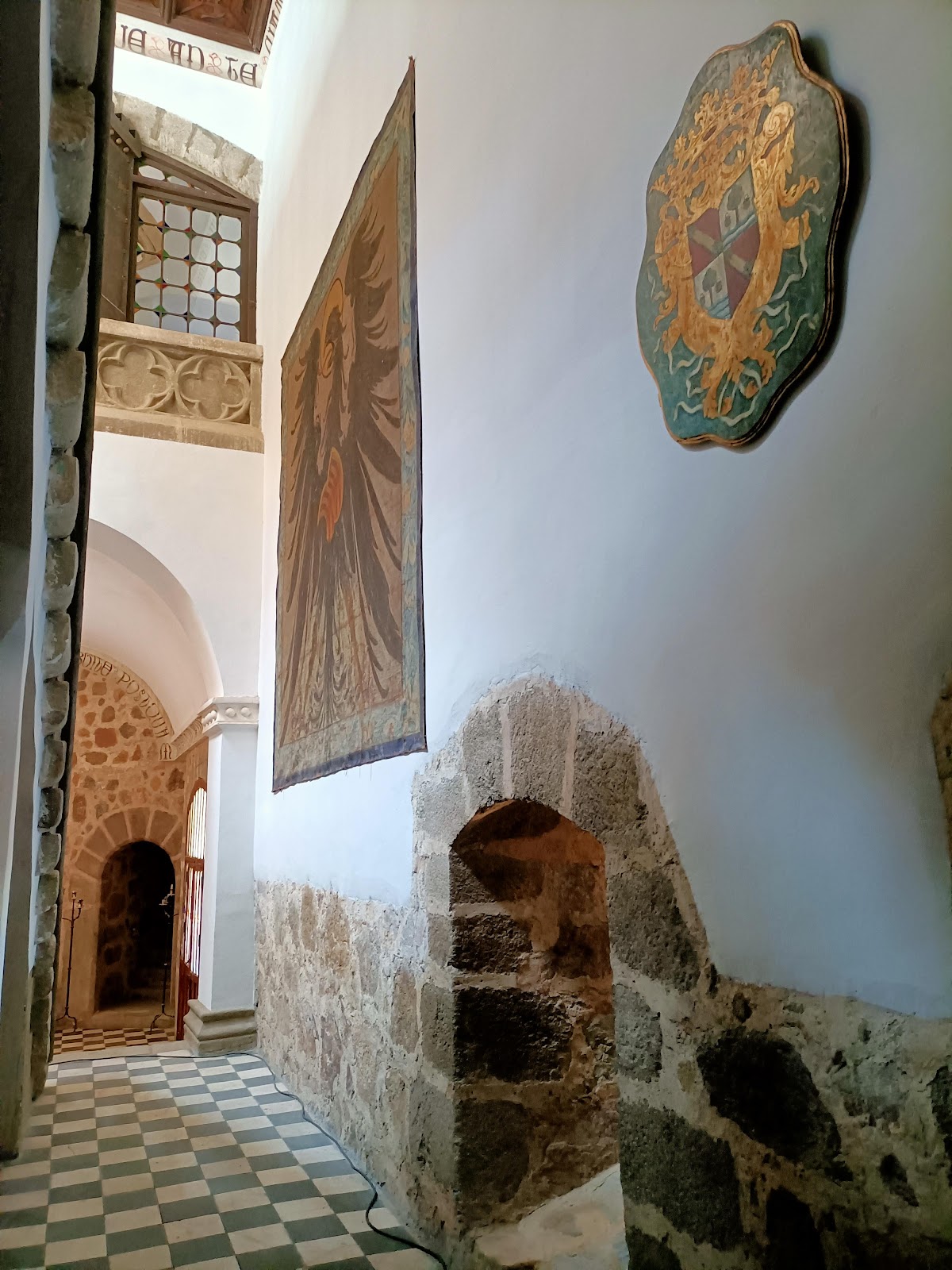
Psalms and Latin prayers are carved into the friezes and cornices of the larger rooms. The wall stones and both sides of the main entrance carry reliefs of lions and diagonal bands belonging to heraldic shields. These details connect the architectural fabric with the noble families who held the castle.
The nineteenth-century restoration preserved parts of fifteenth-century reliefs on the walls. On the noble floor, the Count of Cedillo represented the visit of Princess Joanna and Prince Philip to Guadamur on 11 July 1502 in frescoes. The castle’s artistic record also includes Madrazo’s 1910 painting, which is preserved away from the site at the Hispanic Society of America in New York.