Castle of Medole: A Medieval Fortress in Italy


Site at a Glance
- Rating
- 3.4
- Popularity
- Very Low
- Country
- Italy
- Primary era
- Medieval
- Eras represented
- Medieval, Early Modern
- Civilizations
- Habsburg, Holy Roman Empire
- Site type
- Military
- Remains
- Castle
On this page10 sections
History
The Castle of Medole is a medieval fortress in Medole, Italy, established to defend the settlement probably around the middle of the tenth century, during a period of feudal disorder and Hungarian incursions. Its construction unfolded broadly between the tenth and thirteenth centuries, and the surviving complex preserves the site’s long development from fortified settlement to civic center.
Early medieval foundation
The first recorded reference to the castle appears in a donation act issued by Count Bonifacio of Verona in 1020. A papal bull of 1072 identified it as the property of Count Uberto of Parma, a cousin of Matilda of Canossa, the powerful eleventh-century noblewoman whose territories and alliances made her a leading figure in the struggle between the papacy and the Empire.
In 1090, Uberto donated the castle’s internal chapel, dedicated to Saint Giusto, to the Cluniac Benedictines of Polirone. These monks belonged to a reform movement centered on the Abbey of Cluny, while Polirone was an important Benedictine monastery in northern Italy. The donation connected the fortified settlement with a major religious institution of the period.
Imperial and dynastic control
During the Frederician era, the period associated with the Hohenstaufen emperors and their imperial ambitions in Italy, Medole became one of the strongholds of Ezzelino da Romano. Ezzelino was a thirteenth-century lord and prominent supporter of the imperial cause. After his defeat at the Battle of Cassano d’Adda in 1259, control of Medole passed among the Visconti, the Scaligeri, and the Visconti again, possibly with a short intervening protectorate by the Republic of Venice.
At the beginning of the fifteenth century, the Visconti transferred the castle and the territory of Medole to the Gonzaga family. The grant was probably made in recompense for their support at the Battle of Casalecchio and for other services. The transfer was completed in 1404 between Caterina Visconti, widow of Gian Galeazzo, and Francesco Gonzaga, a condottiero, or professional military commander who led troops under contract.
Gonzaga strengthening and imperial diplomacy
At the beginning of the sixteenth century, the Gonzaga reorganized and strengthened the fortress. They reinforced its walls, attached a projecting forepart to the main tower, and enlarged the external military quarter. The entrance to that quarter bears the heraldic emblem of Count Evangelista Melone, probably a close relative of Antonio Melone, a Cremonese military engineer and colonel who served Ferrante Gonzaga.
On 28 June 1543, Charles V met Ferrante Gonzaga, Cardinal Ercole Gonzaga, and Margherita Paleologa at the fortified castle. Charles V was the Habsburg emperor whose territories included the Holy Roman Empire and Spain. The meeting legitimized the ten-year-old Francesco’s investiture as Duke of Mantua and Marquis of Montferrat, hereditary ranks of nobility, and established his future marriage to Catherine, the emperor’s niece.
Wartime refuge and eighteenth-century decline
In 1629, the castle walls sheltered Medole’s population from the advance of 36,000 Landsknechts sent to besiege Mantua. These German-speaking mercenary infantry brought plague with them, and the disease severely reduced the population during the following year.
During the first phase of the War of the Spanish Succession, an early-eighteenth-century European conflict over the Spanish monarchy, the castle was occupied in turn by Imperial troops and French-Spanish forces. In 1706, it was successively held by Prince Frederick of Hesse-Kassel, later King of Sweden, and by Count Médavy. Their troops fought in the plain of Medole on 8 September.
After Duke Ferdinando Carlo was deposed by the Imperial Diet of Regensburg, the Treaty of Utrecht in 1713 separated the former Mantuan and Montferrat territories. Mantua was absorbed into the Austrian Empire, while Montferrat was assigned to the Duchy of Savoy. Medole consequently became part of the Imperial territories, and the castle’s garrison and defensive walls lost their military usefulness.
Civilian transformation and conservation
During the eighteenth century, sections of the walls were demolished and replaced by civilian buildings that rested on their lower portions. The tower’s projecting forepart was converted for civilian use, its drawbridge was replaced by a masonry bridge, and the small parade ground was opened to pedestrian and wheeled traffic. A mechanical clock took the place of the fortress sundial.
In the second half of the nineteenth century, the deconsecrated castle chapel, which had fallen into a dangerous condition, was demolished and replaced by a small private theater financed by local noble or notable families. That theater was demolished in 1946 to make room for the larger municipal theater, which also incorporated the area of the southeastern tower. The final section of the perimeter moat was filled in in 1911 to permit the construction of public schools.
In the first half of the 1980s, the municipal administration carried out major conservation work on the tower, its projecting forepart, and the adjoining military quarter. These elements were converted into a multifunctional complex called the Civic Tower, with exhibition space for the municipal art collection and rooms for conferences and exhibitions. The surviving castle complex is owned by the Municipality of Medole and is accessible externally.
Remains
Fortified settlement and materials
The surviving complex preserves the original urban layout of the central settlement, with buildings and defensive works concentrated around present-day Piazza Castello. The medieval castle combined quarters for soldiers, officials, and their families with stables, a chapel, a southeastern circular tower, and houses for villeins arranged in two parallel rows at the center. Its construction used river pebbles, mortar, and brick.
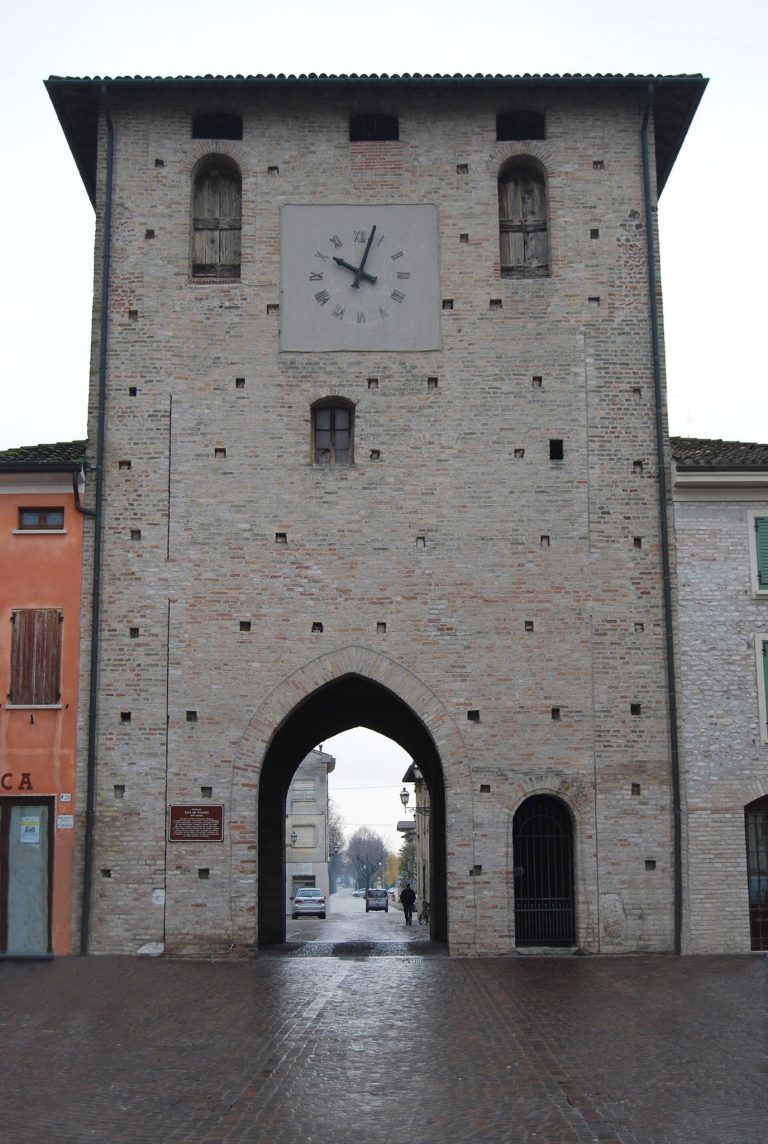
An external perimeter moat once protected the walls and formed the castle’s outer defensive boundary. Its last surviving section was filled in during 1911. In front of the drawbridge, the external military quarter retains walls with the original forms of Ghibelline crenellation, the battlement pattern associated with supporters of the Empire during the medieval papacy- and Empire conflict.
Civic Tower and military quarter
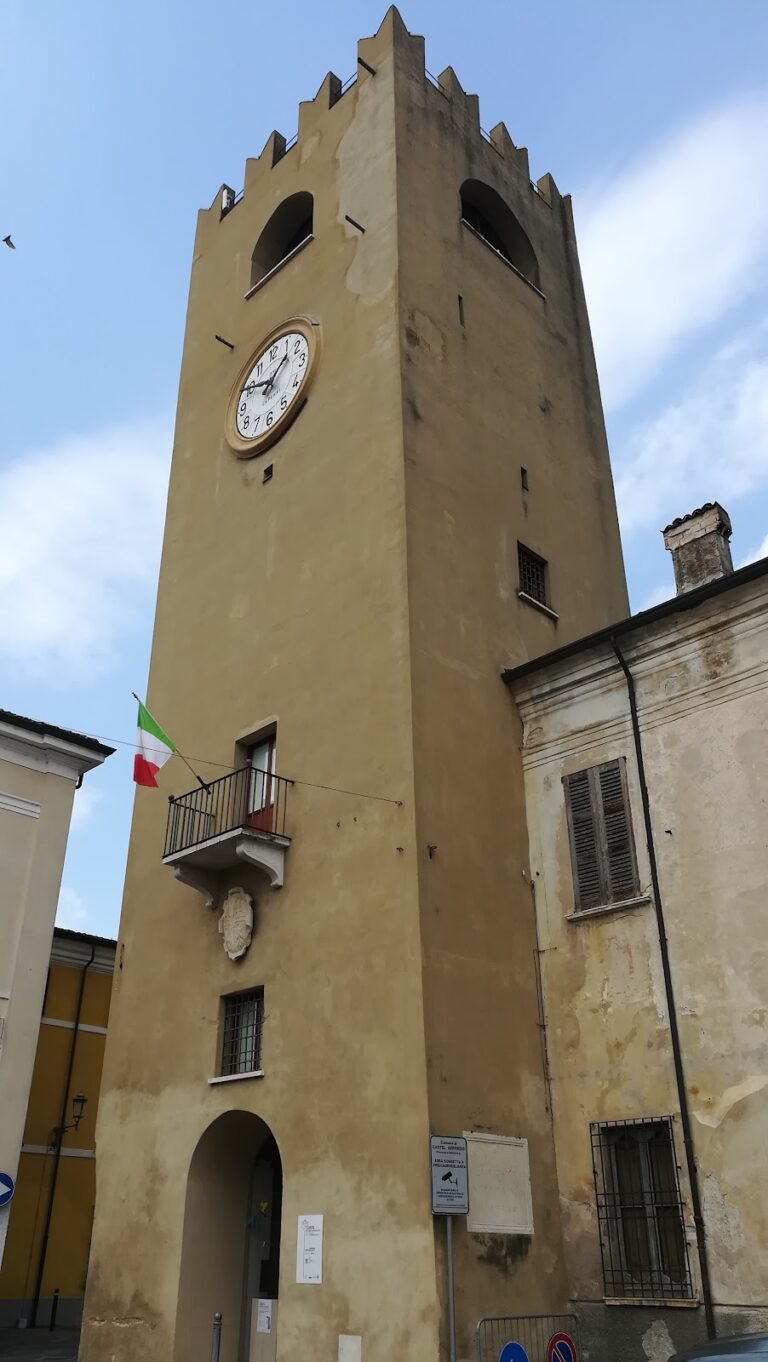
The central northern tower occupies the former main stronghold and the position of the original drawbridge entrance. It is a shielded tower, meaning that its defensive front protected the structure from attack. The Gonzaga-era projecting forepart remains attached to the tower, while the enlarged military quarter preserves the heraldic emblem of Count Evangelista Melone at its entrance.
The restored Civic Tower complex incorporates the tower, its projecting forepart, and the adjoining military quarter. The former drawbridge has become a masonry bridge, providing open access to the small parade ground, now Piazza Castello. The restored spaces contain exhibition areas, including the municipal art collection, as well as rooms for conferences and exhibitions.
Residential core and later buildings
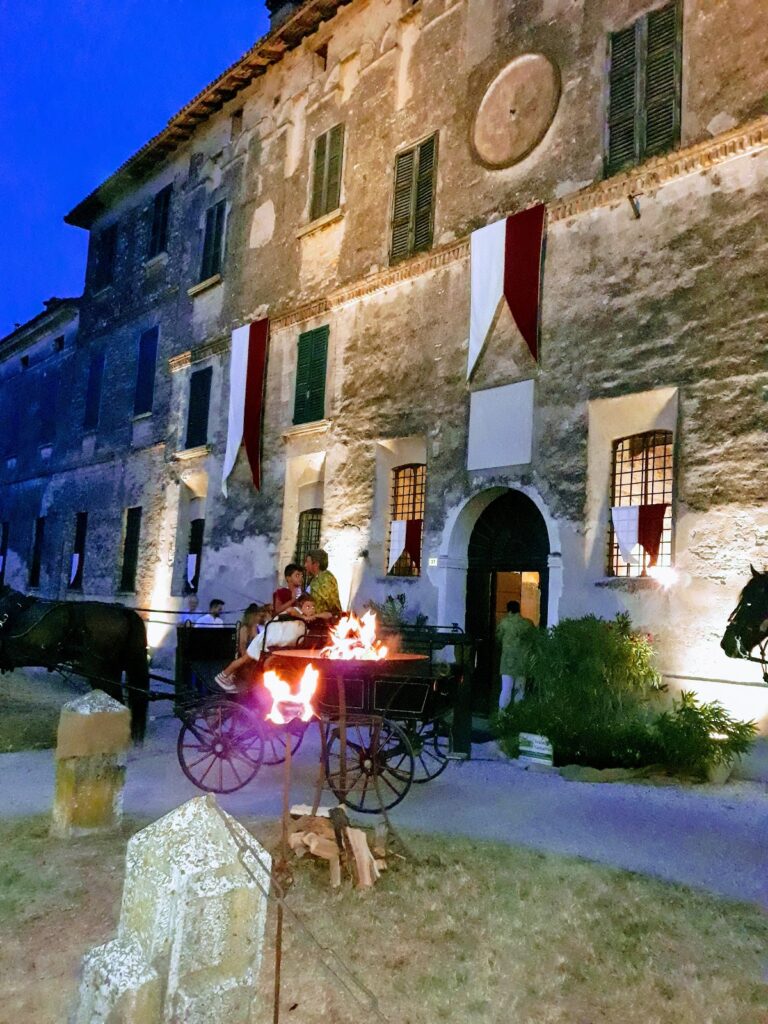
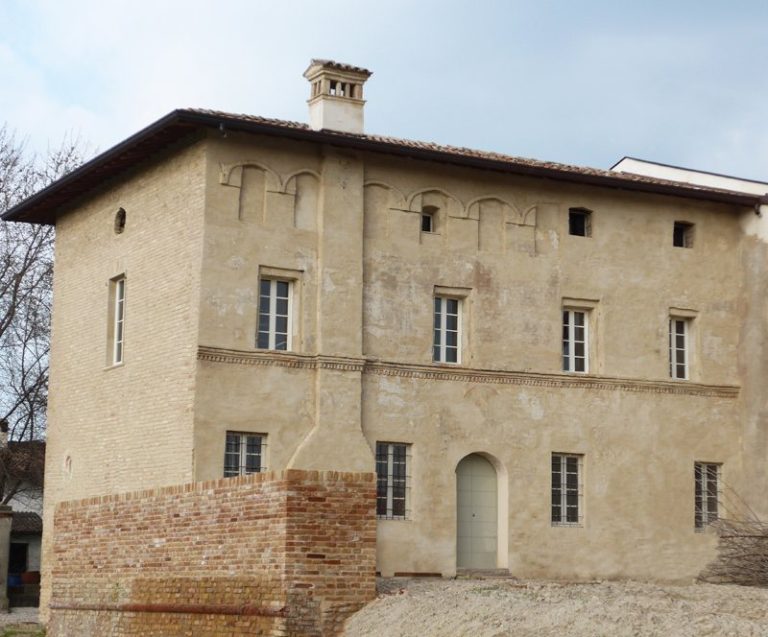
The internal residential core remains continuously inhabited and maintained. Its double-row settlement plan and ancient masonry structures preserve the arrangement of the original central community within the fortress.
The former chapel site is occupied by the municipal theater built in 1946. The theater also incorporates the foundations of the southeastern circular tower, linking the present civic building with the earlier fortified layout.