Castle of Lanhoso: A Medieval Fortification in Portugal


Site at a Glance
- Rating
- 4.7
- Popularity
- Low
- Country
- Portugal
- Primary era
- Medieval
- External website
- Open
- Eras represented
- Classical, Medieval, Early Modern
- Civilizations
- Kingdom of León, Portuguese, Roman
- Site type
- Military
- Remains
- Castle
On this page10 sections
History
Castle of Lanhoso is a fortified site in Portugal, near Póvoa de Lanhoso, whose medieval defenses developed over earlier prehistoric and Roman occupations. The site’s Romanesque rebuilding, carried out from the late twelfth to the early thirteenth century, created a regional military and administrative center. Its history includes the siege of 1121, the Treaty of Lanhoso, and later transformation after the castle lost its strategic role.
Prehistoric and Roman Foundations
The rocky summit was occupied from the Chalcolithic period. After Rome invaded the Iberian Peninsula, a military fort was established on the mount to protect the road connecting Bracara Augusta, the Roman city corresponding to present-day Braga, with Aquae Flaviae, now Chaves, and Asturica Augusta, now Astorga. A Romanized settlement, meaning a local community influenced by Roman culture and institutions, also occupied part of the hillside.
By the tenth and eleventh centuries, the earlier Roman fort had been reduced largely to its foundations. Between 1071 and 1091, Bishop Pedro of Braga supported the reconstruction of the fortification in ashlar, stonework made from regularly cut blocks, over the earlier pre-Roman fortress. The rebuilt stronghold served as an advanced defense for Braga and its episcopal seat. An inscription found at the site identifies the bishop with the words “PETRIS AEPISCOPUS.”
The Castle in the Twelfth and Thirteenth Centuries
In 1121, Teresa of León took refuge at Lanhoso while forces loyal to her half-sister, Urraca, Queen of León, besieged the castle. Teresa was the mother of Afonso Henriques, who later became the first king of Portugal. Bishop Gelmires intervened in the dispute, leading to the Treaty of Lanhoso, an agreement that preserved the territorial holdings of both women.
Tradition later stated that Afonso Henriques imprisoned Teresa at Lanhoso after the Battle of São Mamede in 1128. Modern historical interpretation contests this episode and places Teresa’s death in Galicia in 1130. The castle was rebuilt or substantially reformed in the Romanesque period, from the late twelfth to the early thirteenth century, including the construction of its keep. It then served as a cabeça de terra, a regional administrative and military center.
A traditional account also places a thirteenth-century crime of passion at the castle. According to the story, the alcalde, or castle governor, Rui Gonçalves Pereira ordered the gates closed and the citadel burned after discovering a relationship between his wife, Inês Sanches, and a friar from the monastery of Bouro. Inês, her lover, servants accused of helping them, and reportedly domestic animals died in the fire. The tradition connects Rui Gonçalves Pereira with the family of the later constable Nuno Álvares Pereira.
In 1264, the alcalde Godinho Fafez appointed Mem Cravo as his successor. Godinho was the great-grandson of Fafez Luz, Lord of Lanhoso. The nearby town of Póvoa de Lanhoso received a royal charter from King Denis on 25 September 1292. King Manuel I confirmed the charter on 4 January 1514.
Decline, Reuse, and Conservation
As Portugal’s frontiers became consolidated, Lanhoso gradually lost its strategic importance. The castle entered a period of abandonment and ruin. In 1680, the Porto merchant André da Silva Machado received permission to dismantle part of the old fortress and reuse its stone for the Sanctuary of Nossa Senhora do Pilar, conceived as a replica of the Sanctuary of Bom Jesus de Braga. The work removed parts of the barbican and walls and introduced a church, staircase, and pilgrimage chapels within the enclosure. Construction was still continuing in 1724.
A description from 1726 characterized the castle walls as ruined. The parish memoirs of 1758 stated that only the keep survived, with damage to its southwest angle caused by lightning. The castle was classified as a National Monument on 16 June 1910. Archaeological excavation, cleaning, consolidation, restoration, and partial reconstruction began in 1938 and 1939 under the Directorate General of Buildings and National Monuments. Further campaigns followed in 1958 and 1959, in 1973, and from 1975 to 1976. In 1996, municipal authorities and the Adere-Lanhoso association undertook additional cleaning, consolidation, and remodeling of the keep’s interiors.
These interventions reconstructed or consolidated portions of the walls, entrance gate, flanking towers, keep, two corbels, access routes, and exposed foundations. Work also involved the adjacent sanctuary. The castle now contains a small exhibition of archaeological material and evidence from the nearby fort. The castle, the Sanctuary of Nossa Senhora do Pilar, and the Castro de Lanhoso are points of interest on the mount.
Remains
Castle of Lanhoso occupies the western end of a rocky summit at about 385 metres above sea level. The summit lies on the granite massif of Laje Grande, which divides the watersheds of the Cávado and Ave rivers, and overlooks Póvoa de Lanhoso and a fertile valley watered by the Ribeira da Póvoa, Ribeira Pereira, and Ribeira de Pregal. The castle occupies the highest part of the isolated granite hilltop. Its irregular fortification encloses the former citadel, foundations, angular towers, an access route, and a large cistern.
Fortification and Citadel
Keep
The keep, the castle’s principal fortified tower, stands in the eastern sector of the enclosure. It is about 10 metres high and has walls more than 1 metre thick. Its elevated pointed-arch doorway is approximately 3 metres above ground level and is reached by a stone staircase. The keep incorporates or overlies foundations belonging to the earlier Roman fortification. It is partially ruined but was consolidated and its interiors remodeled during modern conservation campaigns.
Walls, Barbican, and Entrances
The castle walls have crenellations and a parapet walk with pyramid-shaped projections, some pierced by loopholes. An approximately elliptical barbican, an outer defensive enclosure protecting an entrance or wall, surrounds the outer side of the fortification. Reconstructed sections occur in both the barbican and the wall lines, and two visible corbels, projecting structural stones that support or formerly supported another element, survive on the walls.
The entrance system includes an arched gate near the keep, an outer entrance through the barbican, two square flanking towers, and a staircase cut into the rock. The internal rectangular area contains two lines of pillars and a large cistern. Foundations, towers, and part of an accessway preserve elements of the citadel, while sections of the walls, barbican, entrance, towers, and routes remain partially ruined, consolidated, or reconstructed.
Earlier Archaeological Occupation
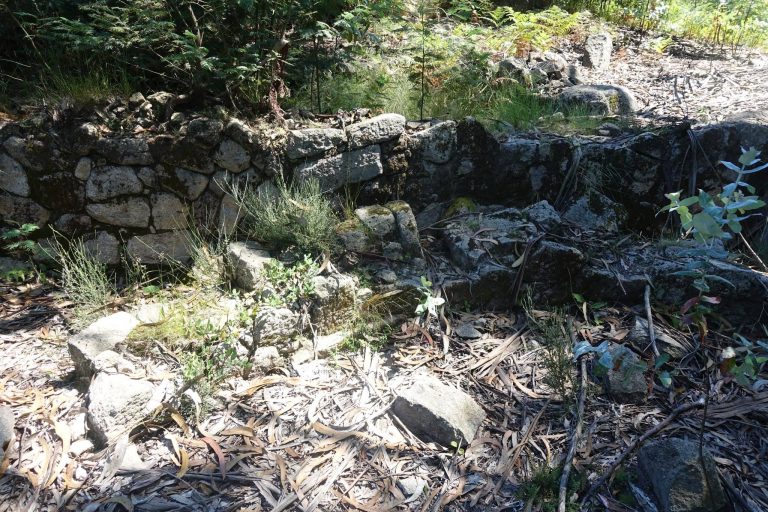
The foundations beneath the keep and surrounding walls belong in part to the earlier Roman fortification. Archaeological remains of the Castro de Lanhoso, a fortified settlement generally associated with pre-Roman or Romanized occupation in the Iberian Peninsula, lie along the northeastern flank of the hilltop. Traces of a Romanized settlement occur partway along the access route. Material from the nearby fort is presented in the castle’s small archaeological exhibition.
Sanctuary and Pilgrimage Structures
The Sanctuary of Nossa Senhora do Pilar stands at the summit within the castle enclosure. Its complex includes a church, a pilgrimage staircase, five chapels, and a support building for pilgrims that includes a restaurant. A winding Via Sacra, a devotional route marked by religious stations or chapels, extends from the foot of the hill toward the sanctuary. These structures occupy part of the fortified enclosure created through the sanctuary’s construction and the reuse of stone from the old fortress.